
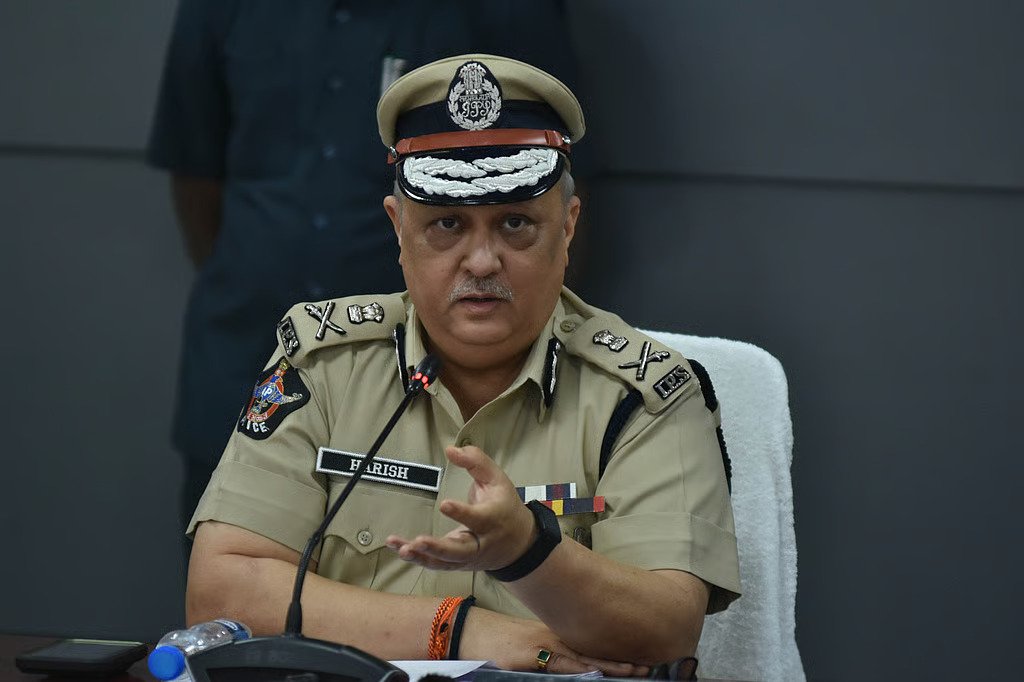
Andhra Pradesh Director General of Police Harish Kumar Gupta on Friday reviewed the operational plan of “AP Cyber Guard” and proposed a broad set of reforms in cyber crime policing, saying the rising scale, sophistication and financial impact of cyber offences required a stronger response system across the state.
90 Day Action Plan for Cyber Crime Response
During a video conference with district police officers, commissioners, range officers and technical services wing officials, Gupta said the police department, IT department and other agencies had prepared a focused 90 day action plan to improve cyber infrastructure, manpower and operational capabilities.
He said every district and supervisory officer must actively participate in building a robust cyber crime response ecosystem and stressed that cyber crime policing could not remain confined to specialised units alone. Referring to directions issued by Chief Minister N Chandrababu Naidu, the DGP said the police department would give special priority to the “golden hour” mechanism for the quick recovery of money lost in online frauds.
Gupta said the first 30 minutes after a victim reports cyber fraud through the 1930 helpline are crucial for fund recovery. He said the proposed AP Cyber Guard framework envisages a mandatory 30 minute lien marking mechanism for banks.
Registration Begins for FutureCrime Summit 2026, India’s Largest Cybercrime Conference
Six Pillars of the AP Cyber Guard Strategy
The DGP outlined a six pillar strategy that includes establishing a 24×7 Cyber War Room, integrating the 1930 helpline with real time bank alert systems, deploying AI driven cyber monitoring platforms, training 500 officers in the first phase, creating a three tier cyber response structure and launching statewide awareness campaigns.
He also directed officers to review the functioning of Central Crime Stations and police stations to address emerging law and order challenges. The review formed part of a wider effort to strengthen cyber crime policing and improve field level readiness.
The plan places emphasis not only on response and recovery but also on coordination between specialised and general policing structures, with district units expected to play a more direct role in cyber crime intervention.
Warning on Unlawful Digital Activity
Gupta also ordered a statewide crackdown on abusive, inflammatory and unlawful social media activity targeting constitutional authorities, public institutions and governance systems. He said police units had been instructed to identify organised digital networks allegedly spreading fake content, hate campaigns, intimidation and communal provocation.
He warned that police would initiate strict legal action under the Bharatiya Nyaya Sanhita, the Information Technology Act and other applicable laws against offenders. According to the DGP, the police view such unlawful digital activity as a serious emerging threat affecting public order, institutional integrity, democratic governance, cyber security and the broader law and order environment.
At the same time, he said freedom of speech and democratic expression remain protected within the constitutional framework. However, he added that organised abuse, malicious propaganda, criminal intimidation, hate driven campaigns, circulation of falsehoods and unlawful digital activity aimed at disturbing public order or weakening institutional authority would invite legal consequences.
About the author – Rehan Khan is a law student and legal journalist with a keen interest in cybercrime, digital fraud, and emerging technology laws. He writes on the intersection of law, cybersecurity, and online safety, focusing on developments that impact individuals and institutions in India.
