

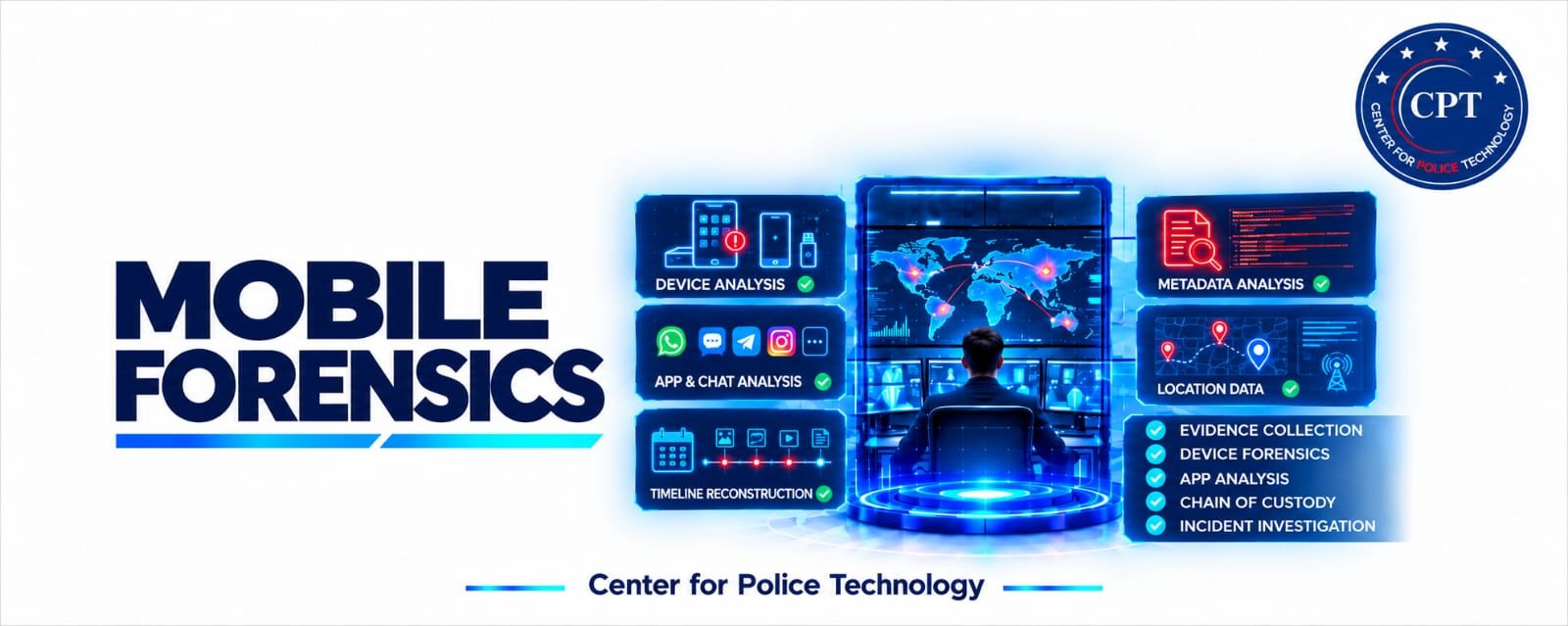
Centre for Police Technology Launches a 31-Day Cybersecurity Knowledge Series for Police, LEAs, Corporate Investigators, Digital Forensics, Fraud, Cyber Risk and Security Professionals
October 9, 2026: A smartphone recovered during a criminal investigation may contain valuable evidence about communications, movements, financial transactions and digital activities.
Messages, photographs, application records, browsing histories and location information can help investigators reconstruct events and establish connections between individuals.
For police and cybercrime investigators, mobile devices have become important sources of evidence in cases involving financial fraud, kidnapping, organised crime, cyberstalking, extortion and other offences.
However, examining a smartphone is not as simple as connecting it to a computer.
Modern devices use encryption, biometric authentication, secure operating systems and cloud storage to protect information.
This makes mobile forensics an essential part of modern criminal investigation.
For investigators, the objective is not simply:
“Unlock the phone and recover its data.”
It is:
“Preserve, acquire, examine and authenticate mobile evidence without compromising its forensic integrity.”
What Is Mobile Forensics?
Mobile forensics is the scientific examination of smartphones, tablets and other mobile devices to identify, recover and analyse information relevant to an investigation.
It involves specialised methods for collecting electronic evidence while maintaining its integrity.
An investigator may need to determine:
- Who communicated through the device?
- Which applications were used?
- When were messages sent or received?
- Where was the device at a particular time?
- Were files deleted or transferred?
- Can the recovered information be authenticated?
The National Institute of Standards and Technology (NIST) describes mobile device forensics as the recovery of digital evidence from mobile devices using forensically sound methods.
Mobile forensics therefore extends beyond recovering files.
It involves establishing the origin, context, integrity and investigative significance of digital information.
How Does Mobile Forensics Work?
A mobile forensic investigation begins when investigators identify a device that may contain relevant evidence.
The first priority is preservation.
Investigators must determine whether the device is powered on, locked, connected to a network or vulnerable to remote alteration.
The device is then examined using an acquisition method appropriate to its operating system, security configuration and available lawful access.
Specialised tools may recover accessible messages, photographs, application databases, documents and system records.
Investigators subsequently analyse the extracted information and compare it with other evidence.
The process can therefore become:
Device Identification → Preservation → Acquisition → Integrity Verification → Examination → Analysis → Documentation → Court Presentation
Every significant step should be recorded.
Mobile forensic analysis begins with protecting the evidence, not searching through the phone.
What Types of Evidence Can Smartphones Contain?
Modern smartphones generate several forms of digital information.
Communication Evidence
Messages, call records, emails and application information may help reconstruct communication between individuals.
Multimedia Evidence
Photographs, videos, audio recordings and metadata may provide relevant information about events.
Location Evidence
Depending on the device and applications, investigators may recover GPS-related records, location histories and other location-associated information.
Application Evidence
Messaging, social media, banking and other applications may contain databases, files and account records.
Browser Evidence
Browsing histories, downloads and cached information may support investigations.
Device Evidence
System logs, installed applications, connection records and device identifiers may provide additional context.
However, not every smartphone stores all these records.
Available evidence depends on the device, applications, settings, encryption and acquisition method.
What Are the Main Mobile Forensic Acquisition Methods?
Several techniques are used to obtain information from mobile devices.
Manual Examination
An examiner views information directly through the device interface.
This provides access to visible information but may change the device’s state.
Logical Acquisition
Logical acquisition retrieves accessible files, databases and records through supported software interfaces.
It may not recover information outside the available access level.
File-System Acquisition
File-system acquisition may provide broader access to application and system files, depending on the device and supported method.
Physical Acquisition
Physical acquisition attempts to obtain data from storage at a lower level.
However, modern encryption and hardware security can restrict meaningful access.
Cloud Acquisition
Relevant records may also be obtained from associated cloud accounts through lawful and technically supported procedures.
The important distinction is:
A forensic extraction does not automatically contain every piece of information stored on or associated with a smartphone.
Which Mobile Forensic Tools Are Important?
Several established technologies support mobile forensic investigations.
Cellebrite’s forensic solutions provide capabilities for authorised mobile-device acquisition and analysis.
Magnet AXIOM, developed by Magnet Forensics, supports examination of evidence from mobile devices, computers and cloud sources.
MSAB XRY provides mobile-device data extraction and examination capabilities.
Oxygen Forensic Detective supports analysis of mobile-device information and other digital records.
Autopsy, an open-source digital forensic platform, can help examine supported files and artefacts obtained during investigations.
These tools have different capabilities.
Their effectiveness depends on the device model, operating-system version, security updates and acquisition method.
A forensic tool’s ability to extract information does not automatically establish the accuracy of every conclusion drawn from it.
How Can Mobile Forensics Support Police?
Mobile devices frequently become relevant during criminal investigations.
In a kidnapping case, communication records and location information may help reconstruct events.
In financial fraud investigations, messaging applications and transaction records may reveal interactions between suspects and victims.
In organised crime cases, contact records, communications and multimedia files may provide investigative leads.
Mobile evidence can also support investigations involving cyber harassment, extortion and identity theft.
For example:
Device Seized → Communication Records Examined → Relevant Accounts Identified → Events Correlated → Timeline Reconstructed
However, investigators must distinguish between device ownership and actual usage.
A smartphone registered to one person may have been operated by another.
Possession of a device does not automatically establish authorship of every activity recorded on it.
Can Deleted Messages Be Recovered?
Sometimes.
Deleted messages may leave traces in application databases, backups or other stored records.
However, recovery depends on the device, storage system and application.
Modern smartphones use encryption and secure storage mechanisms.
Some applications also offer disappearing messages or automatic deletion features.
Investigators may recover certain deleted artefacts, but complete recovery cannot be guaranteed.
Even when a message is recovered, its origin and context must be examined.
Recovering a message is not the same as proving who wrote it or whether the conversation is complete.
What Role Does Location Evidence Play?
Smartphones may generate location information through GPS, applications, wireless connections and other systems.
Such information can help investigators reconstruct possible movements.
However, location records differ in accuracy.
GPS coordinates, application location histories and cellular network records are not interchangeable.
A device’s recorded location also does not automatically establish that a particular individual was present there.
Investigators should therefore examine the source, accuracy and technical limitations of location information.
Location evidence must be interpreted in context, not treated as automatic proof of a person’s presence.
Can Mobile Evidence Be Used in Court?
Yes, subject to applicable legal requirements.
Mobile evidence may include messages, photographs, documents, application records and extracted databases.
However, investigators must distinguish between original electronic information and reports generated during forensic examination.
The process should follow:
Collection → Preservation → Acquisition → Verification → Analysis → Chain of Custody → Reporting → Court Presentation
Investigators should document the device, acquisition method, tools used, relevant hash values and analytical findings.
Where information cannot be independently verified, that limitation should be disclosed.
The central principle is:
Mobile forensic evidence must be technically reliable and legally supportable.
What Are the Major Challenges?
The first challenge is encryption.
Modern devices protect information through hardware-backed encryption and authentication mechanisms.
The second is operating-system security.
Software updates can change forensic access and tool compatibility.
The third is remote alteration.
Connected devices may receive commands or synchronise information after seizure.
Another challenge is incomplete extraction.
Investigators may obtain only part of the available information.
There is also interpretation risk.
Application records, timestamps and database entries may be misunderstood.
Privacy is another concern because smartphones can contain extensive personal information unrelated to an investigation.
What Is the India Perspective?
Mobile forensic evidence falls within India’s electronic-evidence and criminal investigation framework.
The Bharatiya Sakshya Adhiniyam, 2023 recognises electronic and digital records.
Section 63 establishes conditions concerning the admissibility of specified electronic records and includes relevant certificate requirements.
The Bharatiya Nagarik Suraksha Sanhita, 2023 also contains provisions concerning investigation and electronic evidence.
Section 193(3)(i) includes the sequence of custody in the case of an electronic device among the particulars required in the police report on completion of investigation.
The Information Technology Act, 2000 may also apply depending on the offence.
These provisions reinforce the importance of lawful acquisition, evidence preservation and proper documentation.
Technical access to a smartphone does not eliminate legal requirements for evidence handling.
Are Police Agencies Already Using Mobile Forensics?
Yes.
Mobile forensics is an established capability within law-enforcement agencies and digital forensic laboratories.
Police organisations use specialist technologies to examine smartphones recovered during investigations.
Internationally, INTERPOL supports digital forensic capacity-building through technical cooperation and training.
In India, central and state forensic laboratories and cybercrime investigation units undertake digital forensic examination.
However, forensic access varies between devices.
Some smartphones permit substantial acquisition, while others provide only limited information.
Operational capability should not be confused with universal access to every mobile device.
Can Artificial Intelligence Improve Mobile Forensics?
AI can assist investigators in examining large amounts of extracted information.
It may help identify relevant documents, classify images, search communications and organise timelines.
AI-assisted systems may also help correlate records from multiple devices.
However, automated analysis introduces risks.
An AI system may misinterpret conversations, associate unrelated events or produce incorrect explanations.
Important findings must therefore be verified against original records.
AI should accelerate mobile evidence examination, not replace forensic verification.
What Should First Responders Avoid?
An important mistake is unnecessarily operating a seized smartphone before documenting its condition.
Investigators should also avoid changing settings without understanding the forensic consequences.
Uncontrolled network access may create risks of remote alteration.
However, immediately powering down every device can also complicate forensic access because encryption and authentication states may change.
Specialist guidance should determine the appropriate preservation method.
The first responder’s priority is to protect evidence without unnecessarily changing the device’s condition.
What Can Indian Police Adopt?
Immediate: 0–1 Year
Police units can standardise mobile-device seizure procedures and strengthen first-responder training.
Personnel should understand preservation, documentation and chain-of-custody requirements.
Medium Term: 1–3 Years
State cybercrime units could strengthen mobile forensic laboratories, examiner training and evidence-management systems.
Better coordination between investigating officers and forensic specialists could reduce examination delays.
Long Term: 3–5+ Years
Advanced systems may support AI-assisted evidence review, cross-device correlation and automated timeline reconstruction.
These capabilities should remain subject to forensic verification and legal safeguards.
What Skills Will Police Investigators Need?
Investigators do not all need to become mobile forensic specialists.
However, essential knowledge is important.
Device Preservation: Understanding how mobile evidence can be altered or lost.
Acquisition Methods: Recognising the differences between manual, logical, file-system and physical acquisition.
Application Analysis: Understanding how applications store relevant information.
Metadata and Timelines: Interpreting timestamps and reconstructing events.
Evidence Integrity: Understanding hashing, documentation and chain of custody.
Legal Knowledge: Recognising applicable electronic-evidence requirements.
The future investigator may increasingly move from:
“Search the phone for messages.”
towards:
“Preserve the device, verify extracted records and reconstruct relevant digital activity.”
What Could Mobile Forensics Look Like by 2030?
Mobile forensic investigations are likely to become more complex.
Smartphones will continue to rely on encryption, hardware security and cloud integration.
Wearable devices and connected systems may create additional evidence sources.
AI-assisted technologies could help forensic examiners process larger datasets and reconstruct activity across devices.
However, stronger security protections may also restrict forensic access.
The fundamental question will remain:
“Can we demonstrate where this information came from and how its integrity was maintained?”
Police Officer’s Quick Reference
5 Things Every Police Officer Should Know
1. Smartphones may contain important communication, location and application evidence.
2. Improper handling can alter or destroy mobile evidence.
3. Not every forensic extraction provides complete access.
4. Recovered information requires authentication and interpretation.
5. Chain of custody remains essential.
5 Major Opportunities
Communication analysis, timeline reconstruction, financial fraud investigation, location-related evidence and cross-device correlation.
5 Major Risks
Encryption barriers, remote alteration, incomplete extraction, evidence contamination and incorrect interpretation.
5 Actions Police Leadership Should Consider
Standardise seizure procedures, train first responders, strengthen forensic laboratories, improve evidence management and establish clear legal safeguards.
From Smartphone Data to Forensic Evidence
Mobile phones have become important sources of evidence in modern criminal investigations.
They may contain communications, photographs, application records and other information capable of reconstructing events.
But extracting information is only the beginning.
Investigators must establish its origin, integrity, relevance and limitations.
For police and forensic professionals, the central principle is simple:
Mobile forensics is not just about recovering data. It is about producing reliable digital evidence.
Preserve the device. Acquire lawfully. Verify the information. Document the process. Present evidence that can withstand scrutiny.
Day 9 — Mobile Forensics
31 Days | 31 Key Topics | October 2026
A Cybersecurity Awareness Month Knowledge Initiative
Created by Centre for Police Technology (CPT)
Follow Centre for Police Technology (CPT) for the complete 31-Day Cybersecurity Knowledge Series.
Follow for daily updates on cybercrime, corporate fraud, DFIR, hacking, investigations, and digital forensics
