

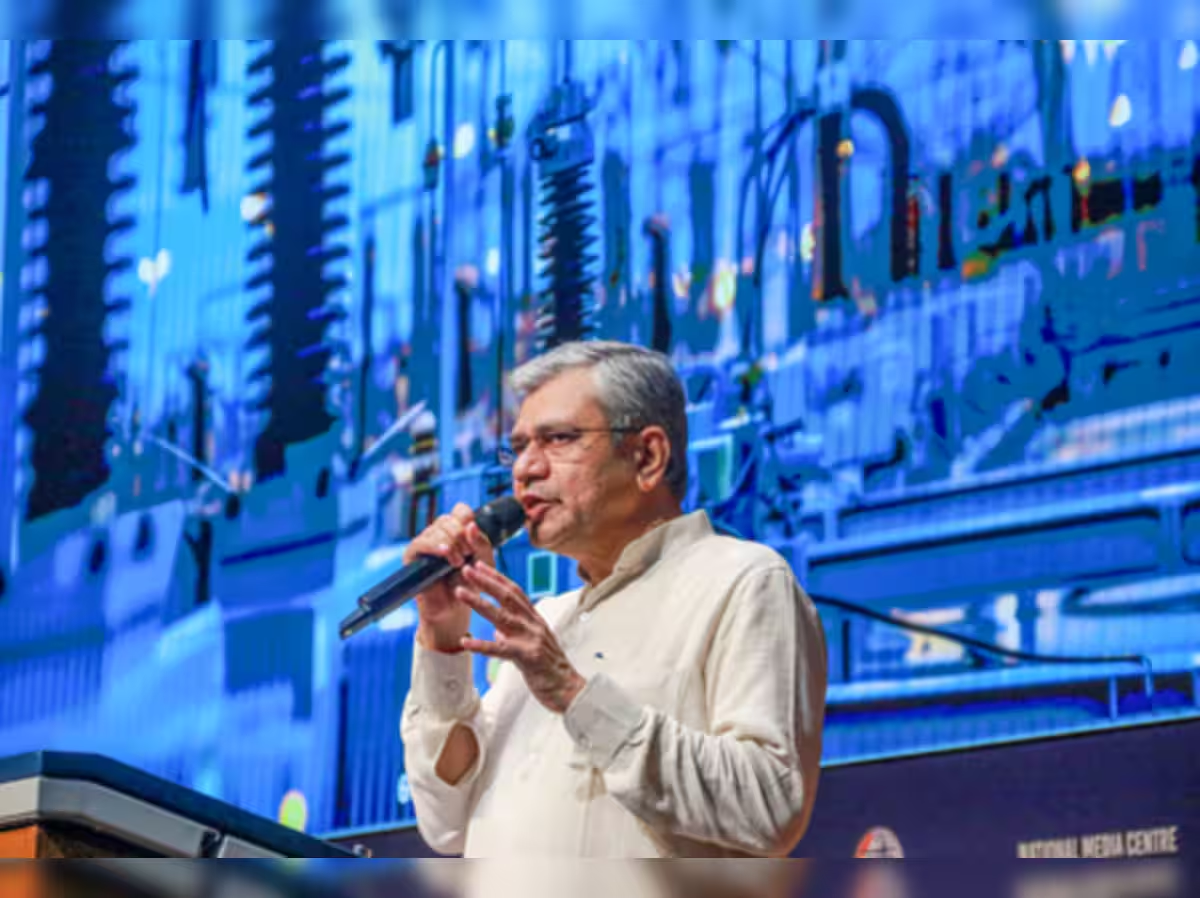

India will release a consultation paper on artificial intelligence regulation within a month, marking one of the clearest steps yet toward a more formal national framework governing AI safety, deepfakes and other emerging harms.
Union Electronics and Information Technology Minister Ashwini Vaishnaw said on October 8 that the government had reached a stage where a regulation-focused consultation was necessary.
The proposed paper will concentrate on AI safety, deepfakes, user harm, skilling and what the government calls a human-first approach to technological change.
Vaishnaw said the consultation would become the basis for the government’s next regulatory steps.
FCRF Launches CP-FRM to Build India’s Next Generation of Fraud Risk Professionals
Consultation Paper Expected Within One Month
Vaishnaw made the announcement during the release of the World Bank’s World Development Report 2026 in New Delhi.
He said he would ask the department to prepare a regulation-focused consultation paper within one month.
Safety would be the most important element of that document, he said.
The government would then use feedback from the consultation to decide how the regulatory framework should move forward.
This is more concrete than many of the government’s previous AI-policy statements.
India has spent the past year building governance guidelines, safety institutions and technical safeguards, but it has generally avoided committing to one comprehensive AI statute.
The consultation paper could begin narrowing that uncertainty.
Deepfakes Will Be a Central Focus
Vaishnaw singled out deepfakes as one of the most serious problems the framework must address.
He described them as a growing social threat because synthetic videos, images and audio are becoming increasingly convincing.
The concern is no longer simply that AI can create fake content.
The problem is that people may believe realistic synthetic material, allowing it to influence financial decisions, political debate, reputations or public behaviour.
India has already moved against some forms of synthetic content through amendments to the IT Rules.
Those rules introduced legal obligations around AI-generated material, including labelling and faster takedown requirements for certain unlawful synthetic content.
The new consultation could determine whether those rules need to be expanded into a broader AI-regulatory system.
Government Wants a Techno-Legal Model
Vaishnaw again rejected the idea that AI can be governed through legislation alone.
He said India would need a techno-legal approach combining legal obligations with technical safeguards.
That position is consistent with the government’s existing AI policy.
India has been supporting work on deepfake detection, algorithm auditing, privacy-preserving AI, bias mitigation and explainability through the Safe & Trusted AI pillar of the IndiaAI Mission.
The government’s argument is that a law can define responsibility, but technical tools are still needed to identify harmful content, test AI systems and verify whether safeguards are actually working.
Industry Will Carry Much of the Responsibility
Vaishnaw said technology companies would have to take primary responsibility for many AI risks.
He pointed to cybersecurity, safety, user harm, psychological effects and deepfakes as areas where the industry cannot simply wait for government enforcement.
That reflects an increasingly important principle in India’s AI-policy debate.
The companies that design and deploy AI systems often understand their technical limitations better than regulators do.
The government therefore wants developers and platforms to participate directly in building safety mechanisms.
The420.in had reported in September that Vaishnaw was already arguing that AI developers should take the lead in ensuring their systems are safe.
The October announcement moves that argument closer to a formal consultation process.
Human-First Approach Will Be Included
The minister said the regulatory discussion would also follow a human-first approach.
That means the government does not want regulation to focus only on technical performance or corporate compliance.
Questions about jobs, skills, social impact and whether people are left behind by automation will also form part of the discussion.
Vaishnaw said skilling would be included in the consultation and stressed that technological change should remain centred on people.
This fits with the wider IndiaAI strategy, which combines computing infrastructure and model development with programmes focused on skills and responsible deployment.
India Already Has an AI Governance Framework
The upcoming consultation paper does not mean India currently has no AI-governance policy.
The government has already released AI Governance Guidelines based on a risk-oriented framework.
Those guidelines address issues including algorithmic bias, misinformation, deepfakes and broader societal harms.
They also proposed institutional mechanisms such as an AI Governance and Economic Group, a Technology and Policy Expert Committee and an AI Safety Institute.
The existing framework has generally been designed to guide responsible AI development without immediately imposing a single heavy regulatory law.
The consultation paper could determine how much of that voluntary or principles-based approach becomes legally enforceable.
Government Position Has Been Gradually Shifting
India’s approach to AI regulation has become more interventionist over the past year.
The government initially emphasised innovation and the use of existing laws.
By July, IT Secretary S. Krishnan said a dedicated AI law was being actively considered as deepfakes, cyber threats and other risks increased.
Vaishnaw has repeatedly argued that AI safety cannot be left entirely to voluntary industry practices.
The new one-month deadline is therefore another sign that the government is moving from broad principles toward specific regulatory options.
It still does not mean India has decided to introduce a standalone AI Act.
No New AI Law Has Been Announced Yet
The distinction is important.
Vaishnaw announced a consultation paper, not a new law.
The government has not yet said whether the eventual framework will take the form of a dedicated AI statute, amendments to existing laws, sector-specific rules or a combination of these approaches.
Those choices are likely to form part of the consultation itself.
The document will therefore be an important policy signal, but it should not be described as India’s final AI regulation.
PM Modi Has Also Called for Stronger Deepfake Identification
The announcement comes two days after Prime Minister Narendra Modi called for clearer identification of AI-generated content and common global standards for emerging technologies.
During a meeting with the GSMA Board, Modi said users should be able to identify the origin of AI-generated and deepfake material more easily.
He also called for stronger technology-led systems to combat cyber fraud.
The timing suggests that deepfake identification is becoming one of the government’s immediate AI-governance priorities.
Any future consultation could examine technical measures such as watermarking, provenance systems and content-authenticity standards.
Deepfake Regulation Will Be Technically Difficult
The central challenge is that detecting AI-generated material becomes harder as models improve.
Watermarks can sometimes be removed.
Metadata can be stripped.
Detection systems can produce false positives or fail when content has been compressed, edited or recorded again.
That is why the government has repeatedly spoken about combining law with technology rather than relying on labels alone.
India is already supporting domestic work on deepfake detection and other AI-safety tools through the IndiaAI Mission.
The consultation paper may have to decide how reliable such tools must be before companies can be legally required to use them.
Regulation Could Affect Major AI Companies
A formal Indian AI framework would have implications for companies including Google, Microsoft, Meta, OpenAI and other firms deploying AI services in the country.
The obligations could eventually cover developers, platforms, model providers or companies deploying AI in sensitive sectors.
But the government has not yet announced which entities would face which requirements.
That is one reason the consultation process matters.
Questions around responsibility, testing, transparency, safety and liability will determine whether India adopts broad platform rules or a more targeted risk-based system.
India Is Trying to Avoid Copying One Foreign Model
India has generally resisted simply copying the European Union’s AI Act.
Its approach has instead emphasised local conditions, innovation, technical safeguards and a risk-based regulatory structure.
At the same time, the government has argued for greater international coordination.
India has participated in AI-governance discussions through the G20, the Global Partnership on Artificial Intelligence and the United Nations.
The result could be a framework that combines domestic regulation with international standards for areas such as deepfake identification and safety testing.
The Next Month Could Clarify India’s AI Rulebook
The consultation paper will be important because it should move the debate from broad statements about responsible AI toward specific regulatory choices.
Businesses will be watching for proposed obligations on testing, transparency, deepfake detection, cybersecurity and liability.
AI developers will also want clarity on whether India intends to regulate the underlying model, the application using it or the company deploying it.
Those distinctions could determine how costly and complex compliance becomes.
What this means for you
India has not announced a new AI law yet, but the government is now preparing the document that could shape one. Deepfakes, AI safety, user harm and industry responsibility are likely to be among the first areas where companies face clearer obligations.
Follow for daily updates on cybercrime, corporate fraud, DFIR, hacking, investigations, and digital forensics
