


New Delhi: Motorists with unpaid traffic challans could soon face much more than repeated payment reminders.
The Supreme Court has directed States and Union Territories to take stricter action against vehicle owners who leave e-challans unpaid, including freezing online vehicle services, blacklisting vehicles on the central Parivahan portal and withholding important certificates until outstanding fines are cleared.
A Bench of Justices J.B. Pardiwala and K.V. Viswanathan passed the directions on September 28 while hearing a long-running road safety case concerning electronic enforcement of traffic violations.
The Court was informed that e-challans worth approximately ₹49,194.05 crore had been issued, of which around ₹26,175.05 crore had been recovered.
That leaves roughly ₹23,019 crore still outstanding.
FCRF Launches CP-FRM to Build India’s Next Generation of Fraud Risk Professionals
Unpaid Challans Could Stop Vehicle Sale or Ownership Transfer
One of the most significant directions concerns the Parivahan portal.
The Supreme Court said vehicles carrying outstanding e-challans should be blacklisted on the central transport database.
Once blacklisted, such vehicles could be prevented from being sold or transferred to another owner until pending fines are cleared.
That means a vehicle owner attempting to sell a car or two-wheeler may first have to settle all unpaid challans before the ownership-transfer process can be completed.
The Court also directed authorities to freeze online vehicle-related services for defaulters.
These restrictions can include renewal of registration certificates, issuance of duplicate registration certificates and requests to update the registered owner’s address.
The move is intended to make unpaid fines harder to ignore by linking them to services vehicle owners regularly require.
PUC and Fitness Certificates Could Also Be Denied
The Court specifically directed that vehicles carrying unpaid traffic fines should not receive fitness certificates until the dues are cleared.
Pollution Under Control certificates, or PUC certificates, are also covered.
The Bench said no centre should be permitted to issue a PUC certificate to a vehicle until its pending traffic fines have been paid.
This could have significant practical consequences.
A valid PUC certificate is mandatory for vehicles operating on public roads, while commercial and certain other categories of vehicles also require periodic fitness certification.
Linking these services to unpaid challans gives authorities another way to enforce payment without relying only on court recovery proceedings.
Driving Licence Renewal Could Be Withheld for Repeat Violators
The Court also directed tougher measures against motorists involved in multiple traffic violations.
In such cases, renewal of the driving licence may be withheld.
Authorities have also been told to take steps to suspend an existing driving licence where repeated violations justify such action.
The measure targets repeat offenders rather than every motorist with a single unpaid challan.
The Court’s broader concern is that repeated traffic violations should carry consequences beyond simply accumulating unpaid fines.
Vehicles With Pending Challans May Be Impounded During Checks
Another significant direction concerns enforcement on the road.
States and Union Territories have been told to conduct checks and take action against vehicles found with pending e-challans.
LiveLaw reported that vehicles discovered with unpaid fines during random checks may be impounded until the outstanding amount is cleared.
This adds an immediate enforcement mechanism to the digital restrictions imposed through Parivahan.
Until now, authorities could issue large numbers of e-challans, but recovery often depended on motorists voluntarily paying them or on cases being sent to the appropriate court.
The Supreme Court said that simply generating challans was not enough if authorities failed to recover the penalties.
Why the Supreme Court Is Tightening E-Challan Recovery
Electronic challans have become an important part of traffic enforcement across India.
Cameras, automatic number-plate recognition systems and other electronic tools can detect speeding, red-light violations and other offences.
Once a violation is recorded, a challan can be issued using the details attached to the vehicle’s registration.
But enforcement does not end when a challan is generated.
If motorists repeatedly ignore the payment notice, large amounts remain outstanding.
The Court was told that while ₹49,194.05 crore in e-challans had been issued, only ₹26,175.05 crore had been recovered.
This left more than ₹23,000 crore pending.
Justice Pardiwala observed that issuing thousands or lakhs of challans served little purpose unless governments developed effective mechanisms to recover the fines.
Electricity Bill Recovery Was Discussed, but Not Ordered
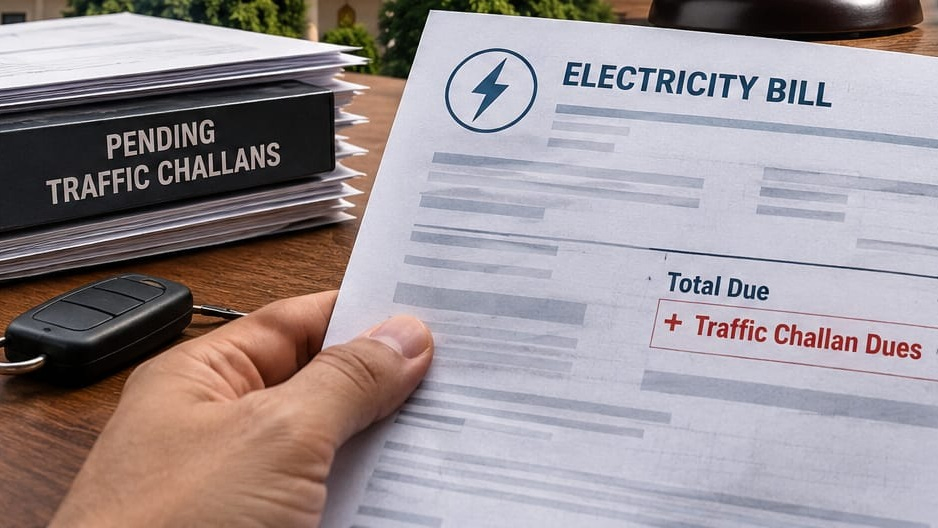
During the hearing, the Bench also raised the possibility of linking unpaid traffic challans with electricity bills.
The idea was that outstanding fines could be added to other essential dues, giving defaulters a stronger incentive to make payment.
However, this was discussed as a possible recovery mechanism.
It should not be interpreted as a nationwide order requiring unpaid challans to be added to electricity bills.
The written directions reported after the hearing instead focus on vehicle blacklisting, online service restrictions, PUC and fitness certificates, ownership transfers, licence action and impounding vehicles during enforcement checks.
Technology to Play Bigger Role in Traffic Enforcement
The Supreme Court has repeatedly pushed for greater use of technology in road safety enforcement.
The centralised Parivahan system already links vehicle registration records with several transport services.
Using the same database to identify vehicles carrying unpaid fines could allow States and Union Territories to enforce penalties more consistently.
Automatic number plate recognition systems can further help authorities identify vehicles with outstanding challans during road checks.
The Court has also examined wider technology-based enforcement measures in its ongoing road-safety proceedings, including the use of central databases and automated monitoring systems.
The latest directions therefore represent a shift from simply detecting violations to making sure penalties are actually collected.
What this means for you
Before selling a vehicle, renewing its registration or applying for a PUC or fitness certificate, check whether any e-challans remain unpaid. Repeat traffic violations could also affect driving licence renewal, while vehicles with pending fines may face blacklisting or enforcement action during checks.
Follow for daily updates on cybercrime, corporate fraud, DFIR, hacking, investigations, and digital forensics
