

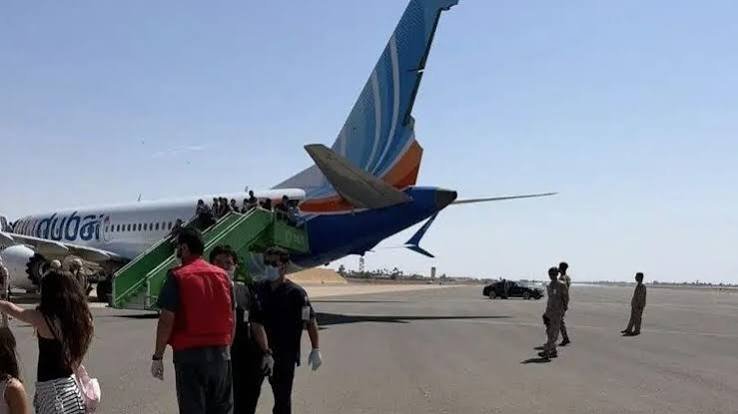

Israel scrambled fighter jets after receiving emergency signals from Flydubai flight FZ1073 during the violent cockpit incident that forced the Dubai-to-Tel Aviv aircraft to divert to Saudi Arabia, Israel’s Ambassador to India has revealed.
Ambassador Reuven Azar said the alert immediately activated Israel’s civil aviation authorities, Air Force and political leadership because officials initially had to prepare for the possibility that the aircraft had lost control or posed a threat as it approached Israeli airspace.
Fighter jets were launched as a precaution.
They ultimately did not have to intervene because the aircraft was brought back under control and later landed safely in Tabuk, Saudi Arabia.
FCRF Launches CP-FRM to Build India’s Next Generation of Fraud Risk Professionals
Emergency Signal Triggered Immediate Israeli Military Response
Speaking in New Delhi on October 1, Azar said Israel treated the Flydubai emergency as an immediate national security concern.
He explained that Israel’s geographical size leaves little time to react if an aircraft approaching the country becomes uncontrollable or is deliberately used as a weapon.
Once emergency signals were received from FZ1073, authorities alerted the relevant civilian aviation bodies, Israel’s Air Force and the country’s political leadership.
Fighter jets were then ordered into the air.
Azar said the military aircraft fortunately did not have to take action because people onboard Flydubai flight FZ1073 managed to regain control of the situation.
The revelation provides a clearer picture of how seriously Israeli authorities initially assessed the incident.
At the time, officials could not immediately know whether the cockpit confrontation was an isolated assault, an attempted hijacking or a broader security threat.
Captain Smit Machchhar Managed to Open Cockpit Door
The flight was travelling from Dubai to Tel Aviv when a violent confrontation allegedly broke out between Indian Captain Smit Machchhar and his Omani co-pilot.
Israeli officials have alleged that the co-pilot stabbed Machchhar and attempted to bring the aircraft down.
Despite being seriously injured, Machchhar managed to open the cockpit door, allowing other people onboard to intervene.
Netanyahu later said the captain’s actions enabled passengers and crew to overpower the alleged attacker.
Reports indicate that other trained pilots travelling onboard subsequently helped regain control of the aircraft.
The Boeing 737 Max experienced a rapid loss of altitude during the incident before stabilising.
According to flight-tracking data cited in international reports, the aircraft fell from about 33,000 feet to 17,000 feet within roughly a minute.
The aircraft was then diverted to Tabuk, where it landed safely.
All passengers survived.
Israel Prepared for a Worst-Case Scenario
Azar said Israel had to prepare for a scenario in which the aircraft might continue toward Israeli territory without the crew being able to regain control.
He indicated that such a situation could have required an immediate political decision.
Because Israel’s major population centres and critical installations are located within a relatively small geographical area, an aircraft travelling at high speed could reach sensitive locations quickly.
The ambassador did not say that Israel had decided to shoot down the aircraft or specify what military action might have been considered.
Instead, he described the deployment of fighter jets as a precautionary response while authorities tried to determine what was happening onboard.
Once the aircraft was diverted and the immediate danger had passed, military intervention was no longer required.
Israeli Officials Praise Indian Captain’s Response
Azar praised Machchhar for what he described as his resourcefulness, courage and determination during the emergency.
The Indian captain has also received praise from senior Indian and Israeli officials.
Israeli Prime Minister Benjamin Netanyahu described him as a hero and credited his actions with preventing a potentially catastrophic outcome.
Indian Prime Minister Narendra Modi also praised Machchhar after the incident and spoke with members of his family.
Machchhar suffered serious injuries during the cockpit confrontation and underwent medical treatment after the aircraft landed.
He was subsequently reported to be stable.
Israel has also indicated that it intends to formally recognise his actions.
Motive Behind Alleged Attack Still Under Investigation
Despite the dramatic circumstances, investigators have not yet established the motive behind the alleged attack.
Saudi authorities detained the co-pilot after the emergency landing and began examining the incident.
The United Arab Emirates has also opened a specialised criminal investigation.
UAE prosecutors have been instructed to examine whether the incident involved terrorist intent, prior planning or external direction.
None of those possibilities has yet been established as fact.
The distinction is important because early accounts of major aviation incidents can change significantly as investigators examine cockpit records, communications, digital devices and witness statements.
Flydubai has urged against speculation while the investigation continues.
Iran Link Has Not Been Established
Questions about possible external involvement have also emerged because of the wider security situation in the Middle East.
Netanyahu has indicated that investigators must establish the facts before conclusions are drawn about whether Iran or another external actor had any role.
No evidence establishing Iranian involvement has been publicly disclosed.
Azar also referred to the timing of the incident and the broader regional security environment, but did not claim that the cockpit episode was directly connected to Iran, Hamas or another organisation.
The UAE investigation is expected to examine communications and events leading up to the flight to determine whether the alleged attack was spontaneous or planned in advance.
Fighter Jet Deployment Shows How Aviation Emergencies Can Become Security Incidents
The Israeli response highlights how quickly a serious cockpit emergency can become a national security issue.
Air traffic controllers may initially have limited information about what is happening inside an aircraft transmitting emergency signals.
If an aircraft appears to be deviating from its expected route or losing control while approaching a populated area, military authorities may be placed on alert before investigators understand the cause.
In this case, the crisis ended before fighter jets needed to intervene.
The next phase of the investigation will focus on why the confrontation occurred, whether anyone else was involved and whether there was any planning before the aircraft left Dubai.
What this means for you
The scrambling of Israeli fighter jets shows the seriousness with which authorities initially treated the Flydubai emergency, but it does not by itself establish that the incident was terrorism or an attempted attack on Israel. Those questions remain under investigation.
Follow for daily updates on cybercrime, corporate fraud, DFIR, hacking, investigations, and digital forensics
