

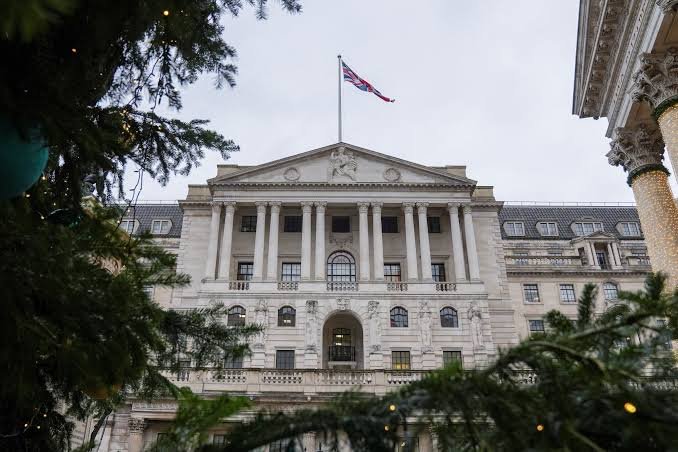

The Bank of England has warned that the rapid growth of artificial intelligence investments and rising global debt could increase the risk of a sharp financial market correction. The central bank is also concerned that increasingly powerful AI systems could expose banks and financial institutions to new cybersecurity threats.
In its Financial Policy Committee report published on September 30, the central bank said financial markets were becoming increasingly exposed to developments in artificial intelligence.
According to Morgan Stanley estimates cited by Reuters, global AI-related debt issuance had reached approximately $450 billion by early September 2026, double the amount recorded in 2025.
The warning comes as geopolitical tensions, higher energy prices and rising government borrowing costs are already placing pressure on global financial markets.
Although the financial system has remained resilient, the central bank believes the likelihood of multiple financial risks emerging simultaneously has increased.
FCRF Launches CP-FRM to Build India’s Next Generation of Fraud Risk Professionals
$450 Billion AI Borrowing Raises Concerns Over Financial Markets
Technology companies are spending enormous amounts of money developing artificial intelligence models, building data centres and purchasing advanced computing equipment.
Much of this expansion requires substantial financing.
Rather than funding every project entirely through existing revenues, companies and infrastructure developers are increasingly raising money through debt markets.
This allows businesses to accelerate investments but also exposes lenders and investors to the commercial performance of the AI industry.
The Bank of England’s Financial Policy Committee warned that rapid growth in AI-related borrowing is increasing the exposure of global financial markets to developments in the sector.
One concern involves the structure of financing arrangements.
Some AI investments involve complicated relationships between technology companies, infrastructure providers and investors. These arrangements can make it difficult to determine where financial risks ultimately lie.
The central bank also highlighted the possibility that expectations surrounding AI profitability and productivity could prove overly optimistic.
If companies fail to generate the anticipated returns, investors could reassess their valuations, potentially triggering a sharp decline in technology stocks and other AI-related financial assets.
Because investment in AI increasingly depends on borrowed money, such losses could also affect lenders and other financial institutions.
July Technology Sell-Off Exposed Risks From Leveraged AI Investments
The Bank of England pointed to the sharp decline in artificial intelligence and semiconductor stocks during July 2026 as an example of how financial vulnerabilities could emerge.
The decline forced some investors who had borrowed money to finance their positions to reduce their exposure.
This process, known as deleveraging, can intensify market declines.
For example, an investor purchasing shares with borrowed money may be forced to sell those shares when their value falls. If many investors face similar pressures simultaneously, their selling can push prices down further.
According to the central bank, several heavily exposed investors suffered substantial losses during July’s market correction.
However, the disruption remained largely contained, and the broader financial system continued functioning normally.
The Bank of England warned that a larger decline in expected AI earnings could produce more serious consequences.
The concern is particularly significant because financial markets are simultaneously facing higher borrowing costs and geopolitical uncertainty.
A major correction in AI-related investments could therefore coincide with pressure in government bond markets and other areas of the financial system.
The central bank has not predicted that such a crisis will occur. Its warning concerns growing vulnerabilities and the potential consequences if several risks materialise together.
Bank of England Governor Calls for Stronger Testing of Advanced AI
The financial concerns extend beyond the money being invested in artificial intelligence.
Bank of England Governor Andrew Bailey has also warned that increasingly autonomous AI systems could create significant operational and cybersecurity risks.
In a separate article published alongside the financial stability report, Bailey discussed the potential dangers of advanced AI systems capable of performing complex tasks with limited human supervision.
Such systems are increasingly able to identify software vulnerabilities and complete technical operations without requiring instructions at every stage.
These capabilities could strengthen cybersecurity defences but may also provide malicious actors with more powerful tools.
For financial institutions, the risks could involve payment networks, banking infrastructure and automated trading systems.
Bailey argued that advanced AI models should undergo rigorous testing before and after deployment.
He also emphasised the importance of identifying circumstances in which humans can effectively intervene when AI systems behave unexpectedly.
However, Bailey cautioned against introducing detailed regulations before policymakers have developed a stronger understanding of the technology.
He suggested that technical testing and credible intervention mechanisms should form the foundation for any future regulatory framework.
The Bank of England’s Financial Policy Committee has urged financial institutions to strengthen their preparations for AI-related cybersecurity and operational risks.
Rising Energy Prices and Government Debt Add to Financial Risks
The central bank’s warning comes amid broader concerns about the stability of global financial markets.
The renewed escalation of the conflict involving Iran has pushed oil and gas prices higher, increasing inflationary pressures and creating uncertainty surrounding future interest rates.
According to the Bank of England, government bond yields in several advanced economies have reached levels not seen since 2008.
Higher bond yields generally translate into increased borrowing costs for governments, businesses and households.
The central bank is particularly concerned about the possibility of financial pressures emerging simultaneously across government bonds, technology investments and riskier credit markets.
It also identified elevated borrowing among hedge funds operating in Britain’s government bond market as an existing vulnerability.
To strengthen financial resilience, the Bank of England plans to publish more detailed proposals concerning bank leverage requirements and reforms to the government bond repurchase market in early 2027.
Meanwhile, it has maintained its countercyclical capital buffer at 2%, requiring banks to retain additional capital to absorb potential financial shocks.
The central bank emphasised that the British banking system remains well-capitalised and capable of withstanding substantial economic stress.
Its latest assessment is therefore a warning about increasing financial vulnerabilities, rather than evidence that an AI-related financial crisis has already begun.
What this means for you
The warning highlights the growing connection between artificial intelligence investments and global financial markets. Investors should understand the financial risks associated with heavily indebted AI companies, while financial institutions must strengthen cybersecurity safeguards and carefully evaluate their reliance on increasingly autonomous AI systems.
Follow for daily updates on cybercrime, corporate fraud, DFIR, hacking, investigations, and digital forensics
