
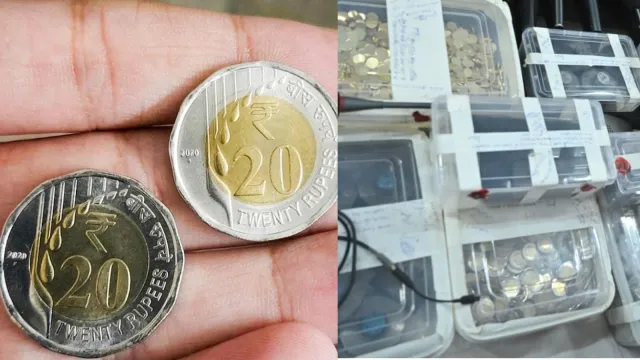

The investigation into an alleged ₹70 crore counterfeit coin network in Saharanpur has moved increasingly towards digital evidence, with police examining seized phones and registers to trace the agents who allegedly helped push fake ₹20 coins into circulation.
Investigators say members of the network avoided conventional phone calls and allegedly relied on the encrypted messaging app Signal for much of their communication, according to details emerging from the probe.
Police are now trying to identify suppliers, distributors and financial links behind a racket that they estimate may have circulated counterfeit ₹20 coins worth around ₹70 crore over several years.
Proposal for Conducting Cyber Crisis Drill, Tabletop Exercise (TTEx) & CCMP Readiness Exercise
Phones and seven registers could expose the wider network
Saharanpur’s City Kotwali Police, Special Operations Group and surveillance teams arrested five alleged members of the syndicate earlier this week.
Police recovered 6,400 counterfeit ₹20 coins with a face value of ₹1.28 lakh, six manufacturing machines, dies and semi-finished coins estimated to be worth around ₹5 lakh.
Seven registers were also recovered.
Investigators believe those books may contain details of coin supplies, payments and people involved in distributing the counterfeit currency.
Amar Ujala reported that the registers contain multiple mobile numbers and transaction-related entries that police hope will lead them to absconding members of the network.
The seized mobile phones have now become equally important.
Police are examining contacts, app data and other available digital material to reconstruct who remained in touch with whom and how orders and payments were allegedly coordinated.
Gang allegedly preferred Signal over ordinary calls
According to investigators, members of the network allegedly communicated through Signal rather than depending on regular mobile calls.
Signal provides end-to-end encryption for messages and calls, meaning message content is normally accessible only to the participants in a conversation.
Its use is entirely legal and the application itself is not connected to the alleged criminal activity.
The significance for investigators is that internet-based calls do not generate the same traditional telecom call records as ordinary cellular calls.
Police therefore appear to be relying more heavily on evidence stored on seized devices, associated contacts, account information and other digital traces.
The presence of Signal on a suspect’s phone does not by itself prove criminal communication.
Investigators will still need to connect individual conversations or contacts with the alleged manufacture, supply or financing of counterfeit coins.
₹70 crore figure is an estimate, not the amount seized
The biggest figure in the case also needs careful context.
Police physically recovered counterfeit coins worth only around ₹1.28 lakh during the operation.
The much larger ₹70 crore number is the police estimate of how much counterfeit currency the alleged syndicate may have put into circulation over the years.
Police say the gang had the capacity to manufacture roughly 10,000 to 12,000 counterfeit coins a day.
The coins were allegedly pushed into everyday circulation through places where small-denomination cash changes hands quickly, including liquor shops, toll plazas and grocery stores.
Investigators allege distributors were paid commissions for placing the coins into the market.
An earlier arrest in the same investigation indicated that one distributor was allegedly offered ₹400 for circulating ₹4,000 worth of counterfeit coins.
That model could allow a relatively small manufacturing operation to spread coins across a much wider geographic area through multiple local agents.
Police are now hunting the distribution layer
The next challenge is identifying the people between the alleged manufacturers and the shops or customers who ultimately received the coins.
Police believe the gang operated beyond Saharanpur.
Reporting on the investigation has linked its activities to several states, while investigators are examining how machinery, raw material and finished coins moved between locations.
The five arrests disrupted the alleged manufacturing side of the operation, but police still need to establish how many agents were supplying the market.
That is where the registers and phones could become critical.
A distribution network can be harder to dismantle than a factory because individual agents may handle relatively small quantities and operate independently.
Police are conducting raids to trace people identified during questioning and digital examination.
Counterfeit coins are harder to spot during everyday transactions
Fake coins can exploit a simple weakness in cash transactions: people rarely inspect low-value coins closely.
A ₹20 coin received at a busy shop, toll booth or liquor outlet may change hands several times before anyone notices anything unusual.
Police have said the counterfeit coins seized in Saharanpur were lighter than genuine ones.
Some reports said the fakes weighed around eight grams, compared with roughly 10 to 12 grams for the genuine coins examined during the investigation.
But consumers should be cautious about relying on weight alone because genuine Indian coins can vary according to denomination, series and design.
Suspected counterfeit currency should be handed to police or a bank rather than knowingly passed to another person.
Separate fake-note case is also under investigation in Saharanpur
The counterfeit coin probe comes while Saharanpur is already under scrutiny over a separate fake-currency investigation.
The National Investigation Agency is investigating counterfeit notes worth ₹17.29 crore discovered in a Punjab National Bank currency chest in the district.
The two cases involve different forms of counterfeit currency.
Police have not publicly established that the fake-note investigation and the ₹20 coin syndicate are connected.
That distinction matters because their proximity in time and location does not itself prove a common network.
What this means for you
Do not knowingly recirculate a coin that you strongly suspect is counterfeit. If a coin appears unusually light, poorly finished or otherwise suspicious, take it to a bank or police station rather than trying to spend it elsewhere.
The420 Insight
The Signal angle is only one part of the investigation. The real breakthrough may come from combining digital contacts with the seven physical registers. If police can match names, transactions and communication trails, they could move beyond the five arrested men and reconstruct the distribution chain that allegedly carried fake ₹20 coins into ordinary cash transactions.
Follow for daily updates on cybercrime, corporate fraud, DFIR, hacking, investigations, and digital forensics
