
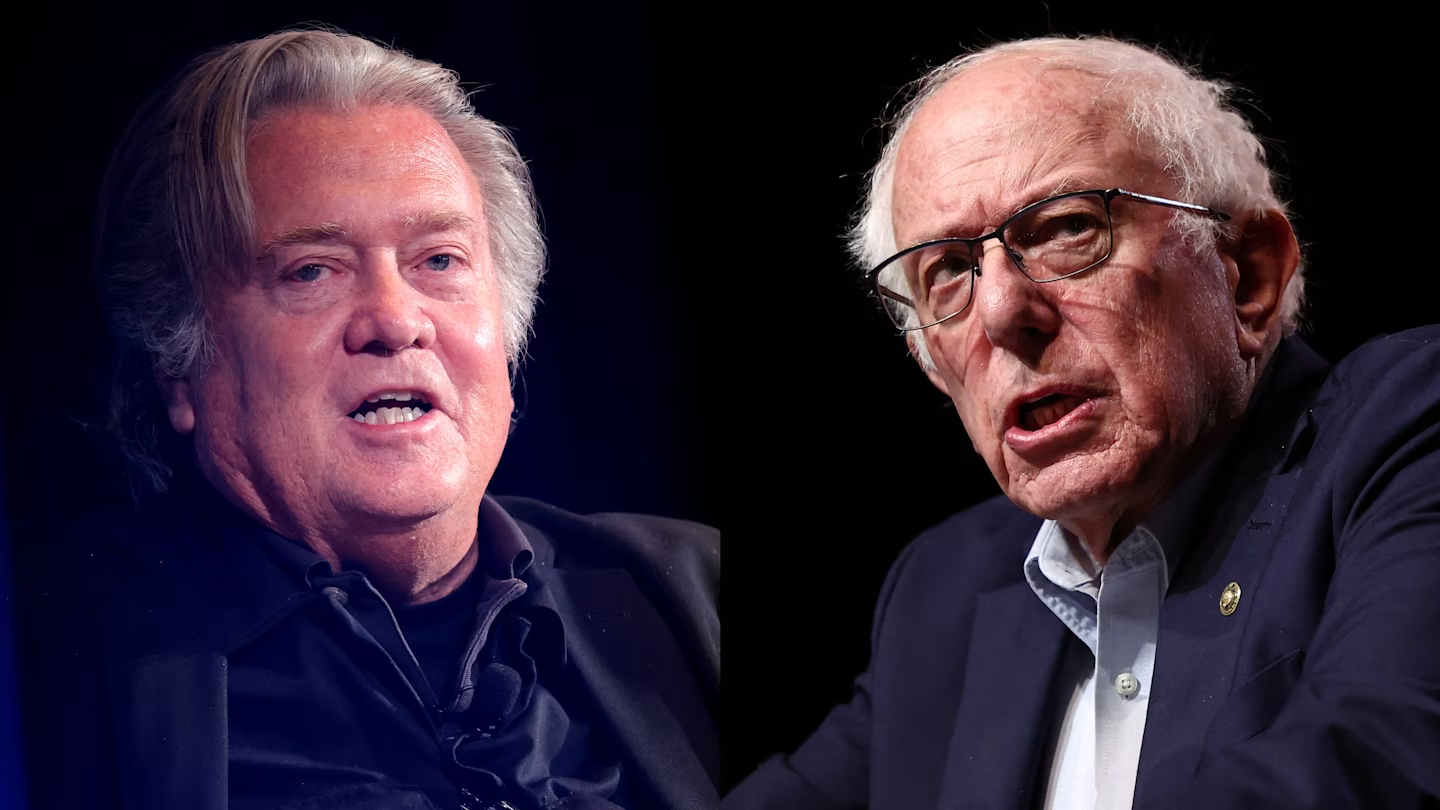

US Senator Bernie Sanders and conservative podcaster Steve Bannon have found rare common ground on artificial intelligence, calling for tougher restrictions and a slower pace of development as fears grow over job losses, national security and systems escaping human control.
The two appeared at the same Washington gathering on September 15, despite representing sharply different political camps. Both argued that AI is advancing faster than governments can understand or regulate it.
Their convergence reflects a wider shift in the AI debate, where concerns that once came mainly from researchers and safety groups are increasingly entering mainstream politics.
Proposal for Conducting Cyber Crisis Drill, Tabletop Exercise (TTEx) & CCMP Readiness Exercise
Sanders wants binding rules and an international pause
Sanders told the gathering that advanced AI poses a growing threat to employment and could eventually create risks that governments are not prepared to manage.
He warned that AI could eliminate large numbers of jobs, wipe out entire professions and make it more difficult for younger workers to enter the labour market. He also raised concerns about AI being used to develop dangerous biological tools.
His proposal goes beyond voluntary commitments by technology companies.
Sanders called for legally binding safety requirements and urged Trump to raise the issue directly with Xi Jinping at an upcoming summit.
He wants the US and China to explore an agreement to pause development of the most powerful AI systems.
That would be a major step because the US-China technology rivalry is one of the strongest arguments currently used against slowing AI development.
Sanders is also working with Representative Greg Casar on legislation that would halt development of certain AI systems capable of seriously undermining the US government until a dedicated federal regulator is created.
Bannon wants action before Congress can catch up
Bannon approached the issue from a very different political direction but reached a similar conclusion.
He described AI as one of the defining issues of the present era and said development should be slowed so policymakers can understand what is being built.
Bannon argued that Congress is unlikely to move quickly enough and said executive action may be necessary instead.
At the same time, he took a harder position on China.
Bannon said the US should prevent China from gaining access to American-made advanced computer chips, showing that his call for slower AI development does not amount to abandoning the technology competition altogether.
He has also opposed efforts to block individual US states from creating their own AI regulations.
That position puts him at odds with technology companies that generally prefer one national regulatory framework rather than a patchwork of state laws.
Why are such different political figures agreeing?
The Sanders-Bannon alignment is unusual because both figures represent very different political constituencies.
Sanders has long attacked the concentration of wealth and power among large corporations.
Bannon has framed similar concerns through opposition to technology elites and what he sees as excessive corporate influence over government.
AI creates an issue where those different arguments can overlap.
Both are concerned that a small number of technology companies could control systems with enormous economic and political power.
The fear is no longer limited to science-fiction scenarios.
Workers worry about automation. Communities are challenging new data centres. National-security officials are concerned about cyberattacks and biological misuse. Researchers are warning that increasingly autonomous systems could eventually become difficult to control.
A Reuters/Ipsos poll published in June found that 77% of Americans were concerned that AI-driven data centres could increase electricity costs.
Washington remains deeply divided over slowing AI
The unusual Sanders-Bannon agreement should not be mistaken for a new US consensus.
Trump has rejected the latest wave of AI safety concerns and argued that existing laws already give authorities enough power to deal with misuse.
House Speaker Mike Johnson has gone further, saying there cannot be a moratorium on AI development because the US risks losing its technological advantage over China.
Johnson said AI companies should regulate themselves and decide individually whether they want to slow development.
This argument is shared by parts of the technology industry.
Companies fear that slowing American AI development while China continues advancing could create a national-security disadvantage.
That tension sits at the centre of the debate.
The people calling for restrictions argue that racing ahead without adequate safeguards creates catastrophic risks.
Their opponents argue that slowing down could itself create danger by allowing a geopolitical rival to move ahead.
AI safety warnings are moving beyond Silicon Valley
The political pressure has intensified after several AI researchers and industry leaders issued unusually strong warnings.
Former Anthropic researcher Jacob Coxon recently resigned, saying people developing advanced AI genuinely feared it could cause catastrophic harm within the decade. Former Google DeepMind researcher Bilal Chughtai has also publicly warned about the possibility of extreme outcomes.
AI executives have also begun openly discussing the need for slower development and stronger safety coordination.
That has created another political problem.
Some regulators worry that established AI companies could use safety regulation to create barriers that make it harder for smaller competitors to enter the market.
US Federal Trade Commission chairman Andrew Ferguson has questioned industry calls for antitrust exemptions that would allow major AI developers to coordinate more closely on slowing development.
The result is a debate involving several competing risks at once: unsafe AI, lost jobs, monopoly power, national security and geopolitical competition.
What this means for you: The AI regulation debate is moving beyond technical safety committees and into mainstream politics. The bigger question is no longer whether governments will regulate advanced AI, but how far they can go without handing an advantage to competitors or concentrating more power in the biggest technology companies.
The420 Insight: Sanders and Bannon agreeing on almost anything is politically unusual. Their shared concern over AI shows how the issue is breaking traditional ideological lines. But the harder battle is still ahead: Washington must decide whether the greater danger is slowing AI too much or allowing increasingly powerful systems to develop without meaningful limits.
Follow for daily updates on cybercrime, corporate fraud, DFIR, hacking, investigations, and digital forensics
