

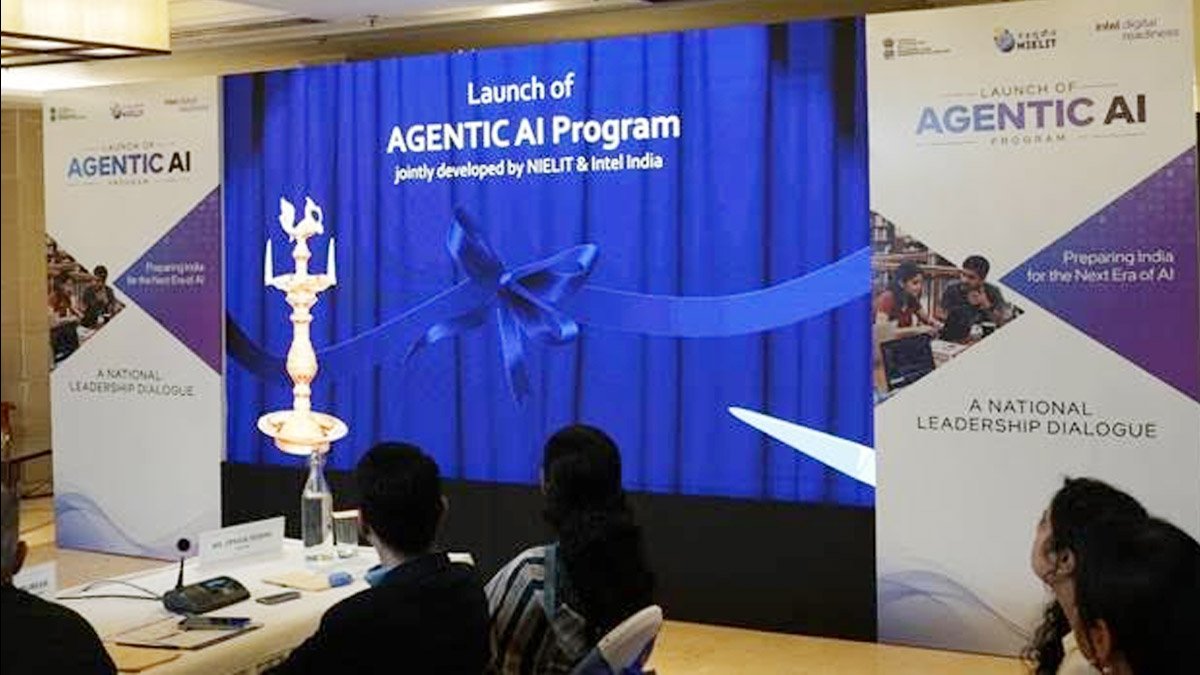

India is beginning to prepare students and professionals for a new stage of artificial intelligence where software will not simply answer questions, but can plan tasks, use digital tools and carry out multiple steps with limited human intervention.
The National Institute of Electronics and Information Technology, or NIELIT, has partnered with Intel India to launch two programmes focused specifically on Agentic AI. The initiative was announced on September 3 following a national dialogue in New Delhi involving government officials, academics and technology industry representatives.
The move signals a shift in India’s AI-skilling strategy. Until recently, much of the public conversation centred on generative AI tools that produce text, images or code. The Government is now looking towards systems capable of taking actions on behalf of users.
Algoritha Security Launches ‘Make in India’ Cyber Lab for Educational Institutions
Two Programmes Target Different Levels of AI Skills
The first programme, Agentic AI for Everyone, is designed to introduce learners to workflow automation, AI agents and systems where several AI agents work together.
Participants will receive practical exposure to creating and managing AI-powered workflows using no-code platforms. The programme is intended to show how such systems can improve productivity, automate business processes and support decision-making.
The second course, Engineering Agentic AI Systems, goes deeper.
It will cover how agent-based AI systems are designed, built and deployed. Learners will work with areas including agent architecture, tool integration, memory, orchestration and deployment, using a combination of no-code, low-code and conventional programming frameworks.
NIELIT Director General Madan Mohan Tripathi said the collaboration combines the institute’s nationwide skilling network with Intel’s industry and technology expertise.
The announcement, however, does not specify course duration, fees, enrolment targets or an exact nationwide rollout schedule. Those details will be important in determining how accessible the programmes eventually become.
What Exactly Is Agentic AI?
A normal chatbot generally waits for a person to ask a question and then responds.
An AI agent goes a step further. It can be given an objective, break that objective into smaller tasks, decide what tools it needs and carry out actions under predefined limits.
Imagine asking an ordinary AI, “How should I organise a business trip?” It may provide an itinerary.
An agentic system could potentially search available options, compare them, prepare a schedule, update a spreadsheet and trigger other software tools as part of the same task, depending on what access it has been given.
A multi-agent system uses several specialised AI agents together. One may collect information, another analyse it, while a third checks the final result.
Orchestration is simply the process of controlling how these agents and tools work together.
The Government also increasingly uses the phrase Sovereign AI. Broadly, it refers to developing domestic AI capabilities, infrastructure, datasets and talent so that a country is not entirely dependent on foreign technology providers for critical AI systems.
These capabilities can bring major productivity gains. They also raise new concerns because an AI system capable of acting autonomously can make mistakes, misuse permissions or perform unintended actions if it is poorly designed or supervised.
India Is Building a Much Larger AI Skills Pipeline
The NIELIT-Intel programme is not a standalone initiative.
It forms part of a much broader push under the ₹10,371-crore IndiaAI Mission, approved by the Union Government in 2024. One of its seven pillars, IndiaAI FutureSkills, specifically focuses on expanding the country’s AI talent and research base.
By July 2026, the Government said 543 Data and AI Labs had been approved and 58 AI Centres of Excellence were part of its broader AI ecosystem. It has also identified hundreds of possible AI applications across Union ministries.
Separate programmes are targeting basic AI literacy.
The Skill India Digital Hub had more than 120 AI-related digital courses available by March 2026, including 11 focused specifically on generative AI. The Government has also launched YUVA AI for ALL, a free introductory programme aimed particularly at young learners.
Another major programme, FutureSkills PRIME, is being run by MeitY with NASSCOM. By August 2026, more than 34 lakh candidates had registered on the platform and over 13 lakh had received certifications across emerging technology subjects.
The rapid expansion reflects a basic concern inside government and industry: AI tools are developing faster than traditional education programmes can be updated.
Learning to Build AI Is Only Half the Challenge
Agentic AI makes that skills gap more urgent.
A worker using generative AI mainly needs to understand how to communicate with a model and judge its output. Someone building autonomous agents must additionally understand permissions, data access, security controls and what happens when software takes an incorrect action.
That makes governance part of the skill itself.
IndiaAI already has a separate Safe and Trusted AI pillar covering responsible AI development. The Government has backed projects dealing with areas such as fairness, security and responsible deployment as it tries to expand adoption without ignoring the risks.
For students entering technology jobs, the shift is significant. Knowing how to use an AI chatbot may soon become a basic digital skill.
Knowing how to design, supervise and secure systems that can independently perform work could become the next layer of demand.
The NIELIT-Intel initiative is an early attempt to build that workforce before agentic systems become routine inside Indian companies, government departments and digital services.
What this means for you:
If you are learning AI for future employment, do not stop at prompting chatbots. Understanding automation, AI agents, data permissions and basic AI safety could increasingly matter as employers move towards systems that can perform tasks themselves.
https://www.linkedin.com/company/policetechnology/home/
