

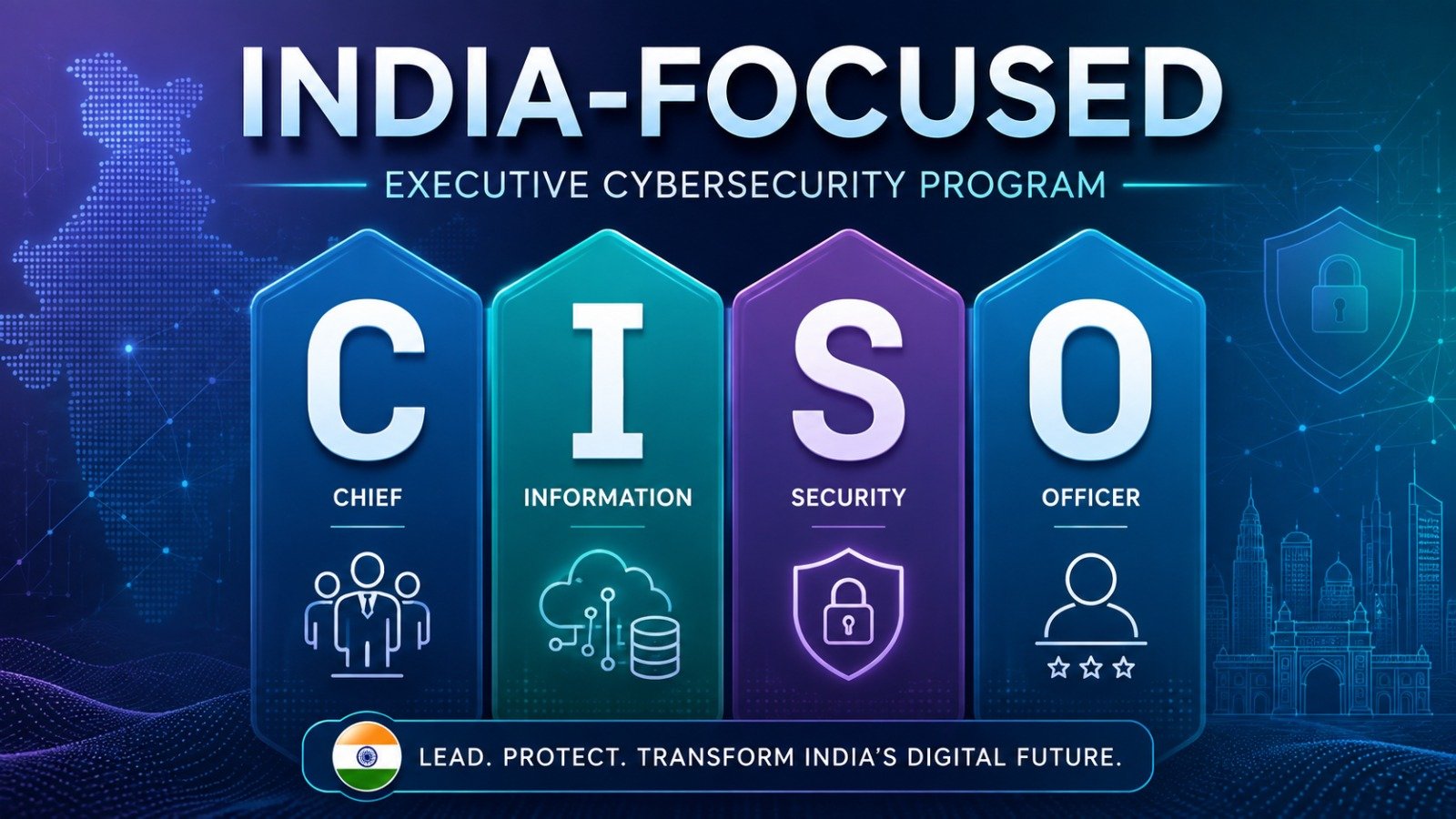

FCRF Academy is opening the second cohort of its Certified Chief Information Security Officer (C-CISO) program from 12 September 2026, bringing back its India-focused cybersecurity leadership certification for CISOs, security heads, GRC leaders, risk professionals and senior IT practitioners. Hundreds of professionals have already completed or joined FCRF Academy’s cybersecurity and leadership certification ecosystem, and the new C-CISO cohort is designed to help experienced professionals move from technical security responsibilities into enterprise governance, regulatory readiness, cyber risk, resilience and board-level leadership.
Unlike generic CISO programs built largely around global frameworks, FCRF Academy positions its C-CISO around the realities of operating in India: MeitY requirements, CERT-In expectations, RBI and SEBI mandates, DPDP compliance, enterprise risk, Zero Trust, SOC governance, incident response and executive communication. The program is delivered through live, interactive weekend sessions and supported by recorded access through the Academy’s LMS.
Why the CISO Role Has Changed
The modern CISO is no longer simply the person responsible for firewalls, endpoint security and vulnerability management.
Cybersecurity has moved into the boardroom.
A serious ransomware incident can stop business operations. A privacy failure can trigger legal and regulatory consequences. A third-party breach can expose customer data. An AI-enabled fraud can create financial and reputational damage before conventional controls detect it.
This means security leaders are increasingly expected to understand not only technology, but also business risk, regulation, governance, financial exposure and crisis leadership.
The CISO has to answer questions from boards and management that are very different from the questions asked inside a SOC.
How much cyber risk does the organisation carry?
Which security investments should receive priority?
What would happen if a critical vendor were compromised?
Can the company continue operating after ransomware?
Is the organisation compliant with relevant Indian regulations?
How should a major cyber incident be communicated to regulators, customers and senior management?
FCRF Academy’s C-CISO program is structured around this transition from technical security manager to strategic cyber leader. Its current program positioning focuses specifically on governance, Indian regulatory compliance, enterprise risk, resilient architecture and board-level decision-making.
Built Around India’s Regulatory Environment
One of the strongest elements of the program is its India-focused positioning.
Security leaders working in Indian enterprises cannot rely exclusively on international standards.
They increasingly need to understand requirements arising from CERT-In, MeitY, the Digital Personal Data Protection framework and sector-specific expectations from bodies such as RBI, SEBI and IRDAI.
This creates a difficult environment for CISOs.
A technical control may appear appropriate from a cybersecurity perspective but still fail to meet a regulator’s reporting or governance expectations. Conversely, an organisation may technically comply with a requirement while remaining poorly prepared for an actual cyber incident.
The C-CISO program therefore attempts to bridge both sides: regulatory compliance and operational security.
FCRF Academy describes the program as an intensive, practitioner-led course aimed at helping security leaders navigate Indian digital regulation while connecting it with global cybersecurity practices.
From Cyber Strategy to Board Communication
The program is structured around areas that increasingly define senior cybersecurity leadership.
Participants explore cybersecurity strategy and governance, enterprise risk, regulatory readiness, Zero Trust and security architecture, SOC and incident-response leadership, business continuity, cyber resilience, metrics, KPIs and risk quantification.
Another important component is executive communication.
A CISO may understand an organisation’s technical vulnerabilities extremely well but still struggle to communicate their significance to the board.
Senior management rarely needs a long explanation of CVEs, attack techniques or firewall configurations.
It needs to understand:
What could this cost?
What could stop the business?
What are the regulatory consequences?
What must be fixed first?
How much investment is required?
The C-CISO curriculum therefore places emphasis on translating cybersecurity risk into language that senior management can use for decisions.
FCRF Academy also highlights quantitative risk approaches, executive dashboards and business-aligned security metrics as part of its CISO leadership model.
Building Breach-Ready Organisations
Another important shift in modern CISO leadership is the recognition that perfect prevention is impossible.
Organisations need to assume that incidents will happen.
The real test is how quickly they can detect, contain, investigate and recover.
That requires mature SOC operations, clear incident-response playbooks, forensic readiness, business-continuity plans, crisis governance and clearly assigned decision-making authority.
The C-CISO program therefore looks beyond preventive cybersecurity controls and focuses on building breach-ready and resilient organisations.
Its program framework includes Zero Trust architecture, Security Operations Centre leadership, incident response, crisis planning and the development of cyber crisis management plans aligned to Indian requirements.
For senior security professionals, this distinction is critical.
A technically secure organisation may still fail during a major incident if management roles are unclear, regulators are informed too late, backups cannot be restored or business teams have never tested their response plans.
Modern security leadership is therefore as much about organisational preparedness as it is about security technology.
A Program Designed for Professionals, Not Beginners
The Certified CISO program is positioned primarily for experienced professionals rather than entry-level learners.
Its natural audience includes:
CISOs, aspiring CISOs, Security Heads, GRC leaders, cyber-risk professionals, senior cybersecurity managers, IT leaders, compliance professionals, SOC leaders and professionals responsible for enterprise technology risk.
The reason is straightforward.
CISO-level responsibility requires context.
Professionals need to understand how security controls interact with business operations, budgets, regulation, governance and organisational politics.
The value of a leadership-oriented certification therefore comes not merely from learning concepts, but from understanding how those concepts are applied inside real organisations.
FCRF Academy describes its teaching model as practitioner-led, applied and India-focused rather than purely academic or theory-driven.
Hundreds Already Part of the Certification Ecosystem
The second cohort also builds on the response to FCRF Academy’s earlier professional programs and the first Certified CISO cohort.
Hundreds of professionals have already participated in FCRF Academy’s certification initiatives, including senior professionals from cybersecurity, government, banking, compliance, risk and law enforcement.
The Academy’s wider training ecosystem has now reached well beyond a single certification.
Its current website reports more than 14,500 law-enforcement and cybersecurity professionals trained, over 500 awareness programs, technical workshops and sessions, and participation from more than 350 national and international speakers and subject-matter experts. Some of its more recent program pages report the cumulative training figure at more than 20,000 professionals, reflecting continued expansion of the Academy’s programs.
FCRF Academy also delivered the Certified Cyber Crisis Management Professional program in collaboration with CERT-In, attended by more than 500 officials from civil services, defence, cybersecurity and regulatory bodies.
That institutional exposure has helped shape FCRF Academy’s approach toward programs that are contextualised around Indian regulatory and operational environments.
FCRF’s Wider Cybersecurity Track Record
FCRF Academy operates under the broader ecosystem of the Future Crime Research Foundation, an IIT Kanpur AIIIDE-CoE incubated non-profit organisation working across cybersecurity, cybercrime, digital forensics, fraud risk and cyber law.
FCRF has worked with institutions across law enforcement, government, academia and industry and has organised large-scale capacity-building initiatives and the FutureCrime Summit.
Its Academy was formally launched to institutionalise professional capacity building in cybersecurity, digital crime and risk. The organisation also has a collaboration with NIELIT under MeitY for advanced training and certification initiatives.
This background is particularly relevant for a CISO program because security leadership increasingly sits at the intersection of multiple domains.
A CISO needs to understand what regulators expect.
They need to understand how attackers operate.
They need to understand how law-enforcement agencies approach incidents.
They need to understand how boards make risk decisions.
And they need to understand how technical teams actually implement security.
A program built inside a broader cybersecurity and cybercrime ecosystem can bring those perspectives together.
Live Learning With Recorded Continuity
The second cohort begins on 12 September 2026 and follows a weekend-based learning format.
Sessions are conducted live, allowing participants to engage with practitioners and ask questions based on their own organisational environments.
FCRF Academy’s learning model also provides recorded access through its LMS, with live-session recordings generally uploaded shortly after classes along with PDFs and supporting learning resources.
That format is particularly useful for senior professionals who may need to balance the program with demanding work schedules.
Rather than choosing between live interaction and self-paced continuity, participants get both.
Why India Needs More Board-Ready CISOs
The biggest cybersecurity challenge facing organisations may no longer be a shortage of security tools.
It may be a shortage of leaders capable of converting technology into institutional resilience.
Enterprises already purchase firewalls, EDR systems, SIEM platforms, threat-intelligence feeds and cloud-security products.
The harder questions are strategic.
Are these investments addressing the organisation’s biggest risks?
Does the board understand its exposure?
Can security teams measure control effectiveness?
Are regulatory obligations integrated into operational workflows?
Can the organisation recover from a serious incident?
Is cybersecurity viewed as an IT expense or an enterprise risk?
These are CISO questions.
And answering them requires a different skill set from operating individual security technologies.
That is why leadership programs focused on the Indian environment are becoming increasingly relevant.
The second cohort of FCRF Academy’s Certified CISO program arrives as Indian organisations face tighter privacy expectations, expanding cyber regulation, increasingly sophisticated AI-driven threats and greater board-level accountability for digital risk.
For experienced professionals seeking to move into cybersecurity leadership—or existing leaders looking to strengthen their governance, risk and boardroom capabilities—the program is positioned as a bridge between technical security expertise and enterprise cyber leadership.
Follow for daily updates on cybercrime, corporate fraud, DFIR, hacking, investigations, and digital forensics
