As financial fraud, cybercrime, digital impersonation, insider threats and technology-enabled scams become increasingly sophisticated, the Centre for Police Technology (CPT) has introduced “FRM as a Service”, a comprehensive Fraud Risk Management offering designed for banks, NBFCs, insurance companies, fintechs and corporate organisations.
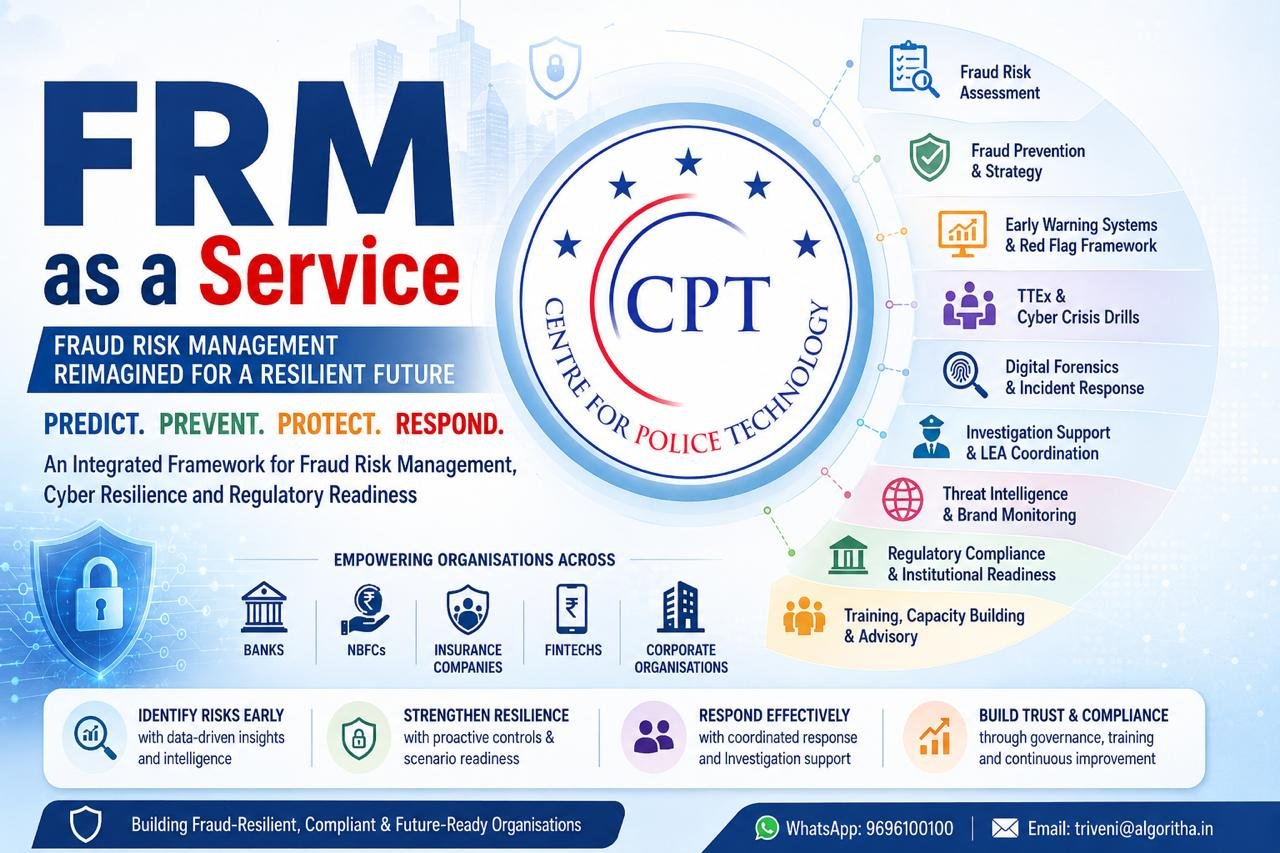
The initiative seeks to bring together fraud prevention, cyber security, digital forensics, investigation expertise, regulatory understanding and law-enforcement coordination under a single integrated framework. Its central philosophy is simple: Predict. Prevent. Protect. Respond.
Unlike conventional fraud-risk programmes that often focus primarily on internal controls and post-incident investigation, CPT’s model approaches fraud from the combined perspectives of the enterprise, investigator, regulator, cyber-security practitioner and law-enforcement agency.
From Fraud Risk Assessment to Investigation Support
Under FRM as a Service, CPT proposes to assist organisations in identifying and prioritising fraud risks across business processes, digital channels, employees, vendors, customers and third-party ecosystems.
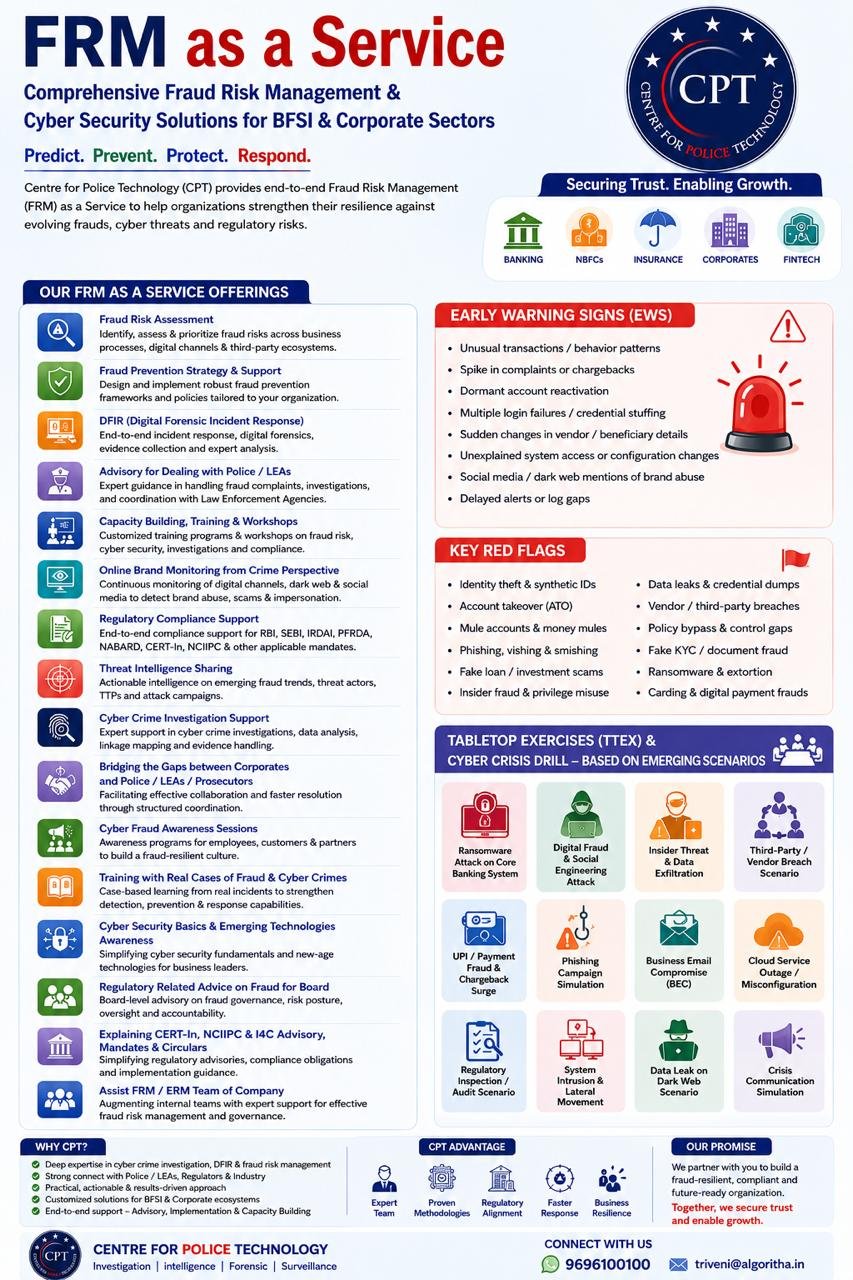
The service portfolio covers Fraud Risk Assessment, Fraud Prevention Strategy, Digital Forensics & Incident Response (DFIR), Cyber Crime Investigation Support, Threat Intelligence Sharing, Online Brand Monitoring, Regulatory Compliance Support and specialised advisory for dealing with Police and Law Enforcement Agencies (LEAs).
An important component is helping bridge the operational gap that can arise between corporate fraud teams and investigating agencies. CPT can assist organisations in understanding fraud complaints, preservation and presentation of digital evidence, investigation requirements and structured coordination with Police, LEAs and prosecutors.
CPT also proposes capacity-building programmes, workshops and case-based training for fraud risk teams, cyber-security professionals, investigators, management and other stakeholders. Real-world fraud and cybercrime cases can be used to help organisations understand how attacks evolve, where controls fail and how an effective response should be structured.
Early Warning Signs and Red-Flag Framework
A major pillar of the service is the development and strengthening of Early Warning Systems (EWS) and organisational Red Flag frameworks.
Potential warning indicators may include unusual transaction or behavioural patterns, sudden spikes in complaints or chargebacks, dormant-account reactivation, repeated authentication failures, unexpected changes in beneficiary or vendor information, unexplained privileged access, configuration changes and gaps in security logs.
The framework can also address emerging red flags such as synthetic identities, account takeover, money mules, fake KYC and document fraud, phishing, vishing and smishing, investment and loan scams, credential leaks, ransomware, insider fraud, third-party compromise and digital-payment fraud.
Rather than treating these indicators independently, the objective is to enable organisations to correlate financial, behavioural, cyber, investigative and threat-intelligence signals for earlier intervention.
TTEx & Cyber Crisis Drills Based on Emerging Scenarios
A distinctive component of CPT’s offering is Tabletop Exercises (TTEx) & Cyber Crisis Drills based on realistic and emerging fraud and cyber scenarios.
Exercises can be customised around incidents such as ransomware attacks on core banking systems, digital fraud and social-engineering attacks, insider-led data exfiltration, third-party or vendor breaches, UPI/payment fraud surges, phishing campaigns, Business Email Compromise (BEC), cloud outages or misconfiguration, system intrusion and lateral movement, dark-web data leaks and crisis communication challenges.
Such exercises can test not merely technology teams but the entire institutional response mechanism involving senior management, FRM, ERM, CISO/SOC, compliance, legal, communications, business operations and other relevant stakeholders.
The objective is to identify weaknesses before a real crisis exposes them.
Regulatory and Institutional Readiness
For highly regulated sectors such as BFSI, fraud management cannot operate independently of cyber-security and compliance obligations.
CPT’s FRM framework therefore incorporates awareness and advisory around relevant requirements and directions issued by institutions and regulators such as RBI, SEBI, IRDAI, PFRDA, NABARD and CERT-In, depending upon the organisation and applicable regulatory framework.
The programme can also help management teams better understand the respective roles and relevant advisories or mandates of institutions such as CERT-In, NCIIPC and I4C in the broader cybercrime and national cyber-security ecosystem.
Specialised board-level fraud risk advisory can further help directors and senior management understand emerging threats, governance responsibilities, control gaps, incident preparedness and organisational accountability.
Threat Intelligence and Brand Monitoring
Modern fraud frequently originates outside an organisation’s conventional security perimeter. Fake websites, impersonation accounts, phishing infrastructure, leaked credentials, malicious applications and underground-market discussions can become early indicators of a larger attack.
CPT therefore proposes threat-intelligence sharing and online brand monitoring from a crime and investigation perspective, enabling organisations to identify emerging fraud trends, threat actors, attack techniques and potential abuse of their brands across relevant digital environments, including social media and the dark web.
Extending the FRM and ERM Team
The service is also designed to function as an expert augmentation layer for existing Fraud Risk Management (FRM) and Enterprise Risk Management (ERM) teams.
Instead of requiring organisations to build every specialised capability internally, CPT can provide access to expertise spanning fraud investigation, cybercrime, digital forensics, cyber security, regulatory understanding, training and law-enforcement coordination.
This model can be particularly relevant when organisations face a major fraud, cyber incident or unfamiliar emerging threat requiring capabilities beyond those available within their routine operational teams.
Building Fraud-Resilient Organisations
The larger objective of FRM as a Service by the Centre for Police Technology is not merely to investigate fraud after financial or reputational damage has occurred. It is to create a continuous cycle of risk identification, early warning, prevention, preparedness, detection, investigation, response, learning and control improvement.
By combining practical investigative experience with cyber-security, DFIR, fraud-risk management, regulatory awareness and capacity building, CPT aims to help BFSI and corporate organisations become more fraud-resilient, compliant and crisis-ready.
In an environment where the boundary between financial fraud and cybercrime is rapidly disappearing, organisations increasingly require a unified response rather than isolated fraud, cyber and compliance silos.
FRM as a Service seeks to provide precisely that integrated capability—helping organisations secure trust, strengthen resilience and prepare for the next generation of digital fraud and cyber risk.
Centre for Police Technology (CPT)
Investigation | Intelligence | Forensic | Surveillance
Connect: WhatsApp: 9696100100 | Email: triveni@algoritha.in