

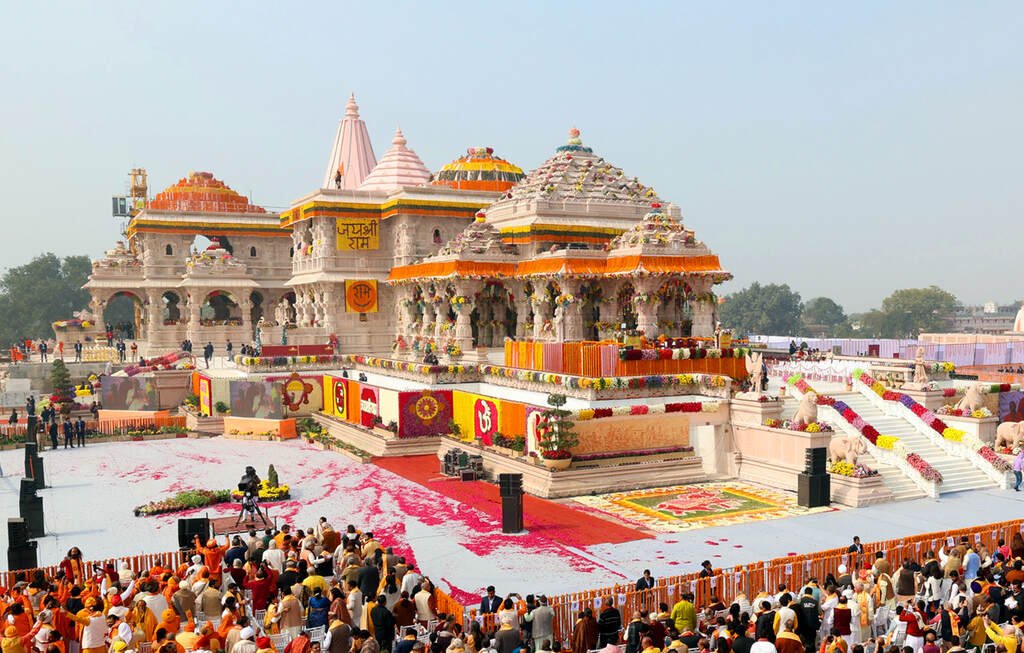

Authorities are moving to overhaul security at the Shri Ram Temple with a technology-driven upgrade centred on artificial intelligence, following an embarrassing episode in which cash meant for the deity was allegedly siphoned off inside the temple’s own donation-counting room. The district administration has submitted a proposal to the state government combining AI-enabled cameras, smart sensors and new watchtowers into a real-time surveillance network spanning the temple complex.
From Recording Devices to Active Threat Detection
Under the proposal, the temple’s existing CCTV network would be upgraded so cameras no longer merely record footage but actively analyse it. The AI-enabled system is designed to detect suspicious behaviour in crowds, flag unusual activity, estimate devotee headcounts in real time, and alert security personnel to potential threats as they emerge, rather than after the fact.
The plan also calls for 25 watchtowers along the temple’s security wall, standing between 25 and 37 feet tall. Of the wall’s planned four-kilometre length, roughly 400 metres has been completed so far, with three watchtowers already built. Smart sensors are to be deployed at sensitive points across the complex to reinforce round-the-clock monitoring.
The Theft That Triggered the Overhaul
The push for AI surveillance follows the exposure of a donation-counting scandal that has embarrassed the Shri Ram Janmbhoomi Teerth Kshetra Trust for weeks. A Special Investigation Team formed on June 13 found that staff at the temple’s cash-counting facility had been pilfering currency notes, in some cases stuffing bundles into their clothing, pockets and shoes, over a sustained period. Reviewing roughly forty days of CCTV footage between April 27 and June 5, investigators documented around 70 separate instances of theft, and warned the true scale of the embezzlement could be considerably larger since earlier footage had already been overwritten due to limited storage capacity.
Eight people have been arrested so far, with police recovering close to ₹80 lakh in cash and jewellery, and some estimates of the total embezzlement running as high as ₹2 to ₹3 crore. The SIT’s preliminary findings blamed the losses on serious supervisory failures and a systematic breakdown of standard operating procedures, including lapses in staff frisking, search protocols and monitoring during the cash-counting process itself.
Tightening Protocols Alongside the Technology
In response, the Trust has already introduced pocketless uniforms, intensified frisking and dedicated changing rooms at the Pilgrim Facilitation Centre, where donations from the temple’s roughly 35 collection boxes are tallied. The Trust has also deactivated VIP-entry credentials previously used by since-departed office-bearers, and is weighing whether to diversify where donation cash is deposited, currently concentrated at a single State Bank of India branch in Ayodhya.
The AI surveillance proposal is expected to be one of the SIT’s key recommendations in its final report to the state government, building on groundwork laid before the temple’s 2024 consecration, when AI-powered analytics were first tested for pilgrim safety during the inauguration.
Accountability Built Into the System
Officials say the new framework is meant to strengthen accountability among supervisory officers as much as it deters theft. Security review meetings are to continue every three months to assess protocols, evaluate the performance of the technological systems, and identify emerging risks before they escalate. The broader goal, officials said, is earlier detection of suspicious activity and faster response to any threat, with the project expected to roll out in phases once it receives final government approval.
For one of India’s most visited and politically significant religious sites, the episode underscores a wider challenge facing major temples nationwide: matching the scale of devotee footfall and cash offerings with security infrastructure robust enough to prevent both external threats and internal lapses.
