
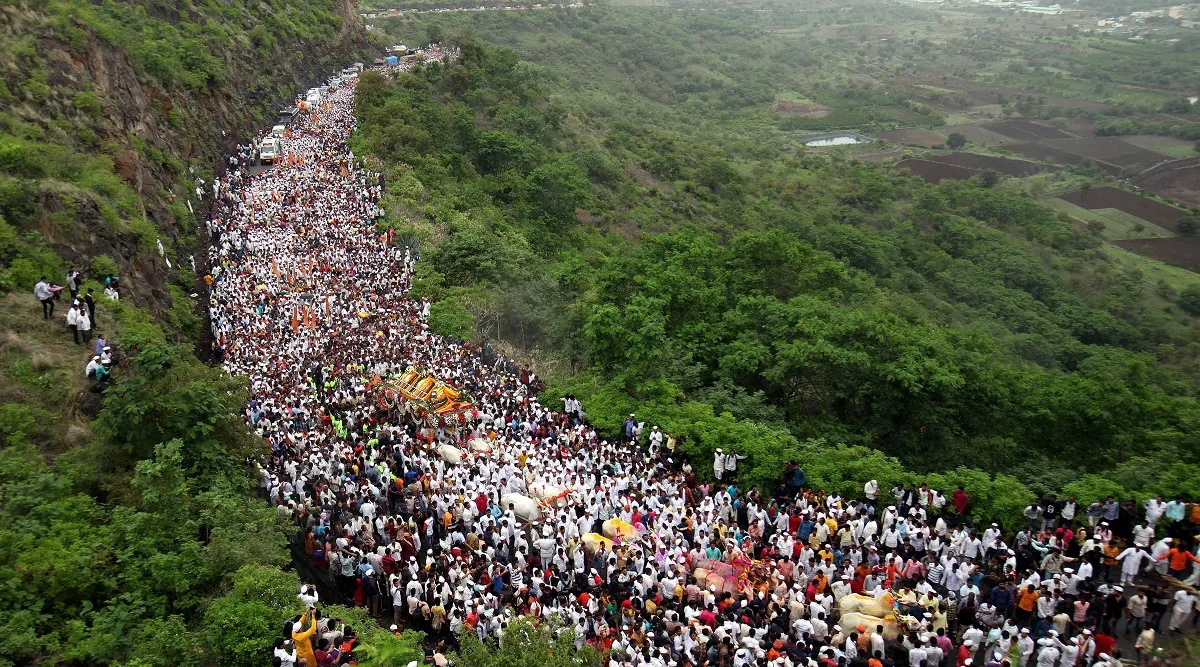

The historic 21-day Ashadhi Wari from Pune to Pandharpur has integrated artificial intelligence into how Maharashtra manages security, crowd logistics and healthcare for over six lakh participating devotees. The fusion of an ancient devotional tradition with new-age software marks a significant shift in how the state administers one of India’s largest annual religious gatherings.
AI-Powered Surveillance on the Ground and in the Air
Pune police and municipal authorities have deployed an AI-integrated CCTV network across high-density friction points along the palkhi route, feeding real-time visual streams into central control rooms where algorithms handle route mapping and crowd-density analysis. Law enforcement has also loaded historical criminal databases into a facial recognition model to flag suspicious activity and improve crowd tracking as the procession moves through the city.
Complementing the ground network, security teams are flying surveillance drones fitted with AI computer vision to patrol the route and major gathering points, an approach that mirrors crowd-control protocols first tested at the Kumbh Mela in Uttar Pradesh. Local traffic management units say these real-time digital inspections have sharpened the precision and safety of the march considerably compared to earlier years.
A Digital Lifeline for Pilgrims’ Health
To support the physical wellbeing of the Warkaris, Maharashtra’s Public Health and Family Welfare Department has launched the Arogya Sampanna Wari mobile application, giving pilgrims real-time information on nearby ambulances, treatment centres and emergency medical services along the route. Health Minister Prakash Abitkar said the department aims to provide uninterrupted medical care from the moment devotees leave home until they return, with ASHA volunteers and health workers assisting pilgrims in accessing the app’s digital services.
The digital layer sits atop a substantially expanded physical medical network. The department has deployed 353 ambulances, including 38 Advanced Life Support units, alongside bike ambulances and, for the first time, an air ambulance service to transport critically ill pilgrims requiring advanced treatment.
Alongside this infrastructure, private medical volunteers have set up screening camps directly along the procession routes. A notable diagnostic tool called Mukhia Plus, developed by Pune-based Edgescan AI, is being used for rapid, non-invasive oral cancer screening. Healthcare workers photograph several regions inside a patient’s mouth, and the tool’s algorithm, validated in a registered clinical trial with a reported sensitivity above 96 percent, processes the images to flag potential precancerous lesions within seconds, work that is particularly significant given India’s exceptionally high burden of tobacco-related oral cancer.
A Template for Future Pilgrimages
Taken together, this year’s deployment of AI surveillance, drone monitoring, facial recognition and app-based healthcare navigation marks a considerable departure from how the Wari has traditionally been managed, relying instead on decades of manual crowd coordination refined year over year by district authorities and local volunteers. Officials are positioning the current rollout as a potential model for other large-scale Indian pilgrimages, including the far larger Kumbh Mela, where similar AI tools have already seen limited trials.
Whether the technology holds up will be tested most severely in the pilgrimage’s final days, as the two palkhis converge on Pandharpur ahead of Ashadhi Ekadashi, when crowd density at the Chandrabhaga riverbed and the temple’s darshan queues typically reaches its peak for the year
Follow for daily updates on cybercrime, corporate fraud, DFIR, hacking, investigations, and digital forensics
