

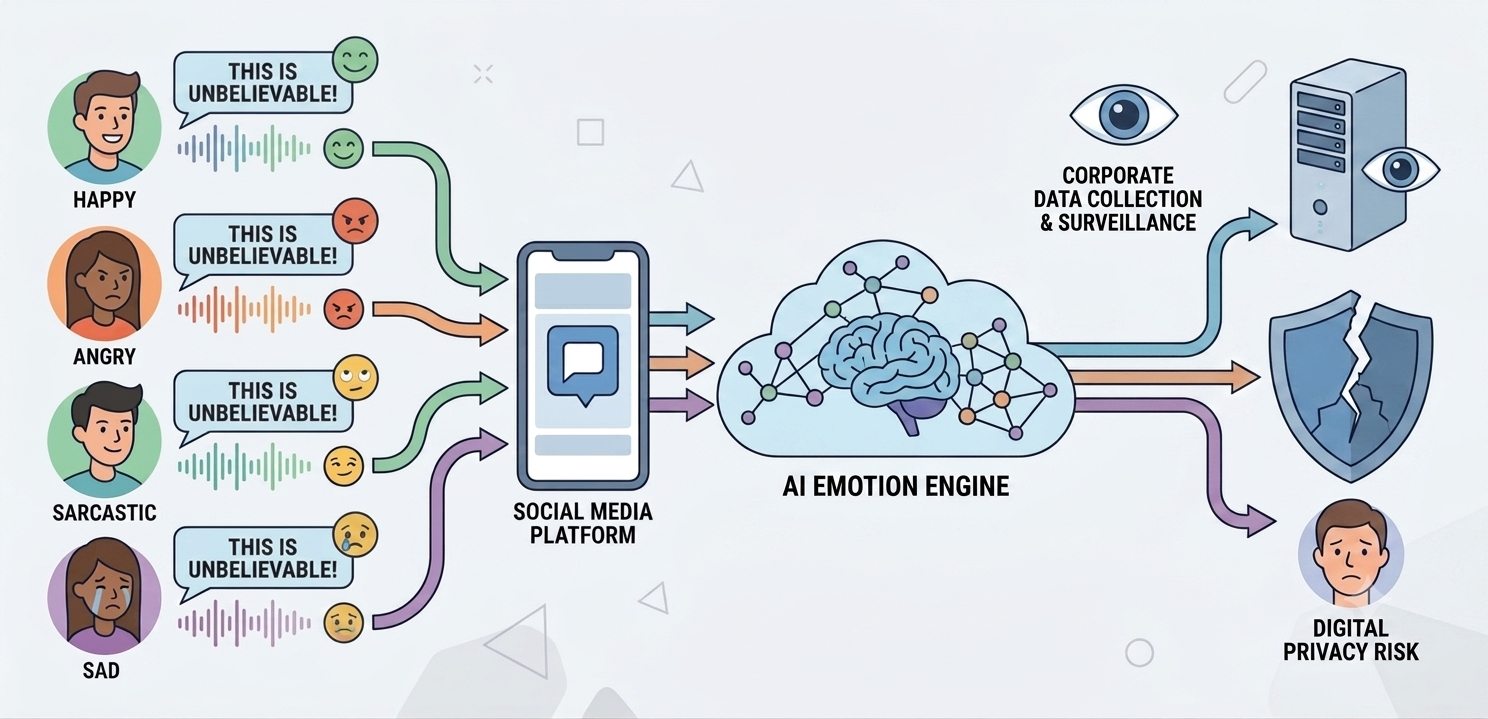

The internet regularly produces strange, repetitive challenges that capture global attention. Recently, millions of users participated in the viral “same phrase trend.” People repeat a single sentence across various emotional tones for the camera. For instance, they act highly supportive, fiercely angry, or deeply sarcastic. Creators frequently laugh off their awkward performances while recording.
Consequently, captive audiences generate millions of views. However, digital ethicist Clara Fulks spots a darker reality beneath this harmless comedy. She recently warned that big tech companies eagerly harvest these public performances. Therefore, corporate developers acquire crucial emotional training data absolutely free. This massive influx of video content represents a major victory for technology firms.
Specifically, these engineers desperately need diverse human reactions to improve their products. They must train complex emotion recognition models urgently. Thus, enthusiastic participants unknowingly contribute to a massive commercial enterprise.
Teaching computers to understand human feelings remains incredibly difficult. Olga Kokhan, founder of Tinkogroup, recently highlighted this persistent technological hurdle. She explained that identical words change meaning entirely based on vocal pacing or emphasis. Furthermore, humans naturally adjust their tone to convey subtle social context.
Therefore, the viral trend provides an unprecedented, rich dataset for eager programmers. Thousands of users deliberately demonstrate exactly how emotion alters verbal delivery. Consequently, artificial intelligence systems learn to separate mere vocabulary from underlying human sentiment. Developers rapidly feed this raw audio-visual data into commercial software pipelines.
For example, tech firms sell these upgraded models directly to corporate customer service centers. The software actively monitors customer moods during live phone conversations. Subsequently, the program dictates appropriate agent responses based on algorithmic mood analysis. Ultimately, this practice transforms a silly internet joke into a powerful corporate tool.
Despite access to massive datasets, advanced models still struggle with genuine human nuance. John Licato, an associate professor at the Bellini College of Artificial Intelligence, emphasizes the deep comedic exaggeration within social media videos. Thus, viral internet performances rarely mirror authentic daily interactions. Moreover, human emotion relies heavily on cultural backgrounds and individual personalities.
Consequently, artificial intelligence frequently misinterprets thick sarcasm or complex mixed feelings completely. Despite these obvious technical flaws, companies rapidly deploy these experimental systems into modern corporate environments. The Institute for the Future of Work recently issued a stark warning regarding this aggressive expansion. Their comprehensive 2025 analysis argues that emotional AI completely transforms workplace surveillance permanently. Specifically, management no longer just watches basic physical employee actions. Instead, the technology relentlessly monitors how workers secretly feel throughout the day. Therefore, employers can track hidden personal frustration or quiet disengagement effortlessly.
This oppressive corporate monitoring carries significant psychological consequences for modern workers everywhere. Over time, employees might feel intensely pressured to perform specific emotions on demand. For instance, workers could suppress legitimate frustration or fake cheerful smiles just to satisfy a machine’s rigid expectations.
Furthermore, this current trend follows a long history of corporate biometric data harvesting. In late 2025, the popular “Hug my younger self” trend tricked users into surrendering vital facial mapping data. Similarly, the widespread “2016 again” challenge gave facial recognition companies a completely free temporal dataset showing human aging. Therefore, innocent internet games constantly act as hidden commercial goldmines. Privacy advocates warn that users surrender permanent biometric markers without fully understanding the severe long-term consequences.
Ultimately, ordinary citizens trade their most intimate facial expressions for fleeting viral fame. As emotion recognition technology expands rapidly, regulators face immense pressure to intervene. Consequently, users must critically reconsider their daily digital participation.
