
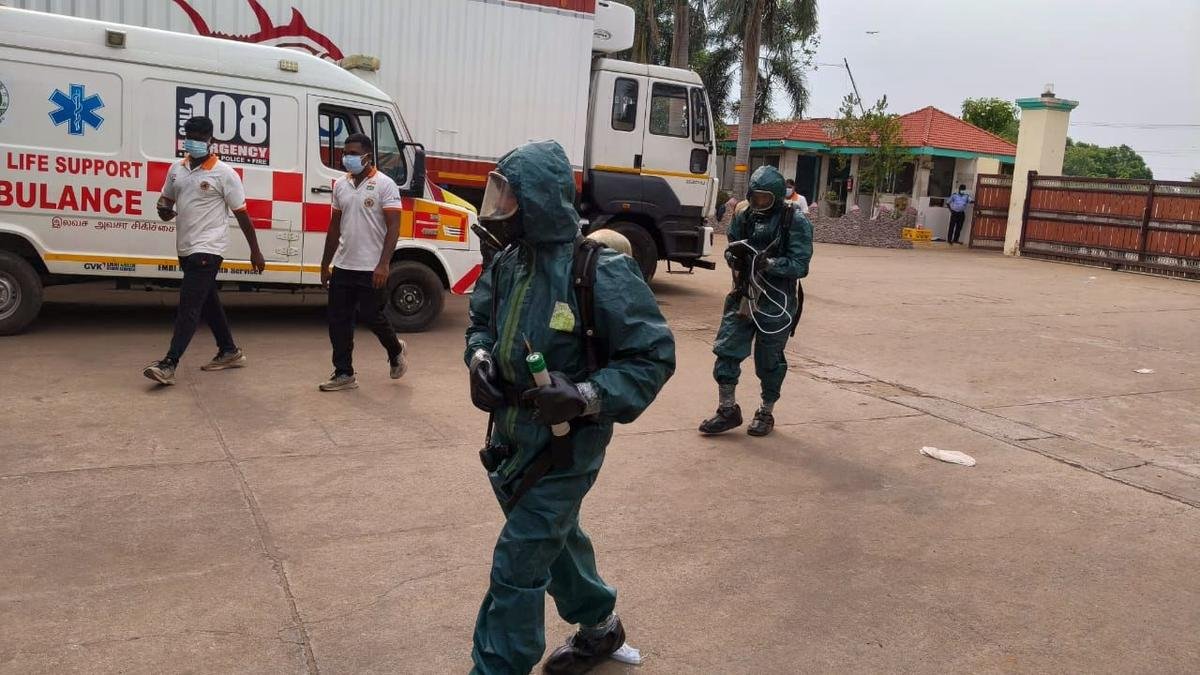
A tragic ammonia gas leak at a private seafood processing facility in Tamil Nadu’s Tiruvallur district on Sunday has raised serious concerns about industrial safety standards. The incident, which occurred at a factory in Manjangaranai near Periyapalayam, claimed the lives of seven women workers during treatment, while 67 other employees were affected and rushed to hospitals. Following the accident, authorities launched an extensive rescue and relief operation involving the district administration, health department, and emergency response agencies.
According to preliminary reports, the leak occurred while routine operations were underway at the seafood processing unit. Workers suddenly began experiencing breathing difficulties, dizziness, and loss of consciousness after ammonia gas spread through parts of the facility. Panic quickly gripped the premises as employees attempted to evacuate. Emergency services were alerted, and ambulances were dispatched to transport the affected workers to nearby hospitals.
Registration Begins for FutureCrime Summit 2026, India’s Largest Cybercrime Conference
Medical Emergency and Specialized Care Shift
Officials said all 67 affected workers were admitted to regional medical facilities for immediate stabilization. The tactical distribution of the patients saw 46 individuals rushed to Vels Hospital, while 21 workers were routed to Venkateshwara Hospital. As the condition of several patients deteriorated due to acute respiratory distress, nine critically ill workers were later shifted to Government Stanley Medical College Hospital in Chennai for advanced treatment and specialized intensive care.
Despite emergency medical intervention, seven women workers succumbed to the effects of the toxic gas exposure. Their deaths have sent shockwaves through the region and sparked renewed scrutiny of safety practices at industrial facilities handling hazardous cooling substances. Authorities have begun the process of identifying the victims and informing their families, with reports indicating that some of the affected workers were migrant laborers employed at the factory.
Fast-Track Investigation Framework
In response to the tragedy, Tamil Nadu Chief Minister C. Joseph Vijay ordered an immediate high-level investigation into the incident to isolate procedural errors.
The administrative action timeline followed a structured multi-agency sequence. The operation opened with the disaster response phase, where teams from the National Disaster Response Force (NDRF) inspected the site to plug the source of the leak and secure the perimeter. This transitioned immediately into the inquiry committee setup, where the state government formally constituted a three-member probe panel comprising the Director of Industrial Safety and Health, the Member Secretary of the Tamil Nadu Pollution Control Board, and the Additional Director of Public Health. The cycle concluded with the reporting mandate stage, with the committee instructed to deliver an interim report within 24 hours and a detailed final asset review within three days.
State Relief and Safety Telemetry
The Chief Minister also announced financial assistance of ₹2 lakh from the Chief Minister’s Public Relief Fund for the families of each deceased worker. In addition, the government assured that arrangements would be made to transport the mortal remains of the victims to their native places with dignity. Authorities further stated that all medical expenses of the injured workers would be borne entirely by the state. Following the incident, several ministers, senior officials, and elected representatives visited hospitals to review medical arrangements and interact with special medical teams deployed for specialist care.
Investigators are currently examining whether the incident resulted from equipment failure in the refrigeration lines, inadequate maintenance, operational negligence, or direct violations of industrial safety norms. Industrial safety experts have emphasized that facilities handling hazardous chemicals such as ammonia must strictly adhere to regular safety audits, automated leak-detection telemetry, emergency isolation valves, and routine employee training programs to minimize casualties when system failures occur.
