

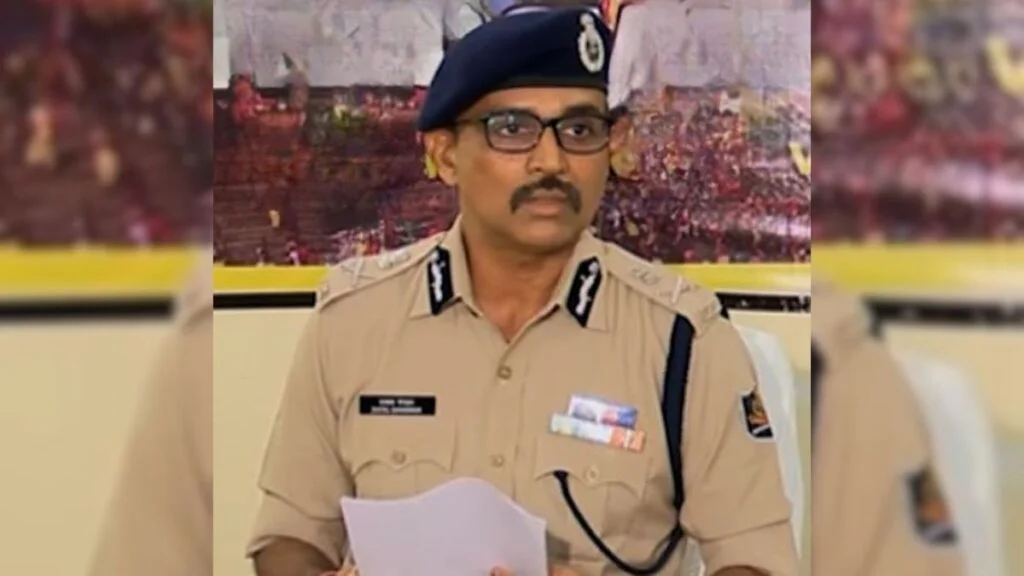

The Odisha government has suspended senior IPS officer Dayal Gangwar following an inquiry into allegations that a Government Railway Police constable serving under him had been deployed for domestic and personal work without authorisation.
The decision was approved by Chief Minister Mohan Charan Majhi, according to officials, after an inquiry examined allegations concerning Soumya Ranjan Swain, a 32-year-old constable who was lynched by a mob in Balianta, near Bhubaneswar, on May 7.
Gangwar has not been accused of involvement in the lynching itself. But Swain’s parents have alleged that their son had earlier been subjected to physical and mental pressure while working under the officer and had been compelled to perform duties unrelated to his official role.
The suspension has therefore drawn attention to two separate but intersecting questions: the circumstances surrounding Swain’s death, and the longstanding practice within parts of the police hierarchy of treating lower-ranking personnel as private staff.
From Senior Police Office to Household Duty
Gangwar, a 1998-batch IPS officer, had held senior positions including Inspector General and Additional Director General of Police. At the time the controversy surfaced, he had served as ADG Railways and later ADG Communication.
The inquiry reportedly found that Gangwar had engaged eight constables of the Railway Police in domestic work at his residence and at a private gym, allegedly without formal approval. Even after being removed from the post, he was accused of continuing to assign personal work to subordinate personnel.
The allegations became public after Swain’s death.
His father, Dushasan Swain, alleged that Gangwar had forced his son to carry out personal tasks that had no connection with his official responsibilities. He further claimed that the officer pressured Swain to invest money in a gym associated with one of Gangwar’s acquaintances and that the money was not returned.
Swain’s mother, Kabita Swain, alleged that her son had been under severe mental stress and that he was required to look after the gym during mornings and evenings. The family said the alleged pressure had affected him deeply.
The officer was transferred to the Home Department as an Officer on Special Duty on May 26, a posting widely seen as punitive. An ADG-rank officer was subsequently asked to investigate the allegations.
Gangwar could not be reached for comment after his suspension.
A Lynching That Opened a Wider Inquiry
Swain’s death initially appeared to be a case of mob violence unrelated to his service conditions.
He was riding pillion on a motorcycle with his friend Om Prakash Rout when the vehicle collided with a scooter near a bridge in the Balianta area. Two women riding the scooter accused Swain of attempting to sexually assault them, after which a crowd of roughly 40 to 50 people allegedly attacked him and Rout.
Rout escaped with minor injuries. Swain was beaten to death.
The attack took place about 16 kilometres from Swain’s home in Maujpur, Cuttack. His family accused the police of failing to intervene effectively during the assault. Four junior police personnel were later suspended, and the Odisha Crime Branch began investigating the killing.
At least 18 people have reportedly been arrested in connection with the lynching, while searches have continued for other accused persons.
The National Human Rights Commission also examined the case and recorded Gangwar’s statement. The family asked that its allegations against the senior officer be considered as part of the wider inquiry into the circumstances surrounding Swain’s death.
There is no allegation that Gangwar ordered, encouraged or participated in the mob attack. The government’s action instead concerns the treatment of Swain before the killing and the alleged misuse of subordinate police personnel.
The Unequal Culture Inside Police Forces
The case has exposed a form of institutional inequality that is often acknowledged informally but rarely reaches the level of disciplinary action against a senior officer.
Police constables occupy the lowest operational rung of the force. They perform long shifts, crowd control, field duty, escort work and routine enforcement. Yet in some departments, lower-ranking personnel are also informally assigned to the homes of senior officers, where they may be expected to cook, clean, drive family members, tend gardens or perform other private tasks.
Such practices blur the line between official hierarchy and private servitude.
A constable may technically remain a government employee, but refusing a senior officer’s personal instruction can carry professional consequences. Transfers, leave approvals, duty rosters and performance assessments are often controlled from above, creating an environment in which apparent consent may be shaped by fear.
The allegations against Gangwar are serious precisely because they involve the conversion of public manpower into private service. If constables were assigned to a private residence or gym without lawful sanction, the issue would extend beyond individual misconduct to misuse of state resources.
The suspension also signals an attempt by the Odisha government to distinguish between permissible official support and unauthorised personal service. Senior officers may receive staff for security, communication or formally approved duties. That entitlement does not extend automatically to unrestricted household labour.
Suspension, Accountability and the Questions Ahead
The inquiry against Gangwar reportedly substantiated allegations that constables had been used for domestic and personal work. The government has now placed him under suspension, but the disciplinary process is not necessarily complete.
A suspension is an interim administrative measure, not a finding of criminal guilt. It removes an officer from active duty while the government considers further action and protects the integrity of the inquiry.
Several questions remain.
It is not yet clear what specific evidence the inquiry relied upon, whether the eight constables gave statements, what records existed concerning their postings or whether any financial transaction linked to the gym was independently verified.
There is also the question of whether responsibility extended beyond one officer. If personnel were regularly assigned to domestic work, others in the chain of command may have known about or facilitated the arrangement.
The case may also prompt scrutiny of how many police personnel in Odisha are deployed outside their sanctioned functions and whether similar practices exist elsewhere in the force.
For Swain’s family, however, the suspension carries a more personal meaning. They have argued that the system in which their son worked allowed a senior officer to treat him as private staff while leaving him vulnerable and under pressure.
The lynching remains a separate criminal investigation. But the disciplinary action against Gangwar has ensured that the circumstances of Swain’s service will not disappear into the background.
The case now stands as a stark reminder of how hierarchy can become exploitation when official power enters the private sphere. A police officer entrusted with enforcing the law is also bound by the rules governing public service. A constable, however junior, remains a state employee — not the personal servant of a superior.
