

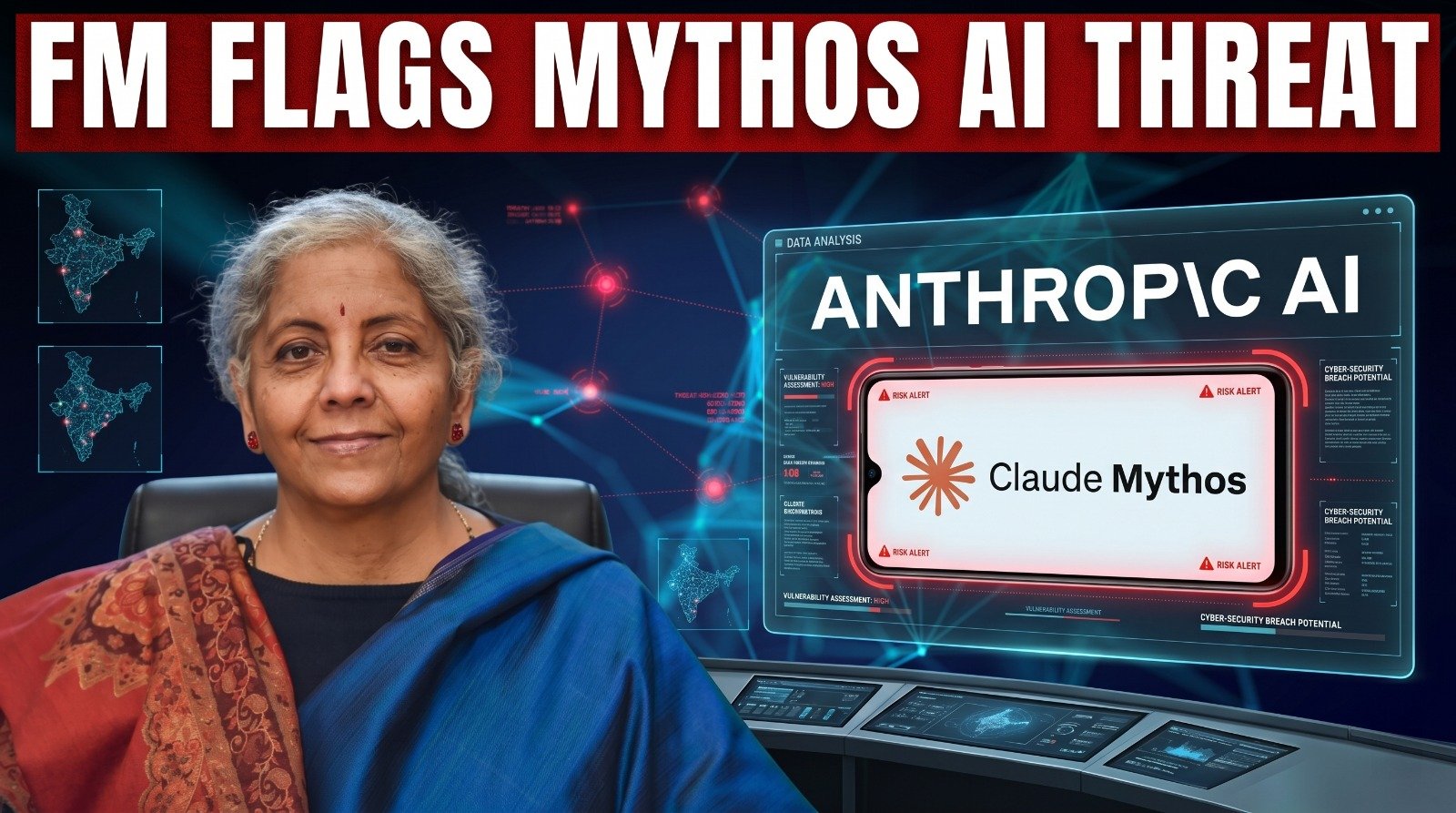

A day after raising concerns over what she described as unprecedented risks linked to Anthropic’s Mythos model, Finance Minister Nirmala Sitharaman said Indian banks were adequately prepared to meet technology-related challenges, while stressing that vigilance around such tools would have to deepen.
Speaking at a press conference, Sitharaman said MeitY was in active engagement with authorities and governments globally to understand the risks associated with Mythos and what those risks could mean for the Indian banking system. She added that India needed to become more versatile in countering newer threats, a remark that suggested the existing framework for digital defence may need to evolve along with the threat landscape itself.
The message was at once reassuring and cautionary. On one hand, the government sought to project confidence in the preparedness of the banking system. On the other, it made clear that a tool like Mythos could not be treated as just another incremental software advance.
FCRF Academy Launches Premier Anti-Money Laundering Certification Program
What Mythos Is, and Why It Has Alarmed Governments
The anxiety surrounding Mythos is not difficult to understand.
Anthropic’s Mythos has drawn worldwide attention because of its reported ability to autonomously identify and exploit vulnerabilities in major operating systems and browsers. That places it in a different category from ordinary productivity-focused AI systems. It is being discussed less as a chatbot and more as a model with direct implications for cybersecurity, infrastructure resilience and financial stability.
Within government discussions in India, Mythos is already being described in dual terms. M. Nagaraju, secretary at the Department of Financial Services, characterized it as both a challenge and an opportunity, saying, “Mythos is a threat and opportunity for the fintech ecosystem.” That phrasing captures the central dilemma now facing regulators worldwide. A sufficiently capable cyber model may strengthen defense, automate detection and improve response. But it may also lower the barrier for sophisticated attacks, accelerate vulnerability discovery and compress the time financial institutions have to react.
That is why banks, regulators and technology ministries are no longer discussing these systems as distant possibilities. They are treating them as live risk objects.
Banks Asked to Tighten Coordination and Threat Sharing
The government’s response has focused on coordination.
Sitharaman held a meeting with banks on issues related to Mythos, with officials from the Department of Financial Services, MeitY and CERT-In participating, signaling an approach that cut across traditional bureaucratic silos. The meeting deliberated on a range of risks AI could pose to the financial sector, and banks were urged to take preemptive measures to secure their systems, customer data and depositors’ money.
The finance ministry later said a robust mechanism for real-time threat intelligence sharing should be established among banks, Indian CERT and other relevant agencies so that emerging threats could be identified early and disseminated across the ecosystem without delay. Banks were also advised to report suspicious activity or cyber incidents immediately to the relevant authorities, including CERT-In, and to maintain close coordination with all agencies concerned.
The role of the Indian Banks’ Association is expected to become central in that effort, with the sector body set to lead consultations among lenders. In effect, the ministry appears to be trying to move the banking system away from isolated institutional responses and toward a more networked defensive posture.
That shift matters because AI-linked cyber threats do not move at the pace of ordinary regulatory reporting. They move at machine speed, often across institutions at once.
A Banking Warning in the Shadow of the Next AI Race
India’s heightened scrutiny of Mythos also comes at a moment when the competitive frontier in artificial intelligence appears to be moving toward similarly powerful systems elsewhere.
The concern is not confined to one company or one model. If Anthropic has reached a point where a cyber-capable AI system can force finance ministries and banking regulators into urgent consultations, then the likelihood of rival firms pursuing similar capabilities only sharpens the urgency. In that sense, the policy challenge extends beyond Mythos itself. It points to a future in which multiple frontier labs may produce models with offensive and defensive cyber relevance, requiring financial systems to prepare not for one exceptional tool, but for a class of them.
That broader context helps explain the tone of Sitharaman’s intervention. Her remarks were not those of a minister reacting to a passing technology headline. They suggested an early recognition that banking risk is being redefined by AI systems whose capabilities may cut across fraud detection, cyber defense, vulnerability exploitation and infrastructure disruption.
Regulators in Asia, Europe and the United States have already warned banks to review their defenses. India is now clearly doing the same, while insisting that preparedness and adaptation must proceed together.
For the financial system, that may be the real significance of the moment. The question is no longer whether artificial intelligence will alter the threat environment for banks. It is whether regulatory institutions can adjust quickly enough before those threats become ordinary.
