
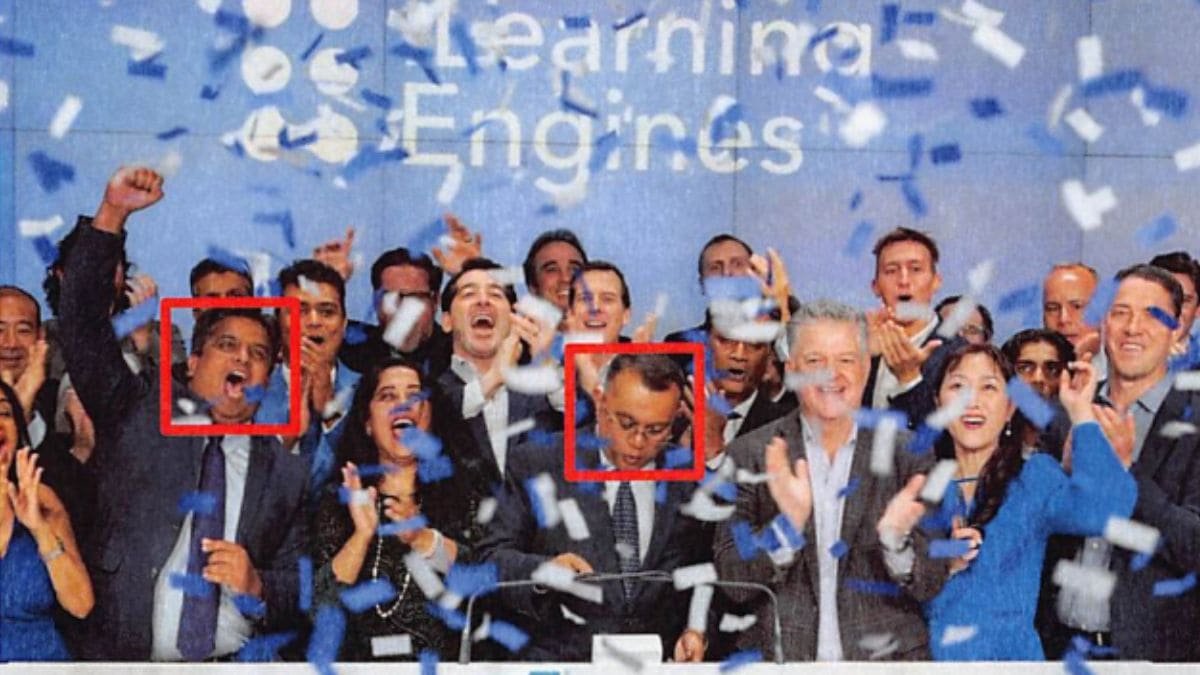

Two Indian-origin former technology executives have been charged in the United States with multiple offences, including running a continuing financial crimes enterprise, securities fraud, wire fraud and related conspiracy counts, in a case centred on allegations that they inflated revenue at the now-bankrupt iLearningEngines through sham contracts and false statements to investors and lenders.
The two men were identified as Puthugramam “Harish” Chidambaran and Sayyed Farhan Ali “Farhan” Naqvi, who previously served as chief executive officer and chief financial officer of iLearningEngines Inc, respectively. A ten-count indictment was unsealed in federal court in Brooklyn on Friday, US time. The US Justice Department said Chidambaran was arrested in Potomac, Maryland, on April 17, while Naqvi was taken into custody the same day in San Jose, California.
Grand Jury Case Centres on Alleged False Revenue Scheme
US authorities allege the two men participated in a multi-year scheme to defraud retail and institutional investors and obtain financing through false and misleading claims about the company’s financial performance. Prosecutors said the defendants sought to capitalise on investor excitement around artificial intelligence by presenting iLearningEngines as a company capable of transforming training and education through AI.
The case alleges that the company’s customers and revenues were falsely represented. iLearningEngines, founded in 2010 and based in Bethesda, Maryland, described itself as an AI platform designed to help customers productise institutional knowledge and generate insights in the flow of work. Authorities said the company claimed its primary revenue came from software licence sales and reported strong revenue growth, including $421 million in 2023.
FCRF Returns With CDPO, Its Premier Data Protection Certification for Privacy Professionals
After becoming publicly traded in April 2024, the company reportedly obtained $40 million in loan proceeds from one New York City branch of a financial institution and another $20 million from a different branch. Its common stock, traded on Nasdaq under the symbol “AILE”, later reached a market capitalisation of about $1.5 billion in June 2024.
Purported Customers, Shell Entities and Insider Gains Under Scrutiny
The indictment alleges that nearly all of the company’s customer relationships and revenues had been falsely represented to investors and lenders. It further claims that employees, or people acting on their behalf, posed as senior executives of purported customers and signed questionable agreements to create the appearance of legitimate business activity.
Authorities also allege that the scheme involved building a website for a shell entity to help deceive investors and lenders into believing the company’s customers were real. The case names at least five additional co-conspirators, though they are not identified in the document by name. They are described as including an assistant vice president of iLearningEngines who also presented himself as the chief executive of a purported customer, a company vice president who posed as the chief executive of multiple purported customers, another person holding himself out as the chief executive of yet another purported customer, an employee who was also a relative of another senior employee and played the role of an executive of several purported customers, and another senior executive.
The indictment also details the personal financial benefit allegedly obtained by the two defendants. Chidambaran is said to have received more than $500 million worth of iLearning common stock and later around $12.5 million in restricted common stock. Naqvi allegedly secured iLearning common stock worth about $11.2 million, while the company also paid nearly $4.5 million in cash to cover his tax liabilities.
Collapse Followed Short Seller Report and Bankruptcy Filing
The alleged fraud began to unravel after an investment research firm issued a report in August 2024 stating that iLearning had misrepresented its revenue. The company’s stock price then collapsed, wiping out a substantial portion of its market value.
US authorities said both men repeatedly lied to investors and lenders when confronted about the report and continued to deny that iLearning’s largest purported customer was actually an entity they controlled. By December 2024, the company filed for Chapter 11 bankruptcy protection in Delaware. In March 2025, that petition was converted into a Chapter 7 liquidation.
The collapse left behind hundreds of reported unpaid creditors and more than $50 million in unpaid liabilities, the indictment states. The case now places renewed focus on how AI-linked business claims were used in the market, and on the alleged use of fabricated customers, false contracts and inflated revenues to sustain a public company before its downfall.
