

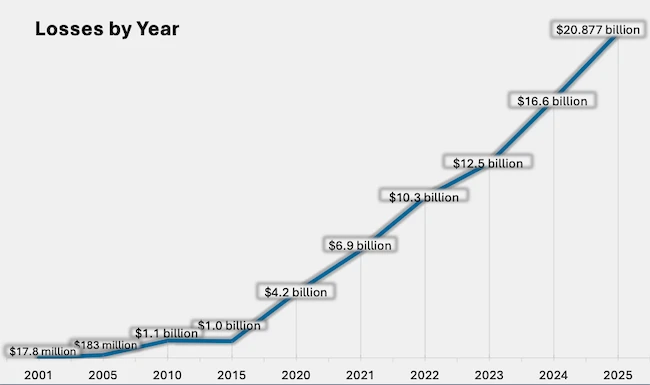

Cybercrime losses reached a record $20.87 billion in 2025, with artificial intelligence increasingly shaping both the scale and sophistication of online fraud, according to findings referenced from the FBI’s Internet Crime Complaint Center report.
AI Expands Role in Cyber-Enabled Fraud
The report marked the first time a dedicated section on artificial intelligence was included, reflecting its growing use in cybercrime. AI has been described as a profitable tool for criminal networks, with financial fraud schemes aided by AI reported to be significantly more lucrative than those carried out without automated assistance.
According to the IC3, 22,364 complaints last year involved AI, accounting for more than $893 million in reported losses. However, authorities indicated that the actual number could be higher, as AI involvement is often not recognised by victims and depends on how complaints are described.
Officials noted that cyber-enabled fraud, defined as crimes using the internet or technology to execute traditional scams, accounted for 45 percent of complaints but 85 percent of total financial losses in 2025.
FCRF Launches Premier CISO Certification Amid Rising Demand for Cybersecurity Leadership
Surge in Complaints and Dominance of Investment Scams
The total number of cybercrime complaints exceeded one million for the first time, rising 17 percent compared to the previous year. Among reported offences, phishing generated the highest number of complaints, followed by extortion and investment scams.
In terms of financial impact, investment scams caused the largest losses, amounting to $8.6 billion. Business email compromise and tech support scams were also among the leading contributors to monetary losses.
While traditional cyber threats such as data breaches and ransomware remained significant, accounting for 75 percent of reported incidents in that category, much of cybercrime activity continued to revolve around digitally enabled fraud rather than purely technical attacks.
AI-Driven Impersonation and Emerging Threat Patterns
The report highlighted several forms of AI-assisted crime, including business email compromise, romance and confidence scams, employment fraud, and investment schemes. These operations frequently relied on fabricated social profiles, cloned voices, falsified identification documents, and realistic video content to deceive victims.
Government impersonation scams showed a sharp rise, increasing from 14,190 reports in 2023 to 32,424 in 2025, representing a 128 percent increase over three years. Despite this growth, such scams received limited attention in AI-related reporting.
Authorities also warned that AI-generated voice and text messages have been used to impersonate senior officials, targeting individuals to gain access to personal accounts. The FBI cautioned that messages appearing to originate from government figures should not be assumed to be authentic.
Officials emphasised the need for vigilance in cybersecurity practices and online interactions, noting that cyber threats will continue to evolve as emerging technologies become more widely adopted.
Follow for daily updates on cybercrime, corporate fraud, DFIR, hacking, investigations, and digital forensics
