
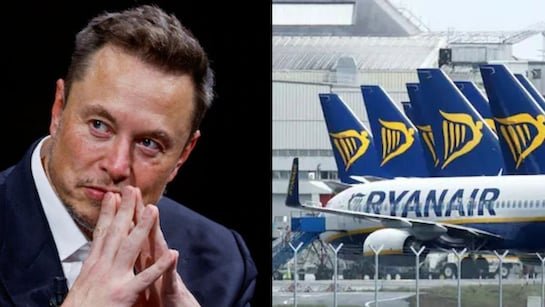
A public spat between billionaire entrepreneur Elon Musk and Europe’s largest budget airline Ryanair has taken a fresh turn, with Musk hinting that he could consider buying the low-cost carrier. The claim, however, appears largely symbolic, as regulatory and legal barriers make any such takeover highly unlikely.
The dispute began after Ryanair declined to install Musk-owned Starlink satellite internet services on its aircraft. The airline cited cost concerns, arguing that the technology would not be commercially viable on its short-haul routes, where passengers are unlikely to pay extra for inflight connectivity.
What started as a disagreement over onboard technology has since evolved into a high-profile social media confrontation, drawing global attention and triggering debate over whether Musk’s comments reflect genuine acquisition interest or are part of a broader publicity battle.
Certified Cyber Crime Investigator Course Launched by Centre for Police Technology
Starlink rejection sparks escalation
In a radio interview earlier this month, Ryanair’s leadership said adopting Starlink would significantly increase operational costs. According to the airline, installing satellite equipment would add weight to aircraft, increase fuel consumption, and require substantial annual expenditure, all of which would ultimately be passed on to passengers.
The comments prompted a sharp reaction from Musk on social media, where he criticised the airline’s stance and questioned its unwillingness to adopt newer technologies. Musk later posted a poll on his platform asking users whether he should buy Ryanair, with a large proportion of respondents voting in favour — further fuelling online speculation.
While the poll carried no formal significance, it added momentum to the narrative and kept the dispute firmly in the public spotlight.
Ryanair hits back with ‘Big Idiot Seat Sale’
Ryanair, known for its confrontational marketing style, responded by launching a promotional campaign dubbed the ‘Big Idiot Seat Sale’. The campaign offered heavily discounted tickets for a limited period and was aggressively promoted across social media platforms.
Industry observers said the airline effectively turned the controversy into a marketing opportunity, leveraging the attention generated by the feud. Posts related to the campaign attracted millions of views, amplifying Ryanair’s brand visibility at minimal cost.
Company sources said the promotion was part of a long-standing strategy to capitalise on viral moments rather than a direct response to takeover talk. Ryanair’s stock showed no adverse reaction to the controversy, reinforcing the perception that investors view the episode as noise rather than a serious corporate threat.
Can Musk realistically buy Ryanair?
A Ryanair acquisition by Musk remains highly improbable, analysts say. The airline is publicly listed in Europe with a market capitalisation running into several billion euros, making any takeover financially and structurally complex.
More significantly, European Union regulations require EU-based airlines to be majority-owned and effectively controlled by EU nationals or approved European entities. As a non-European citizen, Musk would be barred from acquiring a controlling stake in Ryanair.
While the rules do not prohibit non-EU investors from holding minority stakes, they effectively block any scenario in which Musk could exercise operational control over the airline. Ryanair has indicated that it remains open to investment from global shareholders, provided ownership thresholds and governance requirements are respected.
PR spectacle or genuine business interest?
Aviation and business analysts largely view the episode as a clash of public personas rather than the prelude to a serious transaction. For Ryanair, the controversy has generated widespread attention and reinforced its reputation for unconventional marketing. For Musk, it has once again placed him at the centre of a global media cycle.
Neither side has shown signs of de-escalation, but there is little evidence to suggest that discussions have moved beyond online exchanges. Any formal takeover attempt would face regulatory scrutiny across multiple jurisdictions and is widely seen as unlikely.
For now, the standoff appears to remain a battle for visibility rather than a credible corporate move. Whether it fades as quickly as it emerged or evolves into a new commercial dynamic remains to be seen, but the legal and regulatory realities suggest the talk of a Ryanair buyout will remain largely theoretical.
About the author – Ayesha Aayat is a law student and contributor covering cybercrime, online frauds, and digital safety concerns. Her writing aims to raise awareness about evolving cyber threats and legal responses.
