

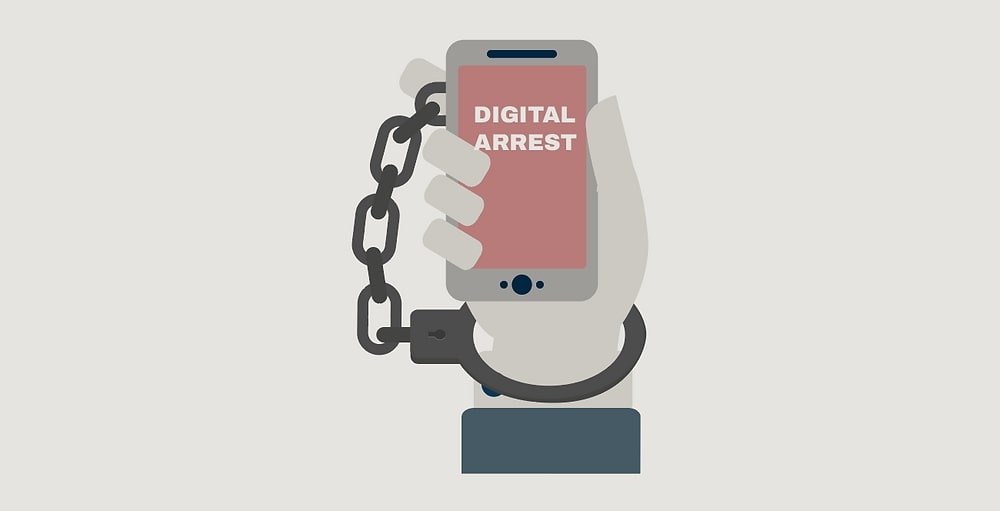
A disturbing cyber fraud case reported from Mumbai has exposed how criminals are increasingly weaponising fear rather than technology alone to execute large-scale financial crimes. An 80-year-old man was duped into transferring ₹4.38 crore from his bank accounts after being psychologically trapped in what fraudsters described as a “digital arrest”. The case took a dramatic turn when ₹1.02 crore was later credited to his account, revealing that the victim had unknowingly been used as a money-laundering intermediary.
The victim is a retired academic who spent his professional life in senior positions at a technical institution. The fraud began on November 18, 2025, with a phone call from an unknown individual claiming to be associated with a cyber data protection body. The caller alleged that the victim’s Aadhaar credentials had been misused to obtain a mobile number linked to financial crimes and that a police complaint had already been filed.
What followed was a sustained and coordinated intimidation campaign. The victim began receiving repeated calls from different numbers, with callers alternately posing as police officials, crime branch personnel and representatives of central agencies. Each call reinforced the same narrative — that the victim’s identity had been used in money laundering and terror-funding activities, and that an arrest warrant had been issued against him.
Certified Cyber Crime Investigator Course Launched by Centre for Police Technology
To deepen the deception, the fraudsters sent a series of forged documents on WhatsApp, including fake FIRs, counterfeit RBI communications, fabricated enforcement notices and forged Supreme Court orders. Drafted in official language and bearing convincing formats, these documents created an overwhelming sense of legal peril and urgency.
The victim was then placed on video calls described as “official verification sessions”. During these calls, he was informed that he was under “digital arrest” and instructed not to disclose the matter to family members or associates, citing national security concerns. He was repeatedly assured that full cooperation would establish his innocence and prevent physical arrest.
Under this intense psychological pressure, the victim began transferring money as instructed. Between November 26, 2025 and January 9, 2026, he moved funds across multiple bank accounts, believing the transactions were part of a formal verification process. In total, ₹4.38 crore was siphoned off from his accounts.
The case appeared to be a straightforward instance of cyber fraud until an unexpected development raised serious alarm. Some time later, ₹1.02 crore was deposited into the victim’s account. While this initially seemed like a partial recovery, investigators soon established that the money did not belong to the victim. Instead, it had been sourced from other cyber fraud victims, making his account a transit point for illicit funds.
This discovery confirmed that the operation went far beyond individual cheating. The victim’s bank account had been deliberately used as a layering mechanism in a wider cyber money-laundering network, with stolen funds routed through multiple accounts to obscure their origin.
Experts note that the term “digital arrest” has no legal standing whatsoever, yet cybercriminals deliberately employ such terminology because it triggers immediate fear, particularly among elderly individuals. The use of forged judicial and regulatory documents, combined with video calls simulating official proceedings, creates an illusion of legitimacy that can overpower rational judgement.
The case highlights a critical shift in cybercrime tactics. Fraud is no longer limited to hacking or phishing alone; it has evolved into a form of psychological warfare, where victims are coerced into transferring their own money while believing they are complying with the law.
Investigators are now examining transaction trails, linked bank accounts and digital communication records to identify others involved in the laundering chain. More accounts are suspected to have been misused in a similar manner.
This case stands as a stark warning that cybercrime today does not merely steal money — it can turn unsuspecting citizens into unwitting instruments of organised financial crime, without them realising it until it is too late.
About the author – Rehan Khan is a law student and legal journalist with a keen interest in cybercrime, digital fraud, and emerging technology laws. He writes on the intersection of law, cybersecurity, and online safety, focusing on developments that impact individuals and institutions in India.
Follow for daily updates on cybercrime, corporate fraud, DFIR, hacking, investigations, and digital forensics
