

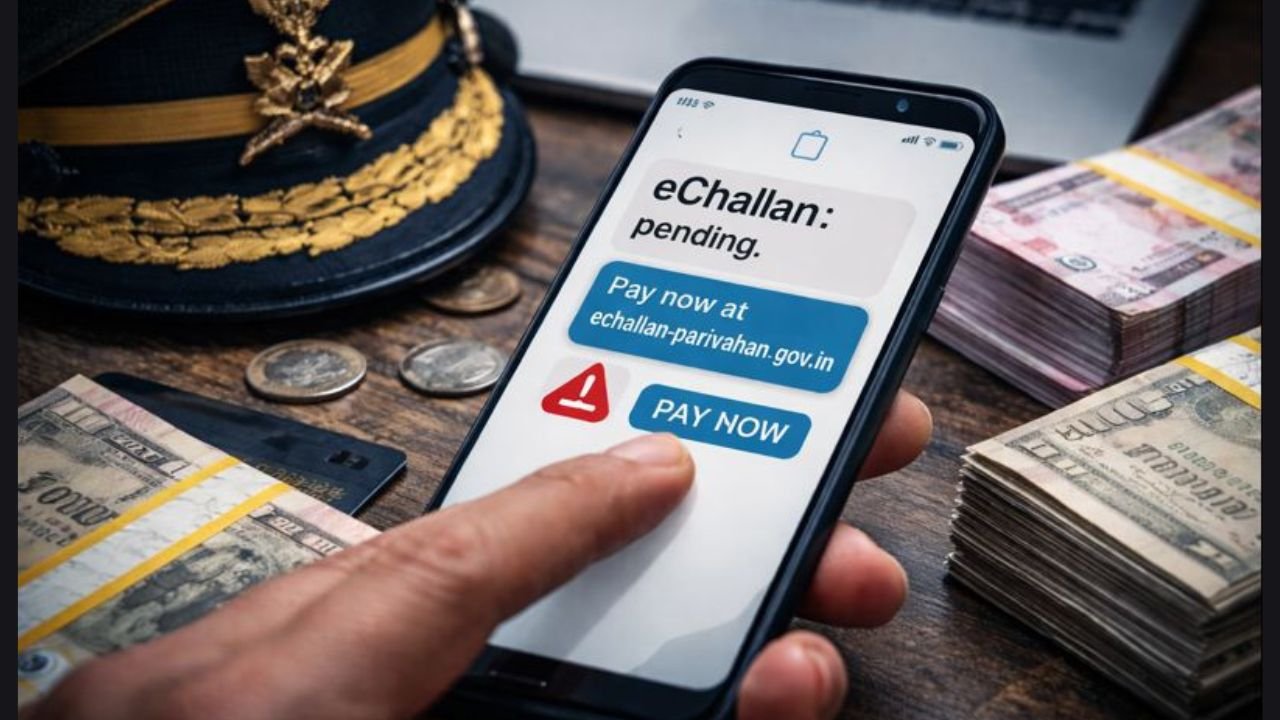

Pune | In a disturbing instance of cybercrime growing increasingly sophisticated, a senior Indian Army colonel posted in Pune has fallen victim to a fake traffic challan scam, losing ₹3.81 lakh. The incident underlines how digital fraud now cuts across rank, profession and experience, exploiting trust and routine behaviour.
According to police, the officer received an SMS claiming that his vehicle had an outstanding traffic challan of ₹590. The message contained a payment link that closely resembled an official government portal, giving it an appearance of authenticity.
From ₹590 to ₹3.81 lakh
Investigators said the message was received late at night and appeared routine. The following day, the officer clicked on the embedded link, which redirected him to a webpage designed to look like a legitimate e-challan payment gateway.
The website displayed a payable amount of ₹590, raising no immediate suspicion. Believing it to be a standard traffic fine, the colonel proceeded to enter his credit card details and the One-Time Password (OTP). Within moments, however, his card was charged 32,939 Hong Kong dollars, equivalent to approximately ₹3.81 lakh.
Police said the amount was transferred to a hotel account in Hong Kong, clearly establishing the case as one involving cross-border cyber fraud.
Police action and international challenges
Realising that he had been defrauded, the officer immediately approached the Pune Police. An FIR has been registered at the Chatushrungi police station, and a detailed investigation is underway.
Officers involved in the probe said that in such cases, money is transferred abroad almost instantly, making recovery difficult. The international nature of the transaction adds another layer of complexity, requiring coordination with multiple agencies and foreign financial institutions.
Police noted that the modus operandi closely resembles recent scams involving fake electricity bills, gas bills and bank alerts, where a small payable amount is used to gain the victim’s confidence before siphoning off a much larger sum.
How the cyber trap works
Cybercrime experts classify this method as “smishing” (SMS phishing). Fraudsters send carefully crafted messages that trigger urgency, fear or a sense of civic duty—such as traffic violations, tax dues or account suspension warnings.
These scams often use punycode or look-alike URLs, which are visually similar to official domains like parivahan.gov.in, making them difficult to detect at first glance. In some cases, such fake websites even appear on search engines, further reinforcing their credibility.
Police have reiterated that traffic police do not send payment links via personal mobile numbers, nor do they ask citizens to pay challans through SMS or WhatsApp messages.
A cautionary tale for citizens
The case has emerged as a stark reminder that digital vigilance is essential for everyone, regardless of professional background. That a senior Army officer could be deceived highlights how cybercriminals are increasingly relying on psychological manipulation rather than technical complexity alone.
Experts warn that clicking on unsolicited “Pay Now” links without verification can result in significant financial loss within seconds.
How to stay safe
Police and cyber experts have advised citizens to follow these basic precautions:
- Check the domain: Official government websites in India always end with .gov.in.
- Avoid clicking on links: Instead of using links sent via SMS or WhatsApp, manually visit echallan.parivahan.gov.in to verify any pending challan.
- Never share OTPs: Government agencies do not ask for OTPs or card details.
- Report immediately: In case of suspected fraud, call 1930 or file a complaint at cybercrime.gov.in without delay.
A strong warning
The incident once again demonstrates that cybercrime is evolving rapidly and that caution remains the strongest line of defence. What appears to be a routine message can quickly turn into a financial disaster. In today’s digital environment, constant alertness is no longer optional—it is essential for safeguarding personal and financial security.
