

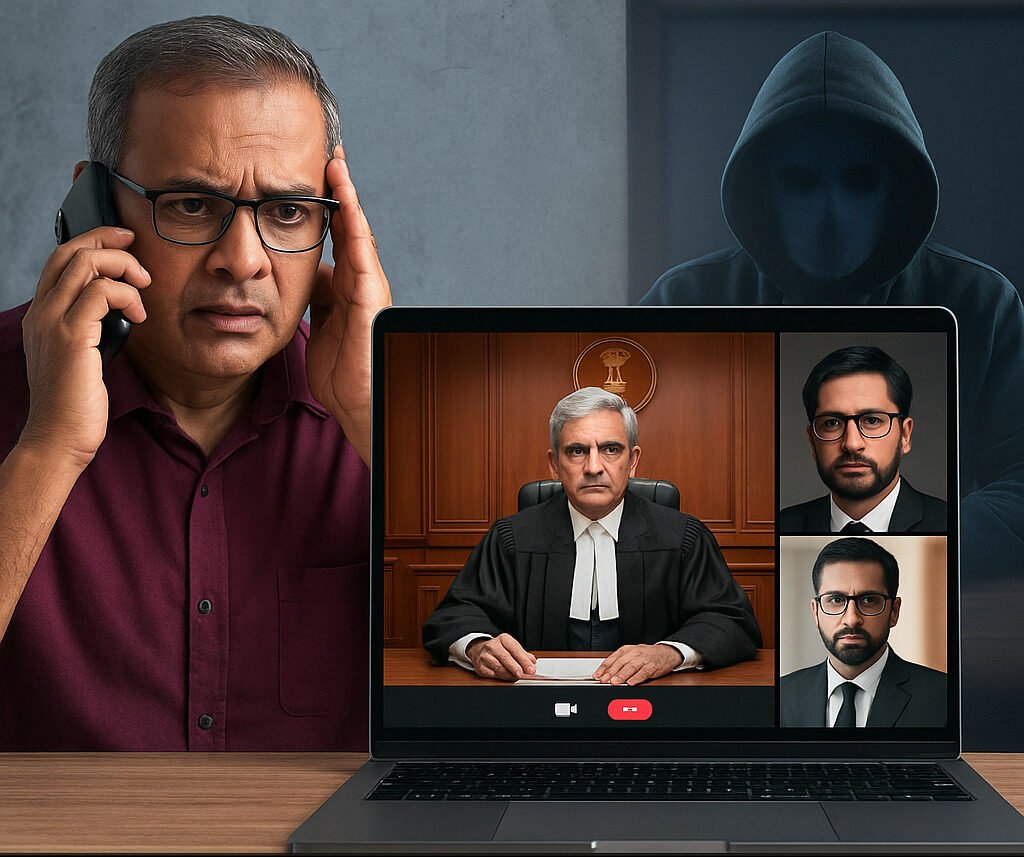

Bhopal/Prayagraj: In one of the most sophisticated digital fraud cases detected recently, cybercriminals duped a Bhopal-based engineer of ₹36 lakh by orchestrating a meticulously crafted scam involving a fake Supreme Court hearing, digital arrest, and threats of Enforcement Directorate (ED) investigation. The gang not only staged a fictitious virtual courtroom but even introduced a “lawyer” to represent the victim—who later turned out to be another member of the cyber syndicate.
Call Posed as NIA Officer; Victim Placed Under ‘Digital Arrest’
The incident took place in Bhopal’s TT Nagar area. The victim received a call from a person claiming to be an officer of the National Investigation Agency (NIA). He was told that his mobile number had surfaced in a major cybercrime case and that he could be arrested if he did not cooperate.
Using intimidation as the primary tool, the fraudsters informed him that he would be placed under “digital arrest” for the duration of the investigation. This meant he could not disconnect the call, leave his house or speak to anyone else. The victim was kept on continuous video call—a tactic designed to psychologically weaken him and prevent him from seeking help.
Fake Link, Fake Court, Fake Judge — Entire Set-up Crafted by the Gang
After several hours, the victim received a link for what was described as an emergency Supreme Court hearing. On joining the video link, he found himself in what appeared to be a virtual courtroom. A man dressed like a judge presided over the session, and the background displayed visuals mimicking the Supreme Court’s online hearing interface.
During the so-called proceedings, another individual joined the call claiming to be the victim’s “defense lawyer”. Speaking with confidence, he declared that the case was extremely serious and could immediately attract an ED probe if the victim failed to cooperate.
The fake lawyer then advised that to secure bail, avoid ED interrogation and complete mandatory legal formalities, the victim must urgently deposit funds—which he described as part of court-ordered procedures.
Intimidation, Pressure and Manipulation — Victim Transfers ₹36 Lakh
Under severe psychological pressure, persistent threats and the illusion of real judicial proceedings, the victim transferred ₹36 lakh in multiple installments to bank accounts provided by the fraudsters. Throughout this time, he was strictly instructed not to speak to his family or disconnect the call.
Once the money was received, the fraudsters gradually stopped responding. After days of silence, the victim became suspicious and finally approached the cyber crime cell. A detailed investigation confirmed that he had fallen prey to an elaborate digital-arrest scam.
Interstate Cyber Gang Suspected; Multi-State Operation Uncovered
Preliminary investigation suggests the involvement of an interstate cyber fraud syndicate. Police sources indicate that similar scams have been reported in Madhya Pradesh, Uttar Pradesh, Maharashtra and Rajasthan in recent months, all following the same digital-arrest pattern.
Cyber cell teams are analysing transaction trails, e-wallet details, call records and IP addresses. Several bank accounts linked to the case have been identified, and many mobile numbers used in the operation were found to be activated using forged documents, some traced to northeastern states.
Experts Warn of Rapidly Evolving Digital Fraud Patterns
Cybersecurity experts say this emerging “digital arrest” model is particularly dangerous because it relies on psychological manipulation rather than technical hacking. Fraudsters exploit the credibility of government agencies, courts and investigative bodies to create fear and urgency.
Police have reiterated that no government agency conducts digital arrests, online court hearings for criminal cases, or demands immediate money transfers. Citizens have been advised to report such calls immediately to cyber helplines.
