

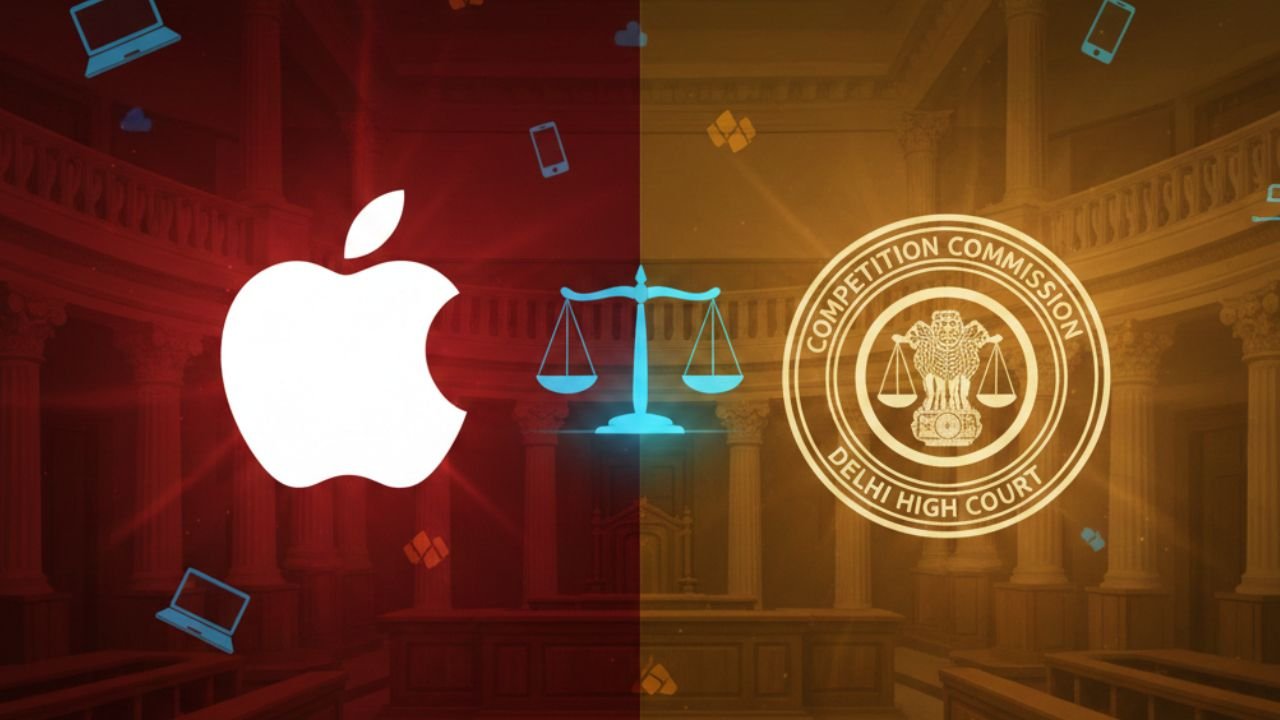

New Delhi | In a significant escalation of its ongoing tussle with India’s competition regulator, technology giant Apple has moved the Delhi High Court challenging the Competition Commission of India (CCI) and its power to impose penalties on the basis of a company’s global turnover, rather than revenues generated in India alone.
The petition was listed before Chief Justice Devendra Kumar Upadhyaya and Justice Tushar Rao Gedela earlier this week but could not be taken up for hearing. The matter is now expected to be heard on December 3, with the Union Government and the CCI named as respondents.
Why has Apple approached the court?
Under India’s updated competition law framework, companies found guilty of:
- abusing market dominance, or
- engaging in anti-competitive conduct
may face up to 10% penalty calculated on their average turnover for the past three financial years.
Recent amendments and the 2024 Penalty Guidelines have clarified that turnover includes global revenue, not merely Indian earnings.
Apple argues that this interpretation is excessive, disproportionate, and could lead to staggering fines — reportedly as high as USD 38 billion (approx. ₹3.17 lakh crore) for the Cupertino-based firm.
The company has also objected to a March 2025 CCI direction asking it to furnish audited global financial details for FY22, FY23 and FY24.
Provision mirrors European Union rules — and Big Tech is alarmed
Legal analysts note that India is increasingly aligning its competition regime with that of the European Union, where:
- penalties can go up to 10% of worldwide turnover
- the duration and gravity of violations determine quantum
- fines are linked to the product or market affected
The EU has already imposed major penalties on leading platforms:
| Company | Fine | Nature of Violation |
|---|---|---|
| Google (Alphabet) | $3.45 billion | Anti-competitive practices in ad tech |
| Apple | $587 million | Digital market rule violations |
With India being one of the fastest-growing digital economies, experts say regulators want Big Tech to follow fair competition rules, not dominate markets unfairly.
Apple invokes Supreme Court precedent
In its plea, Apple has cited the Supreme Court’s Excel Crop Care ruling, which held:
Turnover must relate to the revenue generated from the product or service forming the subject of the alleged infringement — not the company’s entire turnover.
Apple contends that the CCI’s position:
- violates established judicial principles
- seeks to “expand punitive powers without legislative backing”
- creates a punishment far beyond the alleged harm
Scrutiny of Apple’s App Store model continues
The filing comes even as the CCI continues to investigate allegations that Apple:
- forces developers to use its in-app payment system
- imposes hefty commissions
- restricts competing digital payment services
The regulator believes this could amount to abuse of dominant position in India’s rapidly growing app ecosystem.
Similar investigations are underway globally, with Apple facing lawsuits and fines in the US, EU, and several Asian markets.
Why the case matters for India’s digital economy
The outcome will shape:
- future penalty standards for tech platforms
- how India deals with market power in digital ecosystems
- whether global revenue remains a determinant in competition penalties
It could also influence upcoming cases involving:
- Google (app ecosystem, Android compatibility)
- Meta (data practices, ad dominance)
- Amazon (marketplace self-preferencing)
According to competition law experts:
“If the court sides with Apple, CCI may need to recalibrate its enforcement approach.
If it doesn’t, Big Tech will face heavier compliance risk in India.”
Conclusion
Apple vs. CCI has become more than a single-company dispute. It represents a broader clash over how much power regulators should wield in the globalized digital market.
The Delhi High Court’s eventual ruling will signal whether India intends to:
- persist with global turnover-based penalties, keeping Big Tech firmly regulated,
or - adopt a more business-friendly interpretation of competition law.
For now, the world’s largest technology firms are watching closely — as the verdict could redefine their cost of non-compliance in one of their most crucial markets.
