

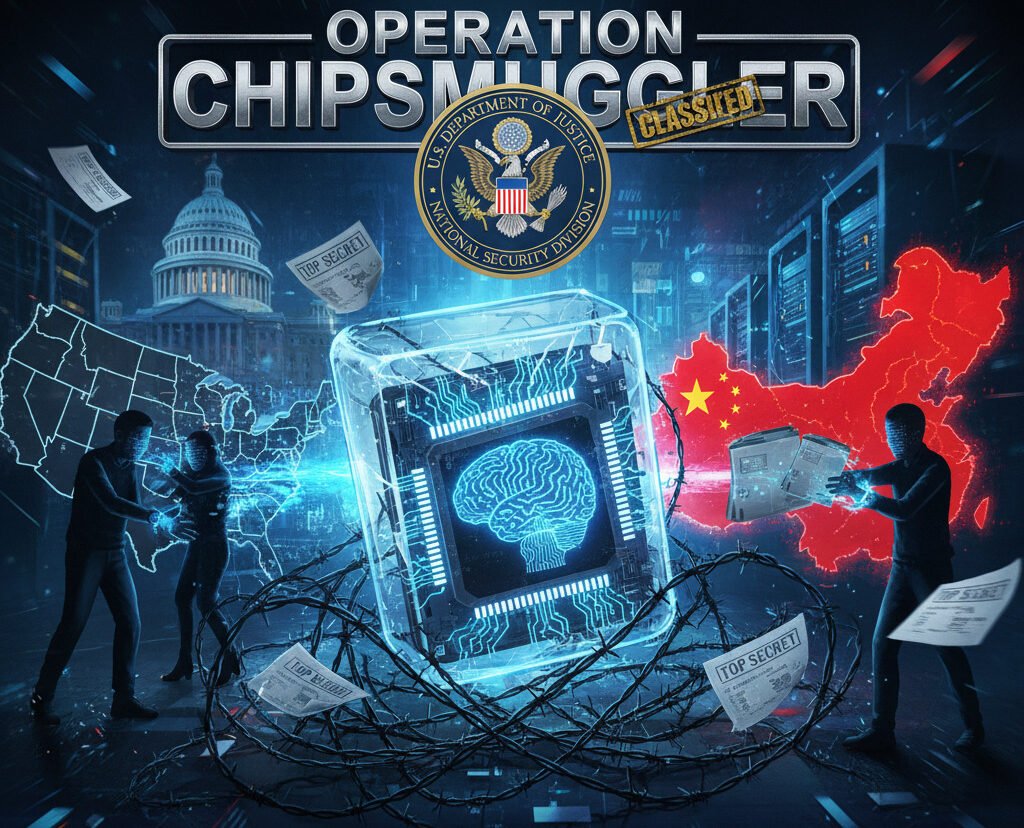

Four Accused in High-End AI Chip Smuggling Plot Face Serious National Security Charges.
Washington, D.C. – The United States has arrested four individuals, including two American citizens and two Chinese nationals, in connection with a plot to export high-performance Nvidia graphics processing units (GPUs) to China without U.S. government approval. The move reflects Washington’s heightened focus on safeguarding advanced technology and national security.
John Eisenberg, Assistant Attorney General, National Security Division, said in a press release that the accused “engaged in a deliberate scheme involving falsified documents, fake contracts, and efforts to mislead U.S. authorities to send Nvidia GPUs to China.”
Algoritha: The Most Trusted Name in BFSI Investigations and DFIR Services
The arrested individuals include:
- Hong Ning Ho (Matthew Ho), 34, U.S. citizen, born in Hong Kong, residing in Tampa, Florida.
- Brian Curtis Raymond, 46, U.S. citizen, Huntsville, Alabama.
- Cham Li (Tony Li), 38, PRC national, San Leandro, California.
- Jing Chen (Harry Chen), 45, PRC national, on F-1 student visa, Tampa, Florida.
Ho and Chen were arrested in Florida on November 19, 2025, and presented in the Middle District Court. Raymond was apprehended in Alabama and appeared before the Northern District Court. All four face charges of violating U.S. export control laws and conspiring to ship high-performance H200 GPUs to China. Authorities have also sought seizure of 50 H200 GPUs allegedly intended for illegal export.
Raymond previously served as CTO of Virginia-based AI cloud computing firm Corvex. The company clarified that Raymond was a consultant, not a formal employee, and stated, “We had no involvement in this plot.”
Court documents indicate that between September 2023 and November 2025, the accused planned to route GPUs to China via Malaysia and Thailand. They used Janford Realtor, LLC, a Tampa-based company controlled by Ho and Li, as a front. While nominally a real estate business, the company conducted no actual real estate operations.
The plot involved four separate shipments. The first and second shipments, between October 2024 and January 2025, were linked to 400 Nvidia A100 GPUs bound for China. The third and fourth shipments were intercepted by law enforcement. These shipments included 10 Hewlett Packard Enterprise supercomputers equipped with H100 and 50 H200 GPUs. The accused deliberately avoided obtaining export licenses and misrepresented the destination. They received $3.89 million via wire transfer from China in connection with the scheme.
U.S. Attorney Gregory Kehoe said, “From a national security perspective, this case demonstrates that those involved in illegal exports of sensitive technology will face rigorous prosecution.”
Since October 2022, the U.S. has imposed new licensing rules restricting the export of high-performance Nvidia GPUs to China. China aims to achieve global AI leadership by 2030 and integrate the technology into military modernization, weapons development, and advanced surveillance systems.
The arrests are part of broader U.S. efforts to curb the black-market trade of sensitive technology and hold violators accountable. Experts note that the case sends a clear signal that the U.S. will strictly enforce national security measures and export controls in the technology sector.
