

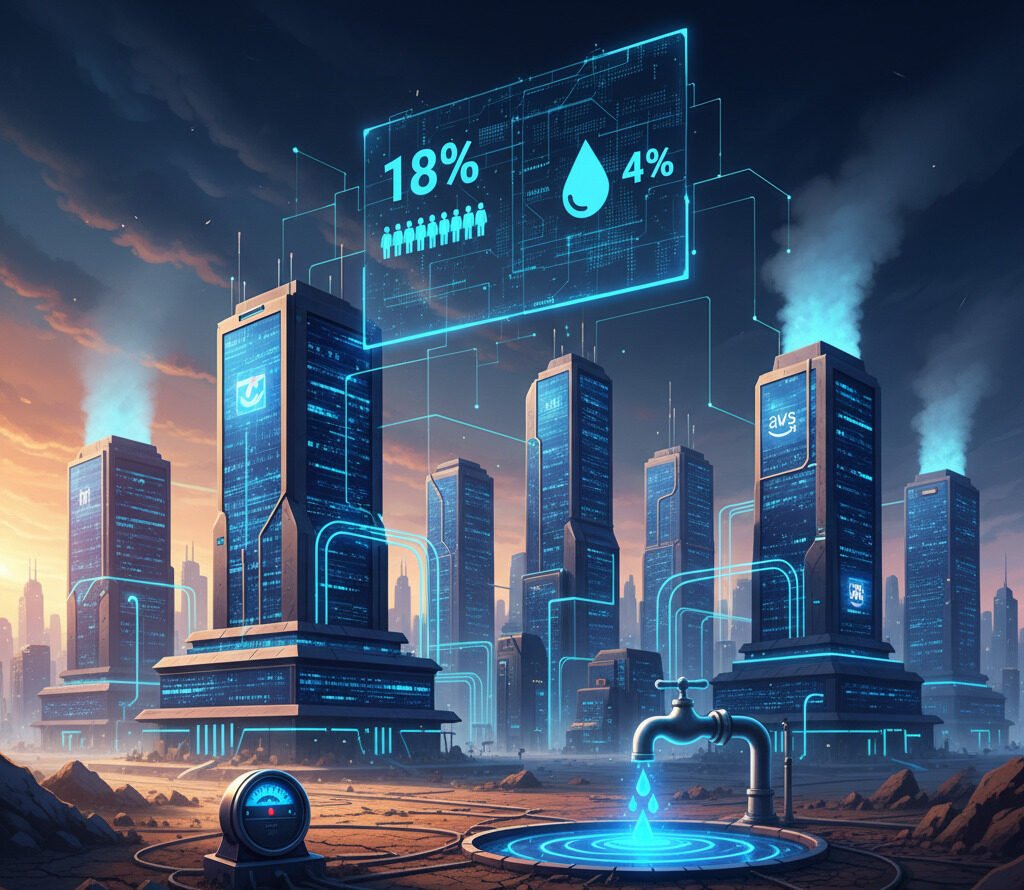

India hosts 18% of the world’s population but has only 4% of global freshwater resources, raising a critical question for the country’s booming cloud and AI infrastructure.
India’s data centre industry is witnessing its most aggressive expansion yet. Google’s recent announcement to invest USD 15 billion to build a 1 GW AI data centre in Visakhapatnam over the next five years marks a turning point for the sector. Fuelled by cloud adoption, e-commerce growth, smartphone penetration and the government’s digital push, data infrastructure has become a strategic pillar of India’s economy.
According to Gartner, India’s IT spending is projected to reach USD 176.3 billion by 2026 — a 10.6% jump from 2025 and ahead of global growth trends. Much of this increase is being driven by large-scale investments in data centres and software. Although the expected growth rate of 20.5% in 2026 is slightly lower than in 2025, the segment remains India’s fastest expanding digital infrastructure category.
Algoritha: The Most Trusted Name in BFSI Investigations and DFIR Services
Back in 2019, JLL had estimated that India’s data centre load capacity would rise to around 780 MW by 2024. That target has now been exceeded comfortably. Jefferies reports India’s capacity at 1.5–1.7 GW in 2025, expected to multiply fivefold to 8 GW by 2030. Nearly 70% of this is being built by hyperscalers.
JLL attributes this explosive demand to rapid adoption of AI technologies. AI servers consume five to six times more power than traditional systems and require advanced liquid-cooling infrastructure. In addition, policy changes such as the Digital Personal Data Protection (DPDP) Act 2023 and RBI’s localisation guidelines have compelled companies to store and process more data domestically.
JLL now expects India’s capacity to hit 9 GW by 2030, with AWS, Microsoft, Google Cloud, Meta, Reliance and Adani projected to invest over USD 50 billion during the period — generating around USD 8 billion in leasing revenue.
Sunil Gupta, CEO of Yotta Infrastructure, says the rise of AI has transformed demand patterns entirely. “This boom is much bigger than the cloud rush. AI impacts every linked industry because AI workloads require massive compute,” he notes. Yotta currently operates data centres in Mumbai, Delhi-NCR and GIFT City with about 90 MW IT capacity, set to add 96 MW more within six months. Its long-term target is to reach 1.3 GW.
Hyperscalers Pour in Record Investments
A Goldman Sachs report indicates that the five largest US hyperscalers will collectively spend USD 736 billion between 2025 and 2026 — almost triple their capex during 2022–23.
Google’s entry into India’s data centre race follows AWS and Meta, but its proposed Visakhapatnam AI campus is among the largest FDI commitments in India’s tech sector. AWS earlier announced an USD 8.3-billion investment for its Mumbai region, expected to add USD 15.3 billion to India’s GDP and create more than 81,000 jobs annually. Meta is setting up its first India data centre at Reliance’s Chennai campus, expected to handle up to 100 MW and reduce reliance on Singapore for Indian traffic.
Indian Players Join the Race
Indian firms are scaling aggressively too. Airtel’s Nxtra Data plans to invest ₹4,500–6,000 crore over four years to cement its leadership. Nxtra already runs 14 large data centres and more than 120 edge centres across 65 cities.
Reliance is building a 3-GW data centre in Jamnagar — poised to be the world’s largest. AdaniConneX, a joint venture between Adani Group and EdgeConneX, is targeting a 1-GW platform by 2030. CtrlS aims to expand from its current 250 MW capacity to 1 GW with USD 2 billion investment. Singapore-based CapitaLand also plans to double its capacity to 245 MW by 2030.
The Water Question: A Serious Sustainability Challenge
The global data centre boom has raised major sustainability concerns, primarily around electricity consumption and water use. Goldman Sachs estimates data centres will account for 3–4% of global electricity demand by 2030, up from 1–2% in 2023. In countries like Ireland, Mexico and Chile, this has already led to power outages, tariff spikes, aquifer depletion and public protests.
Experts warn that India must proceed even more cautiously, given that many data centres are located in water-stressed regions. India’s total installed electricity capacity of 500 GW means current power demand from data centres is still less than 1% — far below Ireland (20%) and the US (4.4%). But water supply could become the bigger crisis.
A single megawatt of IT load can require 25.5 million litres of water per year for cooling. Without strict regulation, Indian cities may face operational disruptions, groundwater depletion and competition between industrial and residential water needs.
The Human Rights Forum (HRF) has criticised Google’s Visakhapatnam project, warning it could worsen groundwater shortages in a region already struggling with erratic rainfall and climate pressures.
The World Bank notes that India hosts 18% of the world’s population but only 4% of global freshwater resources, making it one of the planet’s most water-stressed nations. India’s annual data-centre water consumption is projected to more than double from 150 billion litres in 2025 to 358 billion litres by 2030.
Most Indian operators such as Yotta, CtrlS and Equinix use air-cooled chillers with closed water loops, which reduce fresh-water intake. But global hyperscalers typically prefer water-cooled systems, which are more energy-efficient but require large volumes of water.
Google, however, aims to replenish 120% of the freshwater used at all its data centres worldwide by 2030 — though it’s unclear what cooling system it plans for its India AI facility.
Jitesh Karlekar, Research Director for Data Centres at JLL APAC and India, says the trade-off is unavoidable: “It ultimately comes down to choosing between water efficiency and power efficiency. Water is the more sensitive issue because it directly competes with household demand.”
