
Follow us on Google News

The Indonesian Navy has seized a cargo vessel travelling from China to Bangladesh after detecting suspicious movements in Indonesian waters, recovering 405 tonnes of sodium perchlorate alongside millions of unregistered 4G LTE SIM cards. Naval officials stated that the seized quantity of the chemical could potentially be used to manufacture 100 missiles. Serious irregularities have also been found in the vessel’s registration and shipping documents, prompting authorities to launch an investigation to identify the actual importer and determine the intended purpose of the cargo.
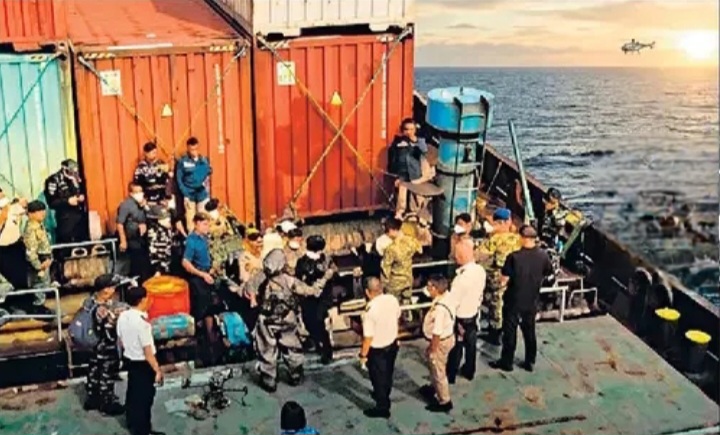
The intercepted vessel, identified as MV Star Line and sailing under the flag of Comoros, was detained on November 7 in the Belawan maritime area of Indonesia. The ship had departed from Lianyungang port in China and was bound for Mongla port in Bangladesh. Rear Admiral Deni Septiana, Commander of the Indonesian Navy’s Regional Command-I, disclosed details of the operation during a press conference in Belawan on November 20.
Suspicion Raised Over Route Deviation
According to the Navy, the vessel drew the attention of security agencies when it halted in Belawan waters to refuel. The patrol vessel KRI Sigalu-857 spotted MV Star Line operating off its designated maritime route, prompting naval personnel to establish contact and initiate an inspection. Preliminary checks revealed multiple discrepancies in the documentation related to both the vessel and its cargo.
Officials noted that MV Star Line was scheduled to reach Mongla port in Bangladesh by the afternoon of November 8. However, the ship made an unscheduled stop in Indonesian waters ahead of its arrival. Following this unusual movement and the discovery of document irregularities, the vessel was detained for a comprehensive search.
Chemical Cargo and Unregistered SIM Cards
During the inspection, authorities found a total of 36 containers aboard the ship, 15 of which held 405 tonnes of sodium perchlorate. Sodium perchlorate is a powerful oxidising chemical used in industrial processes as well as in the production of rocket propellant and certain explosive materials. Rear Admiral Deni Septiana described the seized quantity as unusually large, noting that it could potentially produce materials used in 100 missiles. However, officials clarified that the exact intended use of the chemical remains undetermined, and no direct link to any missile programme or military application has been established so far.
Alongside the chemical cargo, the search uncovered 54 pallets containing millions of blank, unregistered 4G LTE SIM cards. The discovery of such a large volume of SIM cards has widened the scope of the investigation. Agencies are working to trace the destination country and recipient company for the cards, while also examining whether they are linked to organised cybercrime, telecommunications fraud, or other unlawful activities.
Suspended Registration and Ongoing Investigation
Naval investigators also uncovered discrepancies in the ship’s registration papers. While the documents listed IMO number 8356962, official number 1902384, and call sign D-6A4384 with registration validity shown until October 8, 2027, verification revealed that the vessel’s registration was actually suspended. Authorities further suspect that the shipping documents may be forged, and noted that the vessel had failed to respond to radio communications. Officials are currently reviewing administrative records, navigation permits, and compliance with regulations governing the transport of hazardous materials.
Because the ship was intercepted before reaching Bangladesh, the true importer of the consignment has not yet been identified. Naval authorities are questioning the crew on board while tracing the shipping company, cargo owners, and other parties involved in the supply chain. Investigators are also focusing on why 405 tonnes of sodium perchlorate and millions of SIM cards were transported together on the same vessel, with clarity on the shipment’s final destination and intended use expected only after the inquiry concludes.