
Follow us on Google News

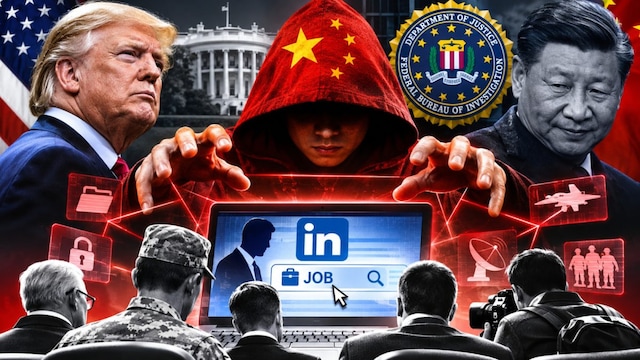
Suspected Chinese intelligence networks are increasingly using fake companies and deceptive job offers on professional platforms to target former United States government officials and policy professionals, seeking sensitive insights into defence and national security. Instead of relying solely on conventional espionage methods, these operations deploy fabricated recruiters who approach experienced individuals with lucrative consulting assignments. The scale and sophistication of this recruitment strategy have drawn heightened scrutiny from security agencies across the United States and its Five Eyes intelligence partners.
Recent scrutiny surrounding former Nvidia chief executive Jensen Huang, who stepped down amid questions over a personal relationship with a businesswoman allegedly linked to Chinese intelligence, has underscored the growing reach of Beijing’s influence operations in the United States. Over the years, China has been suspected of using shell companies, online job advertisements, and professional networking sites to approach current and former American officials and gather sensitive information.
How Fake Consulting Networks Operate
An investigation by CNN revealed that the suspected intelligence operation could be considerably larger than previously reported. According to the findings, multiple fake firms are attempting to extract information from individuals who have worked inside or near the United States government. These networks follow a consistent operational pattern by first creating convincing, professional-looking websites using artificial intelligence and stolen identities.
Once these digital fronts are established, fake recruiters post job advertisements on platforms such as LinkedIn. They specifically look for candidates with backgrounds in defence, foreign policy, international trade, and related critical sectors. Applicants are offered substantial payments to write research reports on China-related topics, defence policies, and global affairs for clients whose true identities remain concealed. While the assignments appear to be standard analytical consulting, security experts warn that the underlying goal is to gather intelligence that helps Beijing understand American policy decisions and government operations.
Federal authorities have already taken action against parts of this network. In June, the Federal Bureau of Investigation seized 13 websites linked by officials to fraudulent consulting companies. Assistant Attorney General for National Security John A. Eisenberg noted that the domain seizures show how foreign actors use promises of easy money to lure Americans into revealing sensitive or classified information they are duty-bound to protect. The FBI also cautioned individuals to exercise extreme vigilance when approached online with offers of easy income for vague consulting work. Despite the takedowns, CNN cited Max Lesser, a senior analyst at the Foundation for Defense of Democracies, who identified more than 100 additional web domains exhibiting characteristics tied to the suspected network.
Former Federal Employees and Experts in Focus
The recruitment campaign has raised heightened alarm following widespread workforce cuts under the Trump administration, which left thousands of federal employees out of work. Security officials note that recently departed government personnel remain valuable targets because they retain deep knowledge of federal policies, defence planning, and national security protocols. Even when former officials no longer hold active security clearances or access to classified files, their institutional experience and understanding of internal decision-making processes remain highly useful to foreign intelligence services.
The outreach is not confined to former civil servants. Investigators found that the fake consulting firms have also approached journalists, trade consultants, and independent researchers who possess specialized knowledge that could benefit foreign governments.
Five Eyes Alliance Issues Broader Warning
Concerns over these recruitment tactics extend well beyond Washington. The Five Eyes intelligence alliance, comprising the United States, the United Kingdom, Australia, Canada, and New Zealand, has warned that suspected Chinese intelligence officers and their associates routinely pose as staff members of consulting firms, think tanks, and recruitment agencies. By offering paid research contracts through networking platforms, these operatives aim to collect privileged military, political, and economic information.
Intelligence officials emphasize that the primary danger lies in data aggregation. While a single commissioned report may not expose a major state secret, compiling hundreds of analyses from different professionals can help a foreign power construct a detailed picture of national policies, military readiness, and potential strategic vulnerabilities. The evolving use of fake job listings highlights the shifting nature of modern intelligence gathering, forcing governments to remind former officials and industry specialists how their professional expertise can be exploited.