
Follow us on Google News

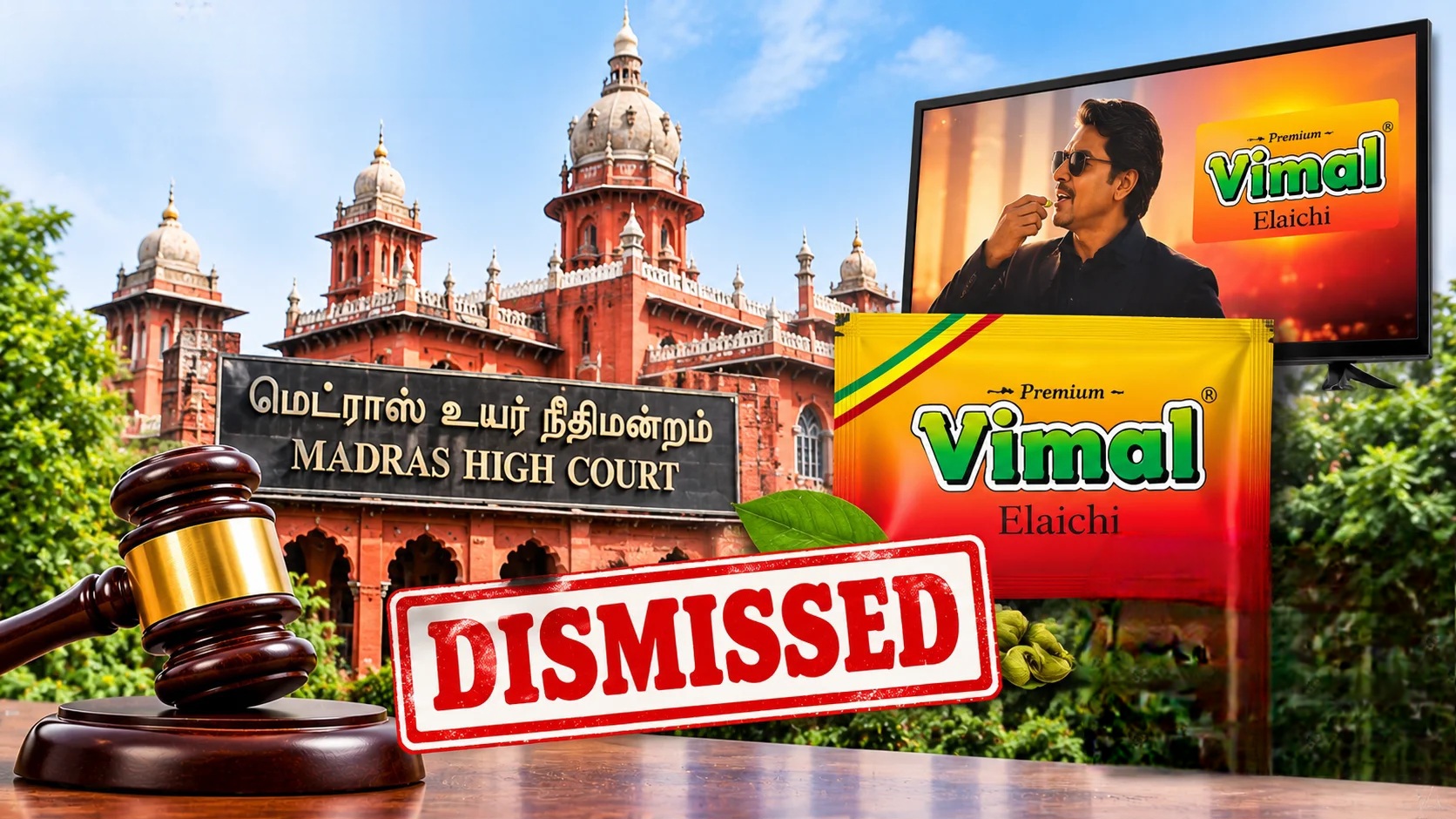
The Madras High Court has dismissed a public interest litigation seeking action against advertisements for Vimal Elaichi on the grounds that they constitute surrogate advertising for pan masala. A division bench comprising Chief Justice Sushrut Arvind Dharmadhikari and Justice G. Arul Murugan delivered the ruling on November 11 in the case of D. Rakesh versus Union of India and Others. The bench held that determining whether an advertisement amounts to surrogate promotion is a question of fact that must first be examined by competent statutory regulators rather than directly through a court order based on unverified apprehensions.
Petitioner Cites Statutory Norms and Maharashtra Notices
The Madurai-based petitioner alleged that PB Agro LLP manufactures both pan masala and saffron cardamom under the Vimal brand and promotes Vimal Elaichi across television, print media, social media, and hoardings featuring three prominent film actors. Arguing that the Vimal brand is primarily associated with pan masala, the plea claimed that heavy expenditure on cardamom advertisements was intended to indirectly promote pan masala. The petition alleged potential violations of the Food Safety and Standards Act, 2006, the Advertising and Claims Regulations, 2018, the Consumer Protection Act, 2019, the Central Consumer Protection Authority (CCPA) Guidelines of 2022, the Cigarettes and Other Tobacco Products Act (COTPA), and the Cable Television Networks Rules.
Senior Advocate Santosh Paul, appearing for the petitioner, contended that the advertisements appeared prima facie to be surrogate promotions and were not entitled to protection under the right to freedom of speech or trade. The plea also cited action taken in Maharashtra in August 2026, where the state Food and Drug Administration issued show-cause notices to the three actors following a July 13, 2026 prohibition order on pan masala. The petitioner pointed out that despite similar restrictions on chewing tobacco and nicotine products in Tamil Nadu, authorities had not acted against the advertisements.
Court Rejects Reliance on Preliminary Action in Another State
Declining to accept these arguments, the High Court observed that the notices issued in Maharashtra were merely show-cause notices seeking explanations and did not represent final findings of any legal violation. The bench also noted that one of the actors had challenged the notice before the Maharashtra High Court, where the matter remains pending. Consequently, preliminary steps taken by authorities in another state under its own orders could not serve as a basis for directing Tamil Nadu officials to take action against the company.
The court further underscored the petitioner’s own admission that cardamom is a legitimate food product and that the company holds registration from the Food Safety and Standards Authority of India (FSSAI) for it. The petitioner had also acknowledged that he had not found any gutkha or tobacco product sold by the company under the Vimal brand. The bench ruled that a judicial inquiry cannot be ordered merely on the suspicion that such a product might exist, nor can a PIL succeed solely on media reports and social media posts.
Regulatory Scrutiny Must Precede Judicial Intervention
Emphasising the factual nature of such disputes, the bench stated that assessing whether an advertisement is a surrogate promotion requires examining several factors, including whether the advertised product is genuinely sold in the market, its packaging and marketing, the contents of the advertisement, and the advertiser’s intent. These matters fall squarely within the domain of statutory regulatory bodies, which can evaluate evidence after hearing the advertiser.
Highlighting a fundamental requirement for maintaining a public interest litigation, the court noted that the petitioner had not submitted any prior complaint to the Commissioner of Food Safety or the CCPA. Without first approaching the concerned authorities, the petitioner could not allege inaction or seek a writ of mandamus against them. Observing that the petitioner was free to lodge a formal complaint before the appropriate regulators, the bench dismissed the petition as premature and baseless, closing the connected interim application without imposing any costs.