
Follow us on Google News

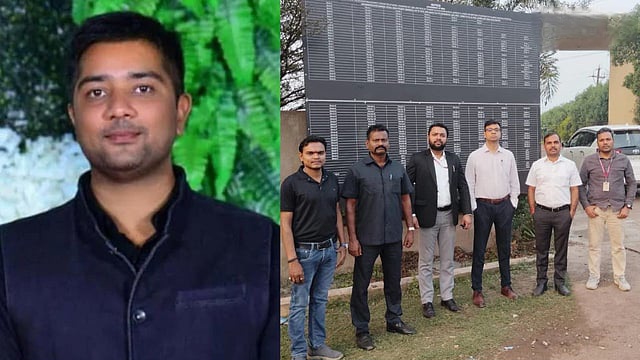
The Enforcement Directorate (ED) has completed the process of taking possession of Vitthal Greens, a real estate project linked to Chaitanya Baghel, son of former Chhattisgarh Chief Minister Bhupesh Baghel, in connection with the money laundering probe into the alleged Chhattisgarh liquor scam. Located in Janjgiri village of Durg district, the residential project has been valued at ₹26.43 crore. On Saturday, a team from the ED’s Raipur zonal office installed the agency’s official board at the premises and pasted a copy of the possession order. According to the central agency, proceeds of crime amounting to ₹18.9 crore generated from the alleged liquor scam were invested into the development of this project. Developed by Chaitanya Baghel through his proprietorship firm, Baghel Developers, Vitthal Greens comprises approximately 355 residential plots, of which around 30 plots have reportedly been sold so far. The agency has broken down the ₹26.43 crore valuation into ₹9.49 crore for the land and ₹16.95 crore for development works, alleging that illicit funds were used for both land acquisition and infrastructure creation.
Attachment Confirmed by PMLA Authority
The physical possession follows a series of legal steps under the Prevention of Money Laundering Act (PMLA). In November 2025, the ED had provisionally attached assets worth ₹61.20 crore associated with Chaitanya Baghel, including the Vitthal Greens project. The Adjudicating Authority under the PMLA subsequently confirmed the provisional attachment order in March 2026, clearing the way for the agency to take formal possession of the property. Under PMLA provisions, taking possession of an attached asset does not immediately transfer legal ownership to the government. Instead, the measure is intended to preserve and secure the property until the conclusion of the trial. Confiscation to the state occurs only if the charges are proven and result in a conviction in court, meaning the action currently remains subject to ongoing judicial proceedings.
Allegations Over ₹2,883 Crore Liquor Syndicate
In its investigation, the ED has alleged that an organized liquor syndicate operated in Chhattisgarh between 2019 and 2023, misusing the state excise machinery to generate illegal profits running into thousands of crores. The agency estimates that the network generated proceeds of crime exceeding ₹2,883 crore through operations linked to the Chhattisgarh State Marketing Corporation Limited (CSMCL). According to the probe, the syndicate collected illegal commissions on the supply of country liquor, sold unaccounted liquor through government-run retail shops, and extracted annual commissions from distillers. The ED has also brought the FL-10A licensing mechanism for foreign liquor under the ambit of its investigation. Investigators claim the illicit funds were layered through multiple channels to purchase real estate, with the ₹18.9 crore investment in Vitthal Greens forming part of this money trail. The agency has placed Chaitanya Baghel at the top tier of the alleged syndicate, accusing him of managing accounts and making decisions regarding the collection, transfer, and distribution of illegal funds.
Prior Arrest and Political Pushback
Chaitanya Baghel was arrested by the ED on July 18, 2025, following searches conducted at his residence in Bhilai as part of the liquor scam probe. The agency later filed a prosecution complaint, or chargesheet, against him in September 2025, focusing on tracing financial transactions and assets acquired using alleged scam proceeds. Meanwhile, former Chief Minister Bhupesh Baghel has consistently denied all allegations leveled against him and his family. He has maintained that his family has committed no wrongdoing and accused the central BJP government of orchestrating the investigation out of political vendetta. The matter remains before the court, where the final outcome will depend on judicial scrutiny and evidence presented during the trial.