
Follow us on Google News

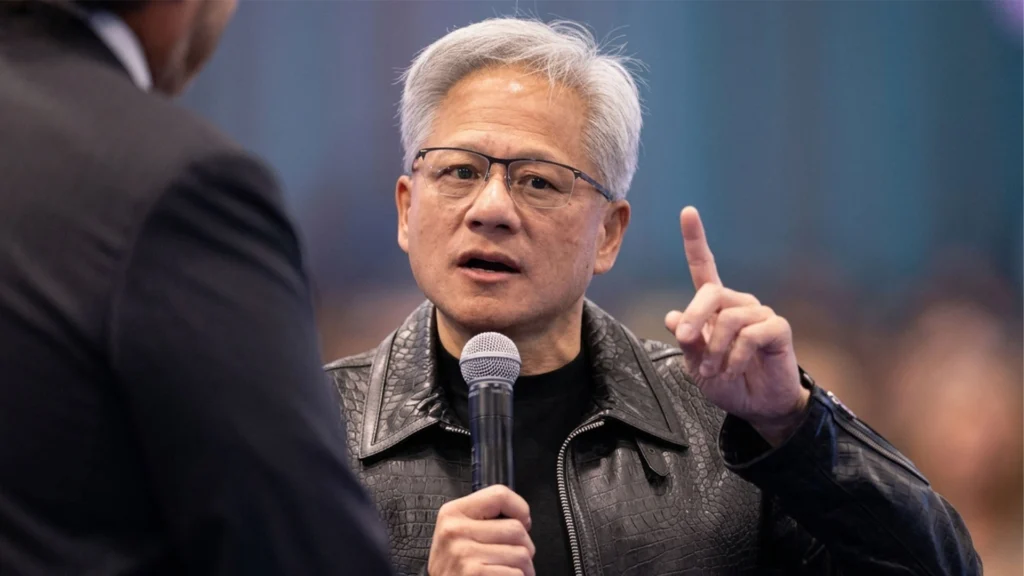
Three Indian-origin technology executives have emerged as possible successors to Jensen Huang following his reported Nvidia exit.
The leadership discussions follow reports that Huang resigned as Nvidia’s chief executive and president amid controversy surrounding alleged extramarital relationships, including one involving a Chinese businesswoman suspected by US authorities of espionage. The reported departure has brought attention to the future leadership of one of the world’s most influential artificial intelligence companies.
Who Are the Three Indian-Origin Contenders?
Sanjay Mehrotra, chief executive of Micron Technology, Nikesh Arora, chairman and CEO of Palo Alto Networks, and Thomas Kurian, CEO of Google Cloud, are among the executives whose names have surfaced in discussions about Nvidia’s leadership. Mehrotra has headed Micron since 2017, overseeing its expansion in memory and storage technologies. He co-founded SanDisk in 1988 and served as its president and chief executive from 2011 until Western Digital acquired the company in 2016.
His experience in semiconductor manufacturing and memory technologies is considered relevant to Nvidia’s expanding artificial intelligence business, particularly as demand grows for high-bandwidth memory and advanced computing infrastructure.
Arora has led Palo Alto Networks since 2018. Before joining the cybersecurity company, he held senior positions at Google and SoftBank, gaining experience in international operations, corporate strategy and technology investments.
Kurian, originally from Kerala, has headed Google Cloud since 2019. His responsibilities include cloud infrastructure, enterprise software and AI-related services. His experience managing large-scale computing systems has also attracted attention, although his background is primarily in cloud computing rather than semiconductor manufacturing.
https://the420.in/fcrf-certified-chief-ai-officer-second-cohort-november-2026/
What Has Nvidia Said About Its Leadership Transition?
According to the reported developments, Nvidia confirmed Huang’s resignation on November 12, ending his association of more than three decades with the company he co-founded. The company’s longtime chief financial officer, Colette Kress, has reportedly assumed responsibility as interim chief executive while its board considers candidates for a permanent appointment.
Kress joined Nvidia in 2013 and has played an important role in financial management, investor relations and corporate expansion. Her familiarity with the company’s operations makes her a potential internal candidate.
However, Nvidia has not officially announced a shortlist of successors. The names circulating in industry discussions remain speculative, and there has been no confirmation that the three Indian-origin executives have been formally approached.
Which Other Technology Leaders Are Being Discussed?
Several executives with experience in semiconductor manufacturing, advanced computing and corporate management have also been mentioned as possible candidates.
Ian Buck, Nvidia’s vice president of hyperscale and high-performance computing, is among the internal names under discussion. Having joined the company in 2004, he has contributed to the development and expansion of CUDA, Nvidia’s computing software platform.
External names include Arm CEO Rene Haas, former Intel chief executive Pat Gelsinger, AMD CEO Lisa Su and Marvell Technology chief executive Matt Murphy. Their experience in semiconductor architecture, chip development and technology management could be relevant to Nvidia’s future requirements.
Apple hardware executive Johny Srouji and former Apple CEO Tim Cook have also appeared in succession discussions. Their inclusion reflects interest in executives with experience managing complex technology businesses and developing advanced computing products.
Why Are Indian-Origin Executives Attracting Attention?
The discussion surrounding Mehrotra, Arora and Kurian comes amid the growing presence of Indian-origin executives in senior positions across major American technology companies.
Sundar Pichai leads Google and Alphabet, while Satya Nadella serves as Microsoft’s chairman and chief executive. Arvind Krishna heads IBM, and Neal Mohan leads YouTube.
Adobe’s Shantanu Narayen is also transitioning towards an executive chairman role following the appointment of Anil Chakravarthy as his successor.
These executives have established significant leadership positions across artificial intelligence, cloud computing, enterprise software and cybersecurity.
The possible consideration of Indian-origin candidates for Nvidia reflects the breadth of their experience in managing international technology businesses. Nevertheless, professional experience and industry speculation do not establish that any individual has entered a formal selection process.
What Challenges Will Nvidia’s Next CEO Face?
Nvidia’s next chief executive would inherit a business operating at the centre of global artificial intelligence development, with its graphics processing units, computing infrastructure and software platforms supporting major technology companies and research organisations.
The leadership role would involve managing intensifying competition in AI chip development, geopolitical tensions, US export restrictions and growing demand for advanced computing infrastructure.
Maintaining relationships with cloud service providers and artificial intelligence companies would also remain important, alongside continued investment in semiconductor development and software technologies.
The reported succession discussions therefore extend beyond a change in corporate leadership. Nvidia’s position in the global AI industry means its future management decisions could influence the company’s technological priorities and business direction.
With no permanent successor announced in the reported account, the selection process remains unresolved, while the possibility of an Indian-origin executive assuming leadership continues to attract attention.