
Follow us on Google News

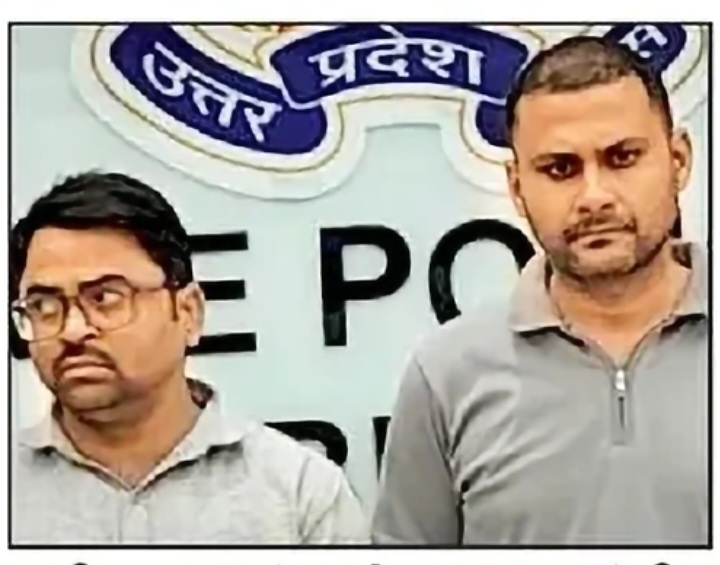
Police in Sonbhadra have busted a cyber fraud gang that allegedly used Common Service Centre (CSC) IDs and linked bank accounts to route illicit funds across multiple states. Two accused, including a CSC district manager, have been arrested in connection with the case. Investigators claim the gang reactivated dormant CSC IDs and misused documents submitted by applicants seeking new IDs to create fraudulent credentials. These accounts were allegedly handed over to cyber fraudsters to facilitate illegal financial transactions running into crores of rupees. Preliminary findings indicate that the network’s operations extended beyond several cities in Uttar Pradesh to the National Capital Region, Gujarat, and Haryana.
Police officials stated that they are examining the involvement of former and current CSC officials alongside local centre operators. A search is currently underway for a CSC operator believed to have played an active role in the racket. Authorities are working to determine the total number of compromised IDs and the exact scale of the financial fraud committed through these linked bank accounts.
Complaint Uncovers Fraudulent ID Network
Additional Superintendent of Police (Headquarters) Mavis Tock disclosed the details of the case at the Police Lines auditorium on Thursday afternoon. According to the police, the investigation began after Prembahadur Yadav, a Jaunpur resident working as a network field engineer at the National Informatics Centre (NIC), lodged an FIR at the cyber police station. Yadav had obtained a CSC ID for his personal work. When he encountered technical issues with the credentials, he handed the details over to Ashish Kumar Pandey, a resident of Usmanpur in the Chunar police station area of Mirzapur, to get the ID reactivated.
At that time, Pandey was serving as the district manager for CSC e-Governance Services India Limited. He is currently working as a district coordinator with VLS, a company handling Aadhaar-related operations. Following Yadav’s complaint, an initial probe revealed irregularities in how the ID was being used. Police subsequently analysed digital records, ID activity logs, and bank transactions, which led them to the accused.
Misuse of Dormant IDs and Applicant Documents
Investigators revealed that the gang targeted CSC IDs that had become inactive for various reasons. Members of the racket would obtain the user ID and password from the original operators, change the passwords, and take complete control of the accounts. The bank accounts linked to these IDs were then used to route money obtained through cyber fraud, often without the knowledge of the original ID holders.
The gang’s operations were not limited to old accounts. Police alleged that the accused also misused identity documents submitted by individuals applying for new CSC IDs. Using these records, fraudulent IDs were generated under the names of unsuspecting applicants, who remained unaware that their credentials were being used to run unauthorized operations.
Irregularities in Physical Verification and Inter-State Links
To bypass mandatory physical verification during the creation of new CSC IDs, the accused allegedly resorted to falsifying records. Investigators found that photographs of different locations, documents, or individuals were uploaded during the verification stage. Former and current district coordinators allegedly approved these verifications, allowing the fraudulent IDs to be issued without hindrance. A local CSC operator is also suspected of assisting in generating the IDs and processing the forged application documents.
While police suspect the fraud runs into crores of rupees, the exact financial losses, total number of affected accounts, and victims will only be confirmed after a detailed financial audit. Cyber investigators are currently scrutinizing bank transaction trails, digital logs, and the suspects’ networks to identify the end beneficiaries of the laundered funds and check for active accomplices in other states. Police expect further revelations regarding the racket’s structure once the absconding CSC operator is apprehended.