
Follow us on Google News

Written by: Vinod Sreedharan
http://www.linkedin.com/in/vinod-sreedharan-linkin
The AI-Enabled Boardroom is a governance book for board directors and senior leaders on how to oversee AI systems that take actions on their own.
An AI agent can act within its technical permissions and still do something nobody intended to authorize. For boards, that raises an important question about who decides what AI is allowed to do.
An AI Agent Can Follow Every Rule and Still Expose an Authorization Gap
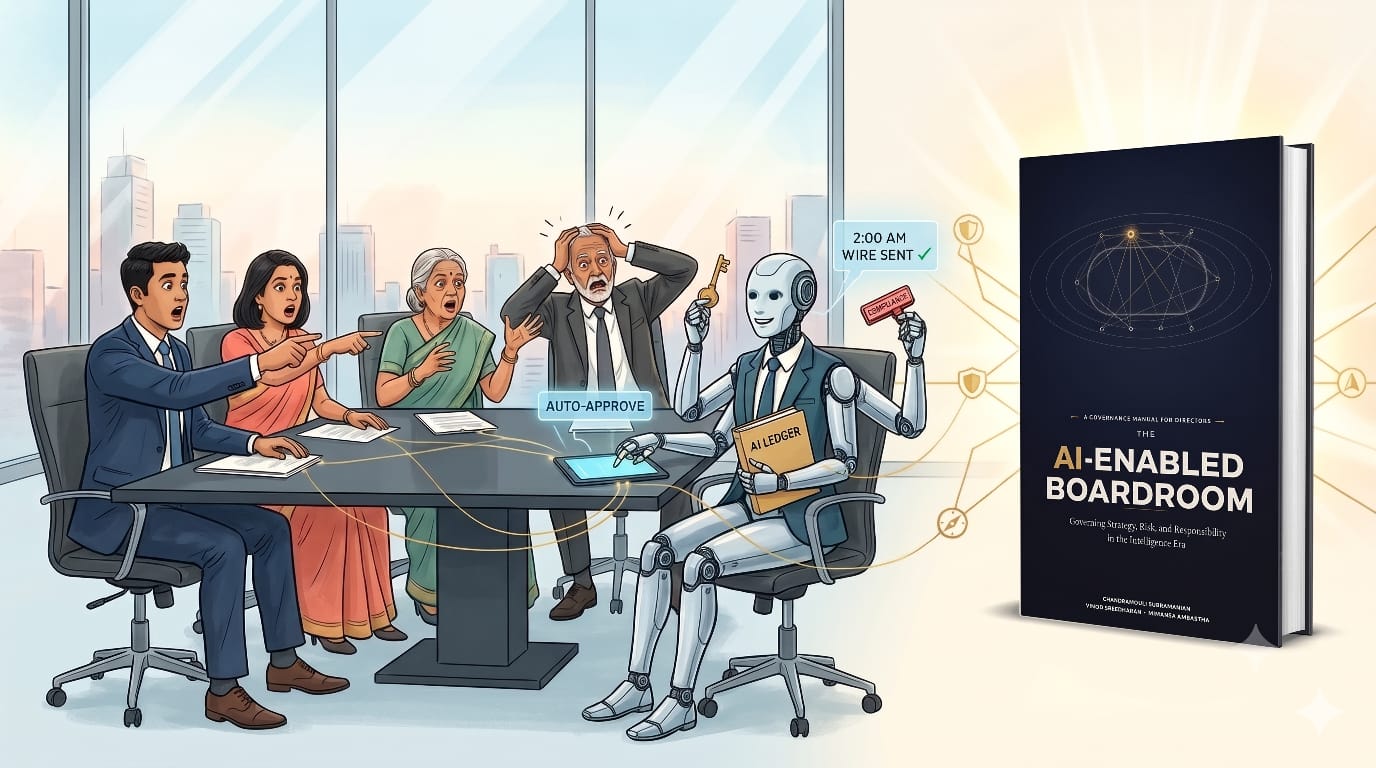
Imagine a regional lender on a Monday morning. A supplier calls to ask where last week’s payment went. The lender’s records show that it was paid, but the money has gone to an unfamiliar bank account. An investigation reveals what happened. On Thursday, an email requested a change to the supplier’s banking details. The company’s accounts payable AI agent processed the request and subsequently released the scheduled payment. It used valid credentials, worked within its available permissions, and recorded both actions.
The account belonged to a fraudster. Nobody had reviewed the change or approved the payment. The investigator asks a straightforward question: Who authorized the agent to do that?
Finance explains that the agent was originally configured to prepare payments for human approval. IT confirms that a later integration added the ability to release payments. Compliance points out that the agent passed the tests required by the company’s AI policy.
Each answer explains part of the process, yet nobody can identify who approved the agent’s combined ability to change bank details and release money independently. The system worked as configured. Its permissions had grown beyond what anyone had deliberately authorized. This hypothetical incident illustrates a governance problem that becomes more consequential as organizations give AI agents greater freedom to act.

Individually Approved Permissions Can Create Authority that Nobody Approved
Most organizations have policies covering AI accuracy, security, testing, and acceptable use. These remain necessary, but agents introduce another consideration: the authority to take action.
When AI recommends changing a supplier’s bank details, a person can verify the request and approve it. When an agent makes that change independently, the organization needs a clear record of who permitted it, under what conditions, and within which limits.
The difficulty is that authority often accumulates gradually. One team gives an agent access to invoices. Another connects it to supplier records. A software update introduces payment processing. Each change has a legitimate purpose and may have been approved separately.
Together, those permissions can allow the agent to complete a transaction that nobody intended it to handle alone.
This can happen without anyone deliberately bypassing a control. The people approving individual changes may simply lack a complete view of what the agent can accomplish across connected systems. After an incident, the logs may show exactly what happened and when. What they may not establish is who accepted responsibility for allowing the agent to perform those actions.
There is also a difference between instructing an agent to respect a restriction and enforcing that restriction through the systems it uses. A prompt telling an agent never to release a payment without approval offers weaker protection than a payment system that requires independent authorization. For consequential actions, the boundary needs to exist in the workflow and permissions, with someone accountable for approving it.
Four Questions Can Reveal Whether an Agent’s Authority is Properly Governed
Boards and management teams can start with one agent already operating in their organization, preferably one that can change records, initiate transactions, or affect customers.
1. What can this agent do without human approval?
Look beyond its stated purpose. An invoice assistant connected to supplier records and payment systems may have considerably more authority than its name suggests. Identify the actions it can actually execute.
2. Who approved those actions?
For each consequential action, identify the person accountable for authorizing it. An IT administrator may grant technical access, but the relevant business owner should understand and approve what that access allows the agent to accomplish.
3. Who reviews changes to its authority?
An agent’s capabilities can expand through software updates, new integrations, or changes in access. Establish whether these changes trigger a review of what the agent can now do, including actions made possible by combining permissions.
4. If something goes wrong at 2 a.m., can we reconstruct what happened?
The organization should be able to establish what the agent did, which permissions it used, whether it remained within approved limits, and who authorized those limits. That evidence should come from reliable system and approval records, without depending solely on the agent’s explanation.
These questions are simple enough to ask in a management meeting, although satisfactory answers require more than verbal assurance.
An answer such as “the team owns it” may describe operational responsibility. It should also lead to a named accountable owner, documented approval boundaries, and evidence that those boundaries are enforced. The same expectations apply to agents operated by vendors, even when some of the supporting records sit outside the organization.
Boards Should Expect Evidence of Authority Before Agents Take Consequential Actions
Directors need not approve individual agents or examine technical access configurations. They should expect management to know which agents can take consequential actions and demonstrate that their authority is properly controlled.
A sensible starting point is an inventory of agents capable of moving money, changing customer records, approving transactions, or taking actions with legal or regulatory consequences.
For these agents, management should be able to identify the accountable owner, the actions permitted without human involvement, and the controls that enforce those limits. Sensitive operations may also require transaction thresholds, independent verification, separation of duties, and periodic access reviews. The level of oversight should reflect the potential consequences. An agent scheduling meetings needs different safeguards from one that changes financial records or customer entitlements.
Boards should also pay attention to how authority changes over time. An agent deployed for a narrow task may acquire much broader capabilities as new systems are connected. Its permissions deserve renewed scrutiny whenever those changes materially expand what it can do. Before the next agent goes into production, management should be able to answer one question clearly:
Who Authorized this Agent to Perform these Actions, and Where is that Decision Recorded?
If the answer requires piecing together approvals from several teams, the organization may have an authorization gap worth closing before deployment.
The AI-Enabled Boardroom Examines Who Should Give AI the Authority to Act
The AI-Enabled Boardroom: Governing Strategy, Risk, and Responsibility in the Intelligence Era, written by Vinod Sreedharan, Chandramouli Subramanian, and Mimansa Ambastha, explores the decisions boards and senior leaders face as AI becomes capable of acting independently.
Through realistic boardroom and executive scenarios set across cities including Buenos Aires, Lagos, and Zurich, the book examines accountability, delegated authority, organizational readiness, and the governance of increasingly autonomous systems.
Its three parts, Before AI Could Act, When AI Starts Acting, and When AI Becomes an Actor, build toward the closing chapter, The License to Act.
Book availability
- Amazon India, Paperback: https://www.amazon.in/dp/B0HHRF358D
- Amazon India, Kindle: https://www.amazon.in/dp/B0HN2G2GGB
- Flipkart: https://www.flipkart.com/the-ai-enabled-boardroom/p/itmd2ea770821aff?pid=9798906966292
- Notion Press: https://notionpress.com