
Follow us on Google News

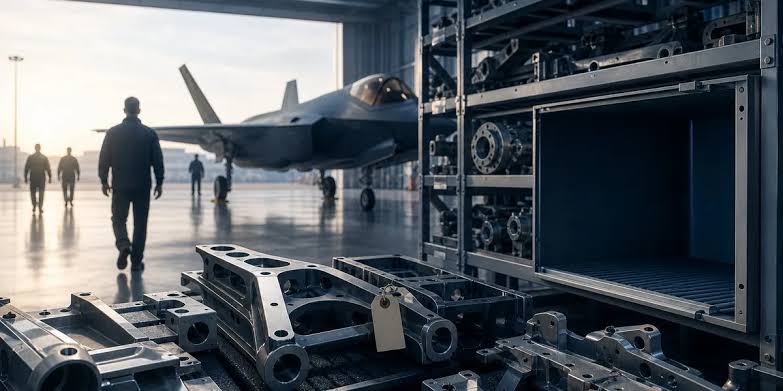
WASHINGTON — More than one million spare parts for American F-35 stealth fighter jets have gone unaccounted for, according to a recent audit report by the U.S. Government Accountability Office. The missing components are valued at approximately $85 million, or about Rs 797 crore, raising fresh concerns over inventory management at the Pentagon.
The GAO report states that the parts disappeared from the records of a prime contractor between 2018 and 2022. Even as of March 2026, the Pentagon’s F-35 Joint Program Office had failed to determine the exact whereabouts of the missing items. The shared global pool for the fighter jet includes everything from engines, tires, and support equipment to nuts, bolts, and screws.
Because existing inventory records are incomplete and outdated, officials cannot confirm how many of these parts were stolen, destroyed, or simply sitting unrecorded inside warehouses. Under the broader F-35 program, roughly 26 million spare parts worth $31 billion, or nearly Rs 2.90 lakh crore, are stored across more than 700 government and contractor facilities worldwide.
Previous Shipment Mix-Up Sent Stealth Parts to Hong Kong
The audit findings follow an earlier controversy in September 2026 involving sensitive F-35 components shipped from Australia to the United States for repairs. At the end of May 2026, damaged parts from a Royal Australian Air Force F-35A aircraft were dispatched to manufacturer Lockheed Martin.
Due to an error by shipping company UPS, the consignment went off course and ended up in Hong Kong, where it went missing. Reports indicated that the shipment contained a cockpit canopy with radar-absorbing coating and a weapons-bay door.
The incident triggered fears that sensitive stealth technology could fall into Chinese hands, prompting investigations by the Pentagon and the U.S. Congress. However, Australia’s defense minister maintained that the parts were damaged and contained no classified or sensitive technology.
Combat Readiness Drops as Only 25 Percent of Jets Remain Fully Capable
Supply chain flaws and poor parts management are directly affecting the combat readiness of the U.S. Air Force. A separate report from June 2026 revealed that only 25 percent of American F-35 fighter jets were capable of performing all types of combat missions.
Officials attributed the low readiness rate to severe spare parts shortages, flawed inventory records, delayed software updates, and corrosion on aircraft structures. To address the crisis, the Pentagon launched the Global Support Solution Reset plan with an additional budget of $13.7 billion through 2031.
Pentagon Agrees to Overhaul Tracking Systems
To prevent further losses, the GAO has recommended that the Pentagon upgrade its inventory tracking systems and provide better training for property management officials. Both Lockheed Martin and the F-35 Joint Program Office have accepted the recommendations.
The agencies stated that they are modernizing their management framework to enable real-time data sharing between government and contractor systems. Maintaining accurate supply records is considered vital for the fifth-generation multi-role fighter, often described as a flying supercomputer.
Unlike conventional jets, the F-35 carries its weapons and fuel tanks internally to evade radar detection, relying on specialized components and integrated data systems to operate effectively in combat.