
Follow us on Google News

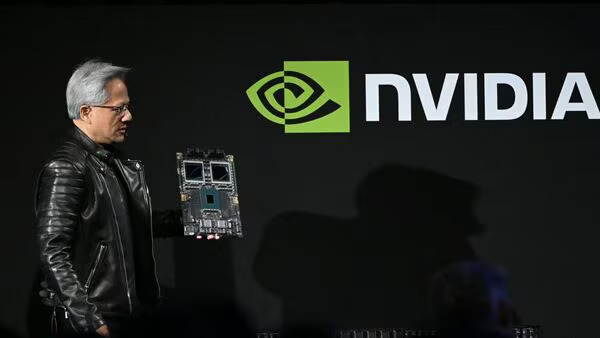
Shares of global chipmaker Nvidia fell by nearly 13 percent at market open following reports regarding the resignation of Chief Executive Officer Jensen Huang. The drop marks the steepest single-day decline for the company’s stock since 2012, sparking immediate concern among investors and raising questions about the company’s future leadership.
According to a report by Moneycontrol, news of Huang’s resignation emerged amid an alleged espionage controversy, creating negative sentiment across the market. However, a clear distinction remains between the circulating report and an official corporate confirmation. While the report attributes the stock decline to news of the resignation, formal details or an official announcement from Nvidia confirming the departure were not available in the provided information.
Heavy Selling Pressure at Market Open
Trading in Nvidia shares saw heavy selling as soon as the market opened, pushing the stock down by roughly 13 percent and threatening a substantial erosion in market value. Nvidia holds a central position in the global technology sector, as its graphics processing units power rapidly expanding industries such as artificial intelligence, data centers, supercomputing, and automation.
Over recent years, rising demand for artificial intelligence chips has elevated Nvidia into one of the most influential companies in global equity markets. Consequently, any uncertainty surrounding its top leadership extends beyond the company’s own shares and carries wider implications for the broader technology sector and artificial intelligence investments.
Leadership Questions and Espionage Controversy
Jensen Huang is the co-founder of Nvidia and has served as its chief executive officer for decades. Under his leadership, the company transitioned from a manufacturer of gaming graphics cards into the primary supplier of global artificial intelligence infrastructure. Major data center operators and developers of artificial intelligence models rely heavily on Nvidia hardware to train and run advanced systems, making Huang the central figure behind the company’s technical and commercial strategy. Any sudden leadership change could affect strategic direction, client relationships, and future chip development plans.
At the center of the current developments is an alleged espionage controversy. However, the available report does not provide full details regarding the exact nature of the dispute, the parties involved, or a direct link to Huang’s reported resignation. Nvidia has already been positioned at the center of technological competition between the United States and China, where tensions over advanced chip supplies, export controls, and access to sensitive technology have regularly impacted business operations. In such an environment, any controversy involving espionage can affect corporate reputation and investor confidence.
Broader Impact on the AI Sector
A sharp decline in Nvidia shares carries the potential to influence the wider technology market, given the dependence of major global technology firms on its hardware. If leadership uncertainty persists over an extended period, investors may reassess the company’s future growth trajectory and the outlook for its artificial intelligence business.
For now, the primary focus remains on securing official clarity regarding Huang’s status at the company and the exact details of the alleged espionage controversy. A formal statement from Nvidia will determine whether the 13 percent drop represents a temporary market reaction or signals a deeper shift in investor sentiment toward the company’s leadership and operational risks.