

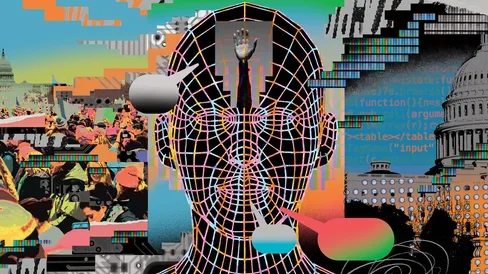

Spain’s main opposition party has triggered a political and legal controversy after publishing an artificial intelligence-generated campaign video that makes people linked to Prime Minister Pedro Sánchez’s Socialist Party appear to admit to wrongdoing.
The conservative People’s Party, or PP, released the video through its official social-media accounts ahead of Spain’s November 29 general election.
The footage uses AI-generated likenesses of several public figures, including Sánchez’s wife Begoña Gómez and former Socialist prime minister José Luis Rodríguez Zapatero.
The people shown in the video did not actually make the statements attributed to them.
FCRF’s Chief AI Officer Certification Returns on November 14 to Prepare Future AI Leaders
AI Video Put Fabricated Statements Into Real People’s Mouths
The campaign video uses artificial intelligence to reproduce the faces and appearances of people associated with the Socialist Party.
An AI-generated version of Gómez appears to make comments about obtaining a university position because of her husband.
Another synthetic depiction of Zapatero appears to discuss hiding jewellery.
The claims refer to controversies or investigations involving political figures, but the statements themselves were fabricated for the video.
The PP included a notice saying the material was created using artificial intelligence.
However, critics said the disclosure appeared in very small and difficult-to-see text.
By October 23, the video had attracted nearly two million views.
Spain’s digital transformation minister, Óscar López, criticised the use of synthetic footage and argued that viewers unfamiliar with AI could mistake the fabricated statements for genuine recordings.
The PP rejects that criticism.
Party spokesperson Borja Sémper said the video was political satire and that it was clear the people depicted had not actually made the statements.
Legal Complaint Filed Against People’s Party
The controversy has now moved into the courts.
Leire Díez, a former Socialist Party member whose likeness appears in the video, filed a legal complaint seeking its removal.
Her complaint reportedly accuses the PP of defamation and digital identity theft.
The AI-generated version of Díez allegedly portrays her as admitting to efforts to interfere with law enforcement and the judiciary.
Those statements were also fabricated.
The filing does not mean the PP has broken the law.
A court would need to determine whether the video crosses Spain’s legal boundaries governing defamation, identity rights and political expression.
Legal experts consulted by Spanish newspaper El País were generally cautious about predicting that the video would be unlawful.
Several said freedom of expression and protections for satire provide broad legal space for political parody.
They also noted that the overall context could make it obvious to viewers that the statements were not genuine.
Deepfake Labels May Become Central Issue
The dispute raises an increasingly difficult question: how clearly should political campaigns disclose that content has been generated or manipulated using AI?
A deepfake uses artificial intelligence to create or alter images, video or audio so that a real person appears to say or do something that never happened.
Deepfakes do not always need to be highly realistic to create confusion.
A viewer may see only a short clip while scrolling through social media without noticing a disclaimer or understanding that the content is synthetic.
That makes labelling particularly important.
In the Spanish case, the PP did disclose that AI had been used.
The argument is therefore not simply about whether disclosure existed, but whether it was prominent enough to prevent viewers from being misled.
That distinction could become important in future political advertising rules.
Election Campaigns Are Increasingly Using Synthetic Media
Spain is not alone in confronting AI-generated political advertising.
Campaigns in several countries have experimented with synthetic images, cloned voices and artificially generated videos.
The technology allows political parties to produce campaign material quickly and cheaply.
But it also creates a risk that fictional scenes or invented statements may circulate faster than corrections.
The problem becomes especially serious when synthetic footage resembles conventional news or genuine video evidence.
Researchers and election-monitoring groups have warned that repeated exposure to manipulated media could make it harder for voters to distinguish authentic recordings from fabricated ones.
There is also a second risk.
As deepfakes become common, politicians may dismiss authentic recordings as AI-generated even when they are real.
That could weaken public confidence in legitimate evidence.
EU AI Rules Add Another Layer
The controversy also comes as Europe introduces stricter rules around synthetic content.
The European Union’s AI Act contains transparency requirements for certain AI-generated and manipulated material, including deepfakes.
Those rules are designed to make it clearer when people are viewing synthetic content.
Political advertising is also subject to separate European rules around transparency and targeting.
However, the legal treatment of satire, parody and political speech remains complex.
A clearly fictional political cartoon and a realistic fake video may both be technically generated with AI, but their ability to mislead audiences can be very different.
Spain’s current dispute may therefore become an early test of how political parties use AI while trying to remain within legal and ethical boundaries.
The immediate legal case concerns the PP video and the individuals depicted in it.
The broader issue is how democracies handle synthetic political speech when the technology becomes good enough to make fabricated events appear real.
What this means for you:
During elections, a realistic-looking video is no longer proof that a politician or public figure actually said something. Check whether the clip comes from an original recording, whether it is labelled as AI-generated and whether reliable outlets have independently verified it.
Follow for daily updates on cybercrime, corporate fraud, DFIR, hacking, investigations, and digital forensics
