


As generative artificial intelligence becomes increasingly integrated into software development workflows, cybersecurity professionals are beginning to confront a new set of security challenges: vulnerabilities embedded not by human oversight, but by automated code generation itself.
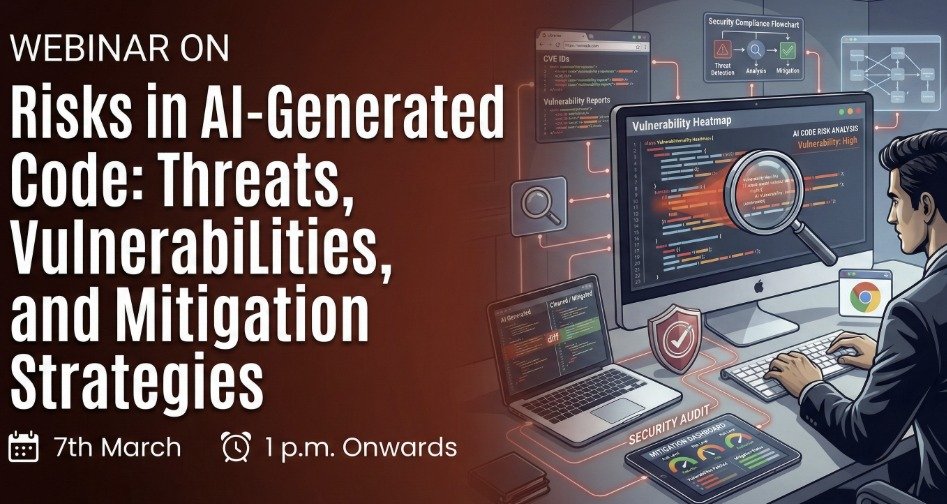
Against this backdrop, the Future Crime Research Foundation (FCRF) is organizing a specialized free webinar titled “Risks in AI-Generated Code: Threats, Vulnerabilities, and Mitigation Strategies,” scheduled for March 7 at 1:00 PM. The session will explore how developers, organizations, and security teams can address emerging threats arising from AI-assisted programming. Interested participants can register for the free webinar. Click here to register now. After registering, participants will receive the official Zoom joining link on their registered email prior to the webinar.
The discussion will feature Bharadwaj D. J., Senior Architect – Cyber Security at Synechron, and Barun Kumar De, Principal Data Scientist at Bosch Global Software Technologies, both of whom work at the intersection of artificial intelligence, software engineering, and security governance.
The Security Risks Hidden Inside AI-Generated Code
Artificial intelligence has already begun transforming how software is written. Tools that automatically generate code snippets, entire modules, and even application frameworks promise faster development cycles and improved productivity. But cybersecurity researchers warn that these systems may also introduce subtle vulnerabilities that can evade conventional review processes.
One of the central concerns involves hallucinated packages, where AI models recommend or reference non-existent or malicious software libraries. Such hallucinations can create entry points for software supply chain attacks, enabling attackers to inject malicious dependencies into otherwise legitimate applications.
The upcoming webinar will examine how such hidden threats can propagate across development pipelines, particularly in environments where developers rely heavily on automated code suggestions without comprehensive verification.
Security practitioners increasingly view these risks not as isolated technical glitches but as part of a broader shift in the threat landscape—one in which vulnerabilities may be introduced automatically at scale.
Injection Attacks and Execution Flaws in AI-Assisted Development
Beyond supply-chain risks, experts say AI-generated code can unintentionally replicate well-known security flaws that developers have spent decades trying to eliminate.
Among the most common risks are injection attacks, including SQL injection, cross-site scripting (XSS), and command injection, which can occur when code fails to properly validate user input. Automated code generation systems may reproduce insecure patterns found in their training data, potentially embedding vulnerabilities into production systems.
Another category of concern involves execution-level vulnerabilities, such as buffer overflows or path traversal flaws. These weaknesses can allow attackers to manipulate system memory or access restricted directories, creating opportunities for data theft or system compromise.
The webinar aims to examine how such vulnerabilities may surface in AI-generated applications and how security testing frameworks must evolve to detect them.
Authentication Failures and Configuration Weaknesses
Security experts also point to the risks posed by hard-coded secrets, weak authentication mechanisms, and insecure configuration practices in automatically generated code.
When AI systems produce sample implementations or default configurations, those examples may include credentials, tokens, or weak security settings that developers inadvertently carry into production environments. Such misconfigurations can expose databases, cloud resources, or internal APIs.
Addressing these risks requires a combination of secure coding standards, rigorous code review processes, and automated vulnerability scanning tools, particularly in organizations adopting AI-driven development workflows.
For enterprises increasingly dependent on AI-assisted software engineering, security governance is becoming a critical layer of oversight. Interested participants can register for the free webinar. Click here to register now.
Building Secure AI Development Practices
The webinar will also explore strategies to embed security into the emerging AI-driven software development lifecycle.
Experts will discuss how organizations can integrate secure CI/CD pipelines, automated vulnerability testing, and governance frameworks aligned with emerging standards such as ISO 42001, which focuses on responsible management of artificial intelligence systems.
The goal, cybersecurity practitioners say, is not to slow innovation but to ensure that the accelerating adoption of AI in software development does not introduce systemic vulnerabilities into digital infrastructure.
With AI tools expected to become standard components of software engineering workflows, the conversation around secure AI development practices is moving from academic discussion to operational necessity.
The March 7 webinar seeks to bring together cybersecurity professionals, developers, and technology leaders to examine how the next generation of code—written partly by machines—can be secured before its risks become embedded in the systems that power modern digital economies. Interested participants can register for the free webinar. Click here to register now.
