

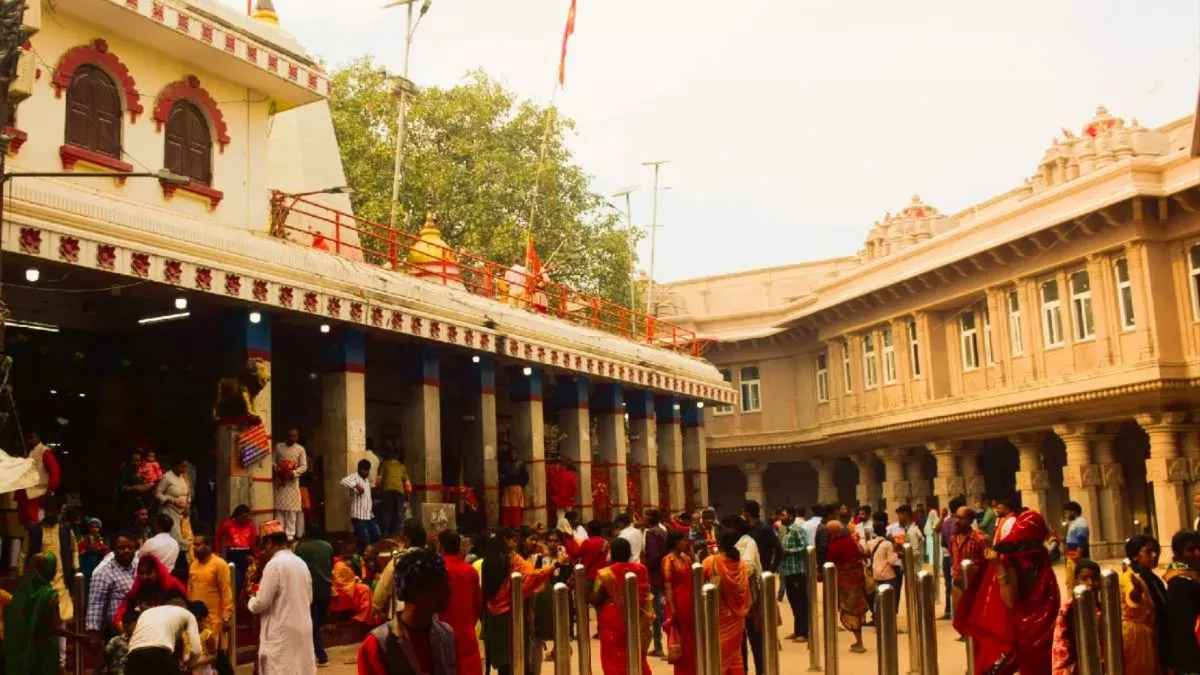

Five privately installed CCTV cameras have been quietly removed from the Maa Vindhyavasini Temple complex and the adjoining Vindhya Corridor in Mirzapur, after district officials discovered they had been operating without authorisation, in some cases for a considerable period. The discovery has prompted a joint review by the district administration, police and representatives of the Panda community, the hereditary priests associated with the shrine, into how such devices went undetected inside one of Uttar Pradesh’s most closely watched religious sites.
The temple already operates under an extensive, officially sanctioned surveillance network monitored jointly by the Vindhya Development Council and the police administration, including high-tech cameras installed as part of the state’s broader push to modernise security at major pilgrimage sites. What alarmed officials was the presence of a separate, unofficial layer of cameras operating alongside that system, apparently without anyone in authority having approved their installation or oversight.
A discreet operation to disconnect and seize
Once information about the unauthorised cameras surfaced, administrative and police officials held a joint meeting with Panda representatives before carrying out a low-key operation to disconnect and confiscate the equipment. Five cameras were removed from locations within the temple complex and along the corridor’s circumambulation path, along with the associated digital video recorder that will now undergo technical examination.
That examination is expected to establish when the cameras were installed, who was responsible for putting them there, who had access to the recorded footage, and whether the devices allowed remote viewing from outside the temple premises. Investigators are also trying to determine whether the footage was stored locally or transmitted elsewhere through an internet connection, a detail that could indicate how far outside the temple grounds the surveillance extended.
Local reporting from Mirzapur has suggested the private cameras may have been used to record disputes and physical altercations within the complex, with such footage reportedly shared on social media platforms, though officials have not yet confirmed this as the definitive motive behind the installation. Other local accounts point to concerns that the cameras may have tracked the movements of devotees, their hosts, or activities specifically around the temple’s exit points.
Questions of privacy at a high-security shrine
What makes the episode particularly sensitive is the setting: a temple that draws large volumes of devotees daily and already sits under one of the more elaborate security frameworks in the region, given its status as a Shakti Pitha shrine and its proximity to Union Home Minister Amit Shah’s visit for the Vindhya Corridor’s foundation-laying ceremony in 2022. The temple management separately introduced restrictions on photography and videography inside the sanctum sanctorum in July, underscoring how closely visual recording within the complex has come under scrutiny in recent months.
The possibility that unauthorised cameras may have captured footage of devotees, priests or temple staff without their knowledge raises broader questions about privacy protections at religious sites that were never designed with private, unregulated surveillance in mind. Officials say they have not yet established the actual purpose behind the cameras and are treating various local theories, including internal disputes within the Panda community, as one line of inquiry among several that the technical examination should help clarify.
What tighter rules might look like
The administration, police and Panda representatives are expected to hold a further joint meeting to review existing security protocols, focusing specifically on rules governing who may install cameras, who is permitted access to surveillance feeds, and how recorded footage is stored and controlled. Officials are preparing to introduce stricter enforcement measures once this review concludes, aimed at ensuring that only authorised equipment, operating under established protocols, functions inside the temple complex and corridor.
The case highlights a tension increasingly visible at India’s major temple redevelopment projects, where large public investments in official surveillance and crowd-management technology can coexist uneasily with informal, unregulated monitoring set up by private individuals with local access. Whether the Vindhyavasini episode results in disciplinary or legal action will depend on what the seized DVR reveals about the duration, scope and intent behind the private cameras, findings officials say will directly shape the security protocols eventually adopted at the shrine.
Follow for daily updates on cybercrime, corporate fraud, DFIR, hacking, investigations, and digital forensics
