

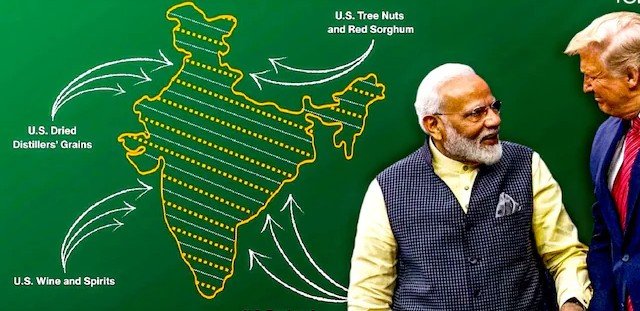
A cartographic detail released by the United States alongside its interim trade agreement framework with India has sparked fresh diplomatic attention, with an official map published by the United States Trade Representative depicting the entire region of Jammu and Kashmir — including Pakistan-occupied Kashmir (PoK) — as part of India.
The map was shared as part of a public communication outlining the contours of the India–US interim trade arrangement, under which the two sides have agreed to expand bilateral commerce across sectors such as energy, agriculture, minerals, technology and aviation components. While the post focused on market access and trade facilitation, it was the accompanying visual that drew immediate notice in strategic and diplomatic circles.
Notably, the map does not show the Line of Control or any alternative demarcation within Jammu and Kashmir. Instead, the region is presented as a single, undivided part of Indian territory, a depiction that differs from how many international agencies and institutions have historically represented the area in public-facing material.
Certified Cyber Crime Investigator Course Launched by Centre for Police Technology
Trade context, unexpected signal
The interim trade framework is aimed at laying the groundwork for a broader bilateral agreement, with both countries seeking to scale up trade volumes over the next few years. The US post highlighted opportunities for American exports — including tree nuts, dried distillers’ grains, red sorghum and fresh and processed fruits — to gain improved access to the Indian market, while also underlining cooperation on supply chains and critical materials.
However, the inclusion of the map alongside the trade announcement has been widely interpreted as carrying a geopolitical undertone, even if no explicit statement was made on territorial issues. Analysts pointed out that official visuals released by government bodies are rarely incidental, particularly in regions marked by long-standing disputes.
Implications for Pakistan
The depiction of PoK as part of India is likely to be viewed in Pakistan as a significant diplomatic setback. Islamabad has consistently objected to international references that appear to endorse India’s position on Jammu and Kashmir, and has previously lodged protests over maps issued by private publishers, academic institutions and even technology platforms.
This instance is different in scale and sensitivity, given that the map was released by a formal arm of the US government in connection with a bilateral agreement. While Washington has not issued a separate clarification or explanation, the absence of any qualifying disclaimer has added to the map’s significance.
India’s long-standing position
India has maintained that Jammu and Kashmir, including PoK, is an integral part of the country, a stance reiterated repeatedly at international forums. New Delhi has also objected in the past to depictions that show the region as disputed or divided, particularly after constitutional changes affecting the former state in 2019.
Though Indian authorities have not issued an immediate public response to the US map, officials privately indicated that the depiction aligns with India’s stated position and does not contradict any bilateral understanding.
A visual that may outlast the post
Diplomatic observers cautioned against reading the map as a formal policy shift without an accompanying statement, but acknowledged that such visuals often take on a life of their own. “Maps released by official bodies tend to be archived, cited and reproduced. Their impact often extends well beyond the immediate context in which they are issued,” said a former diplomat.
As India and the United States move ahead with negotiations aimed at deepening economic ties, the episode underlines how trade, geopolitics and symbolism continue to intersect — sometimes in ways that generate consequences far beyond tariffs and market access.
For now, the map has added an unexpected dimension to an otherwise trade-focused announcement, with regional diplomacy watchers closely tracking whether it prompts any formal reactions in the days ahead.
About the author – Rehan Khan is a law student and legal journalist with a keen interest in cybercrime, digital fraud, and emerging technology laws. He writes on the intersection of law, cybersecurity, and online safety, focusing on developments that impact individuals and institutions in India.
