
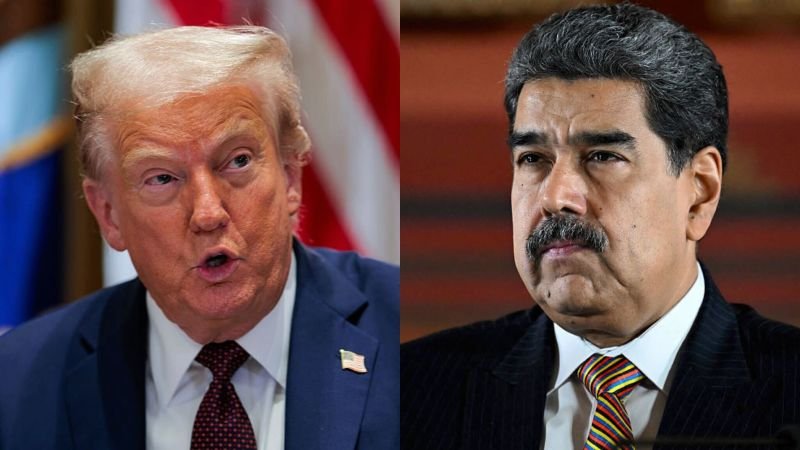

CARACAS, Venezuela — The United States launched a massive military strike on the Venezuelan capital early Saturday, culminating in the capture and extraction of President Nicolás Maduro, a move that effectively decapitates the socialist government and thrusts the oil-rich nation into an abyss of political uncertainty.
In a pre-dawn operation that shook Caracas with multiple explosions, elite U.S. Delta Force commandos, supported by airstrikes on key military installations, detained Mr. Maduro and his wife, Cilia Flores. President Donald Trump, writing on Truth Social shortly after 4:30 a.m., announced the capture, declaring that the Venezuelan leader had been “flown out of the country” to face justice in the United States.
“The United States of America has successfully carried out a large-scale strike against Venezuela and its leader,” Mr. Trump wrote. “The tyrant is gone.”
While the White House has framed the operation as a necessary law enforcement action against a “narco-terrorist” indicted by the U.S. Justice Department, the raid has ignited a firestorm of criticism regarding American hypocrisy on the global stage. For a nation that has spent the last decade rallying the world to defend the sovereignty of borders in Eastern Europe and the Indo-Pacific, the unilateral extraction of a foreign head of state marks a jarring return to the interventionist “Monroe Doctrine” of the 20th century.
A “Peaceful” Invasion?
The operation, dubbed “Operation Southern Spear,” targeted the Fuerte Tiuna military complex and the La Carlota airbase. Residents in Caracas reported the terrifying sound of low-flying aircraft and explosions rocking residential neighborhoods, contradicting the U.S. narrative of a “surgical” extraction.
The disconnect between Washington’s rhetoric and its actions was stark. Only days prior, U.S. diplomats had reiterated calls for “global stability” and “peaceful conflict resolution” at the United Nations. Yet, Saturday’s strikes utilized overwhelming kinetic force to achieve a political objective: regime change.
“They preach peace, but they deliver war,” said Vladimir Padrino López, Venezuela’s Defense Minister, who appeared on state television to denounce the “vile and cowardly imperialist aggression.” He confirmed that U.S. missiles had struck populated areas, a claim that — if verified — would severely undermine Washington’s humanitarian justifications.
The Hypocrisy of “Rules-Based Order”
The seizure of Mr. Maduro highlights what analysts are calling a selective application of international law. The U.S. has long condemned adversaries for extraterritorial operations, yet Saturday’s raid was justified under domestic U.S. indictments from 2020.
“This is the definition of ‘rules for thee, but not for me,'” said a senior policy analyst at the Inter-American Dialogue. “You cannot champion the ‘rules-based international order’ on Monday and then conduct a smash-and-grab operation on a foreign president on Saturday. It reinforces the Global South’s suspicion that ‘sovereignty’ is a concept the U.S. respects only when convenient.”
President Trump’s “Peace Through Strength” doctrine, a cornerstone of his second term, appears to have morphed into a policy of “Peace Through Subjugation.” By removing a foreign leader by force, Washington has signaled that its patience for diplomatic impasses has evaporated, replaced by the raw exercise of military power.
Global Fallout
The international reaction was swift and polarized. Allies in the region, including the Colombian government, issued cautious calls for de-escalation, visibly rattled by the scale of the U.S. intervention next door. Meanwhile, adversaries like Russia and Iran condemned the act as “state terrorism” and a “flagrant violation of sovereignty.”
In Caracas, confusion reigns. Vice President Delcy Rodríguez has demanded “proof of life” for Mr. Maduro and urged the populace to mobilize. But with the head of state in U.S. custody and American warships patrolling the Caribbean, the “Bolivarian Revolution” faces its darkest hour.
As the dust settles over a shell-shocked Caracas, the United States stands triumphant in its military objective but diplomatically isolated in its methods. The capture of Nicolás Maduro has indeed changed the regime, but it has also shattered the illusion that the United States is merely a passive guardian of international peace.
