

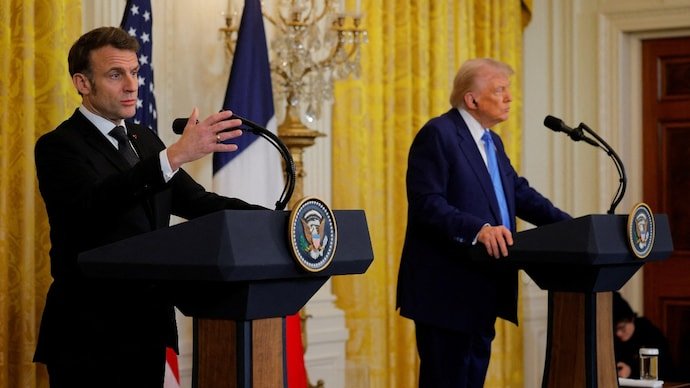

Washington | Relations between the United States and France have entered a fresh phase of strain after US President Donald Trump made public a private diplomatic exchange with French President Emmanuel Macron. The development comes amid rising geopolitical friction over Greenland and growing signs of confrontation on the trade front.
According to international media reports, the text-based communication between the two leaders reflects broad agreement on issues such as Syria and Iran. However, France raised explicit objections to the US position on Greenland—differences that have now spilled into the public domain and triggered wider diplomatic debate.
Certified Cyber Crime Investigator Course Launched by Centre for Police Technology
Concerns Over Public Disclosure of Private Dialogue
French diplomatic circles have expressed unease over the public release of a private exchange between heads of state. Analysts say the move challenges long-standing conventions of confidential diplomatic communication. French officials have indicated that using private dialogue as a pressure tactic is unacceptable and risks eroding trust between allies.
‘Board of Peace’ Emerges as a Key Flashpoint
At the heart of the dispute is a proposed multilateral platform referred to by Washington as the ‘Board of Peace’. The US has described the initiative as a mechanism to oversee reconstruction and stability efforts in Gaza following the conflict.
France, however, has voiced reservations, arguing that the proposed body’s mandate appears vague and excessively broad. Paris fears that its scope could extend beyond Gaza, enabling wider geopolitical intervention. As a result, France has signalled that it is unwilling to join the forum in its current form.
Tariff Threat Raises Stakes
In response to France’s reluctance, President Trump publicly warned of imposing tariffs of up to 200% on French wine and champagne. The statement has been widely interpreted as an attempt to exert economic pressure through trade measures.
French officials close to the matter have countered that trade threats cannot be used to dictate a country’s foreign policy. They described such tactics as ineffective, inappropriate, and unlikely to alter France’s strategic position.
Why Greenland Matters
Greenland, an autonomous territory of Denmark, occupies a critical strategic location in the Arctic region. The area is considered increasingly important from both security and military perspectives, particularly as competition intensifies among major powers.
The US has long argued for a stronger strategic footprint in the Arctic, citing concerns that countries such as Russia could pose future security challenges in the region. France and several other European nations maintain that any decisions concerning Greenland should be guided by cooperation and multilateral consensus, rather than unilateral pressure.
France’s Firm Position
France has made it clear that it will not revise its diplomatic stance under threat or coercion. In a pointed response, the French foreign ministry indirectly criticised the approach, suggesting that inflicting present damage based on hypothetical future risks is neither rational nor responsible.
Officials reiterated that Paris does not endorse the current structure or mandate of the proposed ‘Board of Peace’.
What Lies Ahead
Diplomatic observers warn that the combination of publicised private communications and aggressive tariff rhetoric could further strain US–France relations. The fallout may extend beyond bilateral ties, potentially affecting broader Europe–US relations and the balance of global diplomacy.
In the days ahead, developments surrounding Greenland, the ‘Board of Peace’, and trade pressure tactics will determine whether the standoff remains a temporary episode—or signals a deeper strategic divergence between two long-standing allies.
About the author — Suvedita Nath is a science student with a growing interest in cybercrime and digital safety. She writes on online activity, cyber threats, and technology-driven risks. Her work focuses on clarity, accuracy, and public awareness.
