

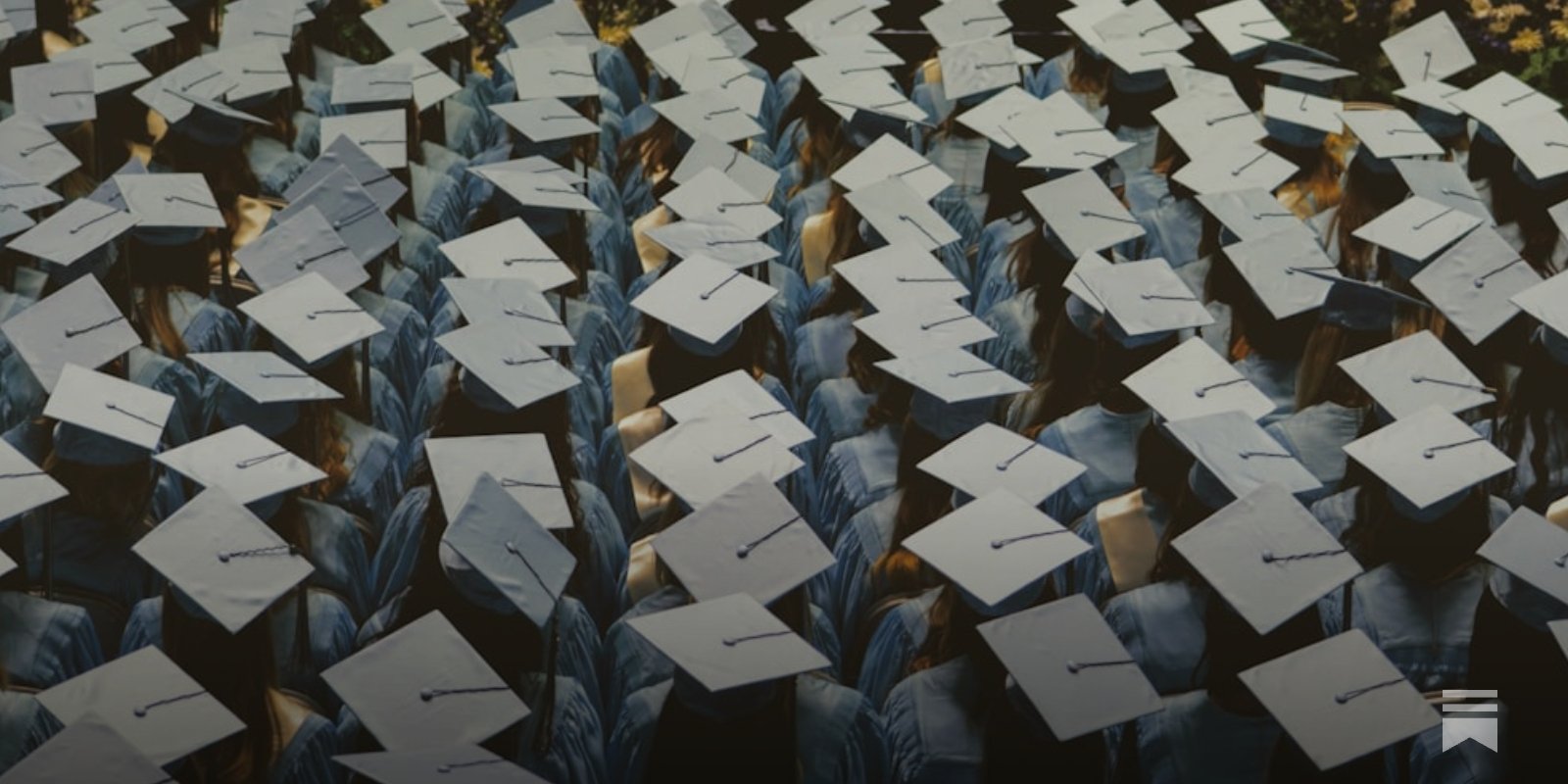

For years before artificial intelligence became a household phrase, American universities were already grappling with falling enrollment, rising costs and growing doubts about the value of a degree. Now, as graduates confront one of the weakest entry-level job markets in decades, those pressures are converging in ways that are reshaping higher education itself.
A System Under Strain Before AI
Long before artificial intelligence entered the lexicon of evening newscasts, the traditional university model in the United States was showing signs of stress. Between 2010 and 2022 — the year ChatGPT was released — university enrollment across the country fell by nearly 15 percent. Public funding cuts pushed a greater share of higher-education costs onto students, driving tuition higher and forcing many families to reconsider whether college was still a worthwhile investment.
The decline reflected more than demographics. Rising student debt, uneven wage gains for graduates and skepticism about job prospects increasingly shaped enrollment decisions. Even as universities expanded programs and amenities, the financial calculus for students grew harsher, particularly for those without access to elite institutions or strong professional networks.
By the early 2020s, questions about the return on investment of a college degree were no longer confined to policy circles. They were becoming central to how students and parents assessed higher education — just as technological disruption accelerated.
Certified Cyber Crime Investigator Course Launched by Centre for Police Technology
Graduates Meet a Bleak Job Market
When AI chatbots entered the mainstream, they did so against the backdrop of a tightening labor market for young workers. For many recent graduates, the timing has been unforgiving. Alina McMahon, a recent graduate of the University of Pittsburgh, told New York Magazine that after applying to roughly 150 full-time jobs, the only responses she received were notifications that roles had been eliminated.
“I know those are kind of rookie numbers in this environment,” she said. “It’s very discouraging.”
Her experience aligns with broader labor data. According to figures released in mid-December by the Federal Reserve Bank of New York, the unemployment rate for recent college graduates stands at 5.8 percent — 1.7 percentage points higher than the overall workforce average. It is nearly double the unemployment rate for all college graduates, which remains at 2.9 percent.
For employers, particularly in sectors that once served as reliable entry points for graduates, hiring has slowed or stopped altogether. The result has been a growing disconnect between educational attainment and immediate employment opportunities.
The Disappearing On-Ramps to Work
Internships and early-career training programs — long considered critical bridges between college and full-time work — are also being cut back. Companies facing economic uncertainty and rapid technological change have become more cautious about investing in inexperienced workers.
Simon Kho, the former head of early-career programs at Raymond James Financial, told New York Magazine that artificial intelligence has altered the hiring calculus. Training a fresh graduate, he said, typically took about 18 months before the employee generated sufficient value to offset the cost of onboarding and mentorship.
“At around that point, they get fidgety,” Kho said, describing how young employees often begin searching for their next role just as companies start to see returns. From an employer’s perspective, he added, the question becomes increasingly uncomfortable: where is the value, and can AI perform some of these functions more cheaply or efficiently?
As a result, companies have grown more hesitant to shoulder the burden of training — even as graduates find themselves needing experience more than ever to secure stable employment.
An Existential Question for Universities
These labor-market dynamics are feeding back into higher education itself. As perceived returns on college decline, class sizes are shrinking, particularly in tech-focused fields such as computer science. Students without internship experience by graduation are significantly less likely to land jobs in their chosen fields, yet opportunities to gain that experience are diminishing.
Ryan Craig, author of Apprentice Nation, described the challenge starkly. Colleges and universities, he told New York Magazine, face an existential issue. They must determine how to integrate relevant, in-field and ideally paid work experience into the undergraduate experience — and not as an optional add-on.
“They need to figure out how to integrate relevant, in-field, and hopefully paid work experience for every student,” Craig said, “and hopefully multiple experiences before they graduate.”
For institutions already under financial pressure, the task is formidable. But as enrollment declines and employer expectations shift, the future of the traditional college-to-career pathway appears increasingly uncertain — shaped as much by economic realities as by the rise of artificial intelligence.
