
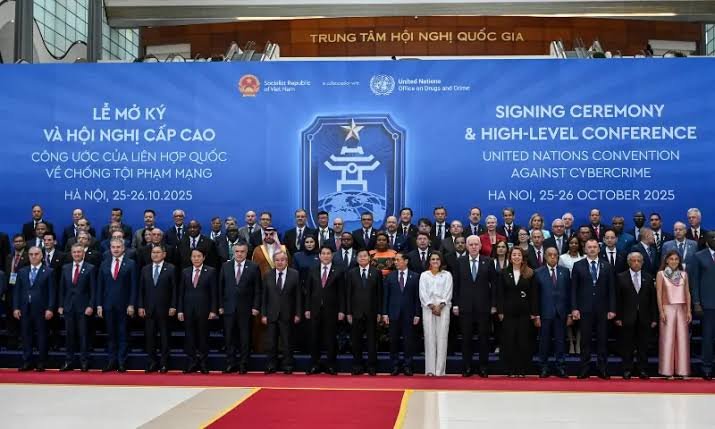

HANOI: After five years of negotiation, world leaders gathered in Viet Nam this week to sign the United Nations’ first-ever Cybercrime Convention — a sweeping treaty that aims to protect citizens, economies, and governments from the mounting costs of digital threats.
A Treaty Born of Rising Threats
The digital economy, once celebrated as a borderless realm of opportunity, has become a battleground of unprecedented scale. With global cybercrime losses projected to reach $10.5 trillion annually by 2025, the United Nations has moved to formalize a long-debated framework to curb online criminality.
The Convention against Cybercrime, adopted by the UN General Assembly in December 2024 after years of negotiation, establishes the first universal framework for investigating and prosecuting offences committed online—from ransomware and financial fraud to the non-consensual dissemination of intimate images.
“This is a powerful, legally binding instrument to strengthen our collective defenses against cybercrime,” said Secretary-General António Guterres at the signing ceremony, calling it “a vow that no country, no matter their level of development, will be left defenseless against cybercrime.”
A Collective Defense for the Digital Era
In his remarks, Mr. Guterres acknowledged that while technology has brought “extraordinary progress,” it has also unleashed new vulnerabilities.
“Every day, sophisticated scams defraud families, steal livelihoods and drain billions of dollars from our economies,” Guterres said. “In cyberspace, nobody is safe until everybody is safe. One vulnerability anywhere can expose people and institutions everywhere.”

The Convention, he added, represents a victory for victims of online abuse and a breakthrough for international investigators struggling to pursue cross-border crimes. It provides a global standard for electronic evidence and creates mechanisms for real-time cooperation between law enforcement agencies—while safeguarding privacy and human rights.
Experts say the treaty’s success will depend on how effectively it balances national sovereignty with data-sharing requirements, a challenge that has historically divided member states.
The First Firm to Assess Your DFIR Capability Maturity and Provide DFIR as a Service (DFIRaaS)
The Global South and the Digital Divide
For many governments, particularly in the Global South, the treaty offers more than legal reform. It promises training, technical assistance, and access to shared infrastructure, enabling developing nations to better detect and respond to cyber threats.
“The Convention must be ratified quickly, implemented fully, and supported with funding, training and technology,” Mr. Guterres said, emphasizing that the benefits of a secure digital environment must be distributed equitably.
Hosting the ceremony, Viet Nam was hailed as a fitting location—a country that has rapidly embraced digital transformation and become an integral node in global supply chains. At a joint press conference, Mr. Guterres praised Viet Nam’s “innovation-powered growth” and its example in linking emerging economies to global cybersecurity governance.
A Framework for the Future
The new treaty criminalizes a wide spectrum of cyber-dependent and cyber-enabled offences, including online fraud, ransomware, and data theft. It also makes history as the first international legal instrument to recognize the non-consensual sharing of intimate images as an offence—a milestone for digital privacy advocates and victims of online harassment.
The Convention establishes a 24/7 cooperation network among states, facilitating the exchange of electronic evidence across borders. It will enter into force 90 days after the 40th State ratifies the agreement, setting in motion what diplomats describe as a “collective digital security compact.”
“Let us seize this moment,” Mr. Guterres urged. “Let us build a cyberspace that respects everyone’s dignity and human rights—and ensure that the digital age delivers peace, security and prosperity for all.”
