

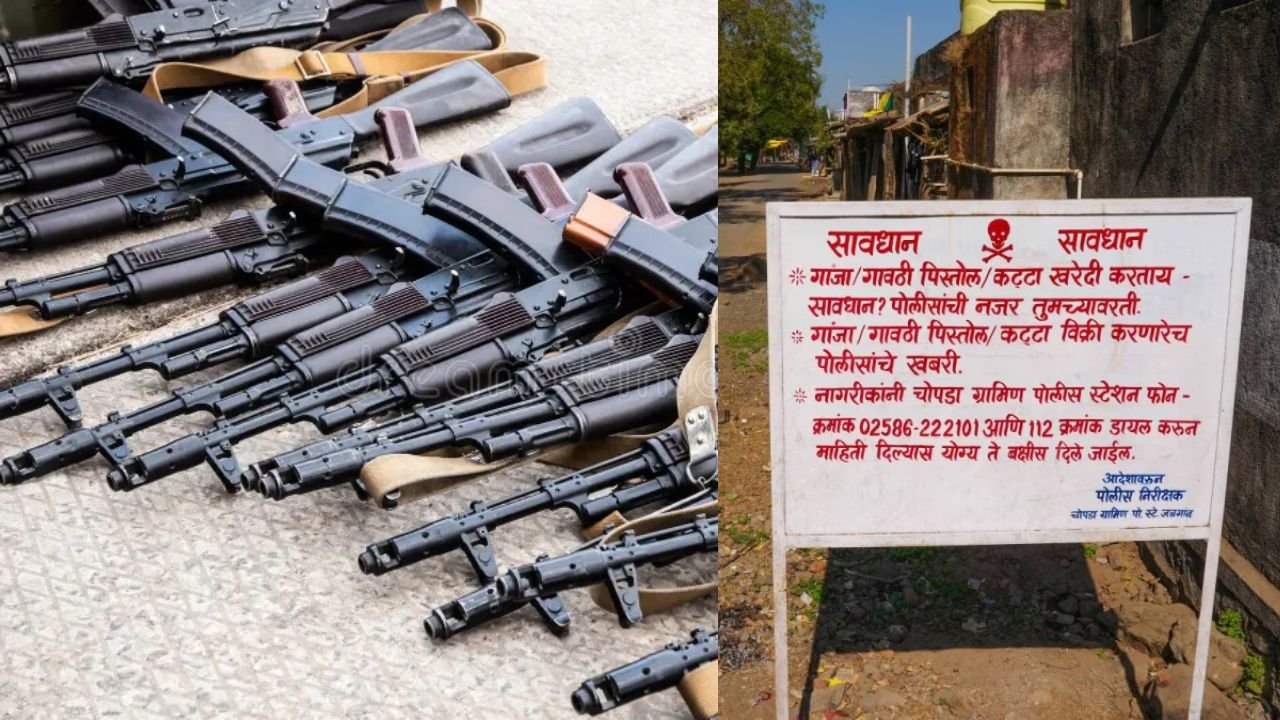

Madhya Pradesh | December 27, 2025 | A warning sign on a narrow road leading to Umarti catches the eye of passers-by: “Buying country-made pistols? Beware. Police are watching.” Curiously, the sign does not stand in Madhya Pradesh’s Umarti, but across the border in Maharashtra’s Jalgaon district, in a village bearing the same name. Separated only by the Aner river, the two Umartis are linked not just by geography but by a shared notoriety built around the illegal arms trade.
Over the past decade, Umarti village in Barwani district of Madhya Pradesh has earned an unofficial and infamous brand name in criminal circles — ‘Umarti Sikligar Arms’, or ‘USA’. Investigations into gang wars, contract killings and organised crime across several states have repeatedly traced seized country-made pistols back to this village.
With around 300 households and a population of nearly 2,000, Umarti is predominantly home to members of the Sikligar community — a Sikh sub-community traditionally associated with metallurgy. Barela and Bhil tribal families also live in the village. Police officials say that the Sikligars’ historical expertise in metalwork, once used to supply weapons to princely states and freedom fighters, has in some cases been diverted into illegal firearm manufacturing.
Why Pune Police stepped in
Last month, during investigations into a series of sensational gang-war cases in Pune and Pimpri-Chinchwad, the trail of recovered country-made pistols repeatedly led investigators back to Umarti. Matters escalated when six minors detained in a murder case allegedly revealed that they had purchased pistols and cartridges from Umarti for ₹50,000.
Based on these inputs, the Pune City Police planned a major interstate operation. In the early hours of November 22, a team of 105 police personnel led by Deputy Commissioner of Police Somay Munde travelled nearly 500 km to reach the village.
The operation was heavily technology-driven. Officers wore bulletproof jackets and carried service weapons, while body cameras transmitted live footage to a control room in Pune. Drones were deployed for aerial surveillance, and a temporary wireless network was set up on the ground. The level of caution was deliberate: in February this year, a Jalgaon police team had been attacked in Umarti, and a constable was briefly abducted before being released.
What the raid revealed
According to police, the raid led to the dismantling of four illegal firearm manufacturing units operating out of residential premises, and the destruction of nearly 50 kilns. Seized items included country-made pistols, cartridges, magazines, more than 100 gun barrels, grinding machines, unfinished pistol bodies and spare parts buried underground.
A total of 47 individuals from the Sikligar community were detained, most of whom were later released after questioning. Though the units appeared rudimentary, investigators warned against underestimating their capability. A trained craftsman, officials said, could assemble a fully functional pistol in two to three days. In many cases, components were pre-manufactured and assembled only after receiving specific orders.
Layers of an interstate network
The Madhya Pradesh Police suspects that Umarti’s operations extend well beyond the village. After the seizure of over a thousand gun barrels in recent months, investigators have intensified probes into possible interstate rackets. There is also suspicion that higher-grade raw material sourced from Gujarat is being used to manufacture more sophisticated firearms.
Investigators say weapons produced in Umarti have been supplied to Punjab, Haryana, Rajasthan and Maharashtra. Social media, officials add, has further amplified the village’s reputation, making it easier for buyers to locate suppliers.
A village under suspicion, a community responds
Village representatives argue that the actions of a few have unfairly stigmatised the entire community. Sarpanch Ramesh Tarole maintains that most families have completely distanced themselves from weapon-making. He points to youths serving in the Indian Army, children studying in English-medium schools, and families engaged in farming or small businesses.
The gram panchayat and community leaders have urged the administration to act firmly against offenders but avoid harassing innocents. They have also demanded concrete measures for alternative livelihoods and rehabilitation. Officials concede that earlier initiatives, including skill development programmes and employment fairs, have delivered limited results.
Balancing enforcement and rehabilitation
Senior officials in Barwani district acknowledge that the problem goes beyond law and order. It is rooted in tradition, poverty and demand from organised crime networks. While police surveillance and enforcement have intensified, creating sustainable livelihood alternatives remains a major challenge.
