


New Delhi: The University Grants Commission (UGC) has issued a nationwide advisory warning higher education institutions about attempts by vested foreign entities to collect sensitive information related to India’s national security, defence establishments, and critical infrastructure by exploiting job portals, academic networks, and freelance writing assignments.
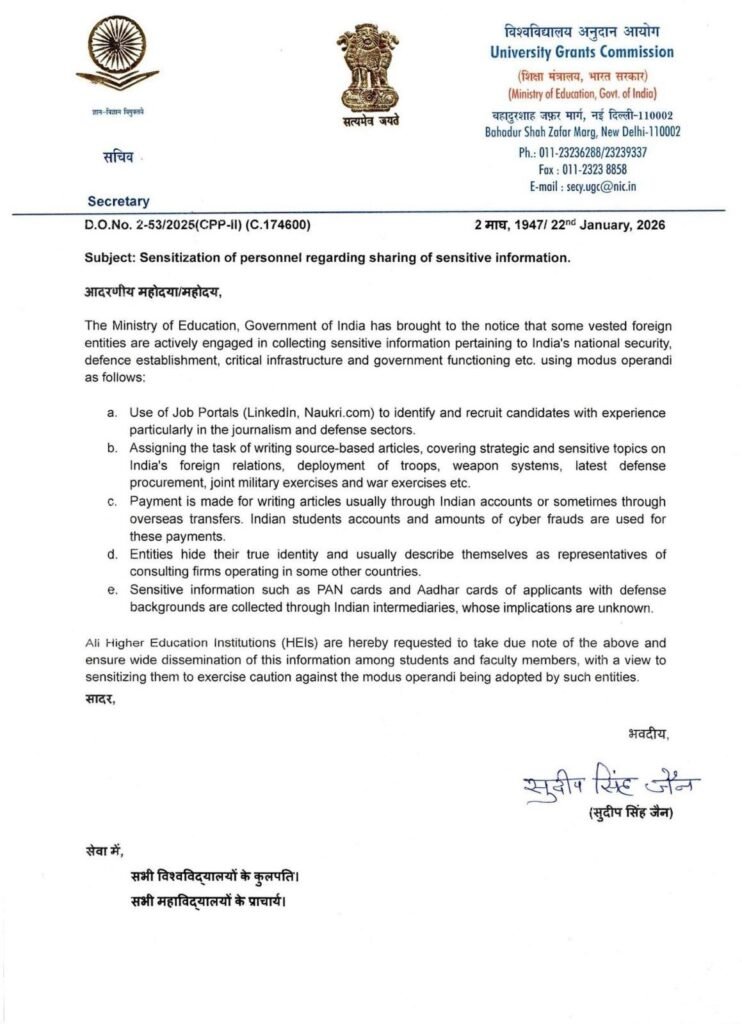
In an official communication dated January 22, 2026, the UGC said the alert was issued after the Ministry of Education flagged concerns over emerging tactics being used to covertly extract strategic and sensitive information from Indian citizens, particularly those with backgrounds in journalism, defence, and strategic studies.
Job Portals Used for Targeted Recruitment
According to the advisory, foreign-linked entities are actively using popular job portals such as LinkedIn and Naukri.com to identify and recruit individuals with experience or academic exposure in sensitive domains.
Certified Cyber Crime Investigator Course Launched by Centre for Police Technology
“These platforms are being leveraged to approach candidates under the guise of legitimate professional opportunities,” the communication noted, adding that journalism and defence-related backgrounds appear to be primary targets.
Writing Assignments on Sensitive Topics
One of the key methods highlighted involves assigning source-based articles on subjects considered sensitive to India’s national interest. These include:
- India’s foreign relations
- Troop deployments
- Weapon systems and defence procurement
- Joint military exercises
- War exercises and strategic preparedness
The UGC cautioned that while such assignments may appear academic or journalistic in nature, they could cumulatively reveal sensitive patterns, assessments, or vulnerabilities.
ALSO READ: ‘Digital Arrest’ Scam Nets Over ₹1.1 Crore: Two More Accused Held, Total Arrests Rise to 16
Payments Routed Through Indian Accounts
The advisory also raised red flags about payment mechanisms used by these entities. In many cases, payments for such writing assignments are made through Indian bank accounts, while in some instances overseas transfers are used.
Alarmingly, the UGC noted that Indian students’ bank accounts and even proceeds from cyber fraud have reportedly been used as conduits for these transactions, potentially exposing individuals to financial and legal risks.
Concealed Identities and Shell Consultancies
Another major concern flagged is the concealment of true identities. The entities involved often present themselves as representatives of consulting firms purportedly operating from other countries.
“Their actual affiliations remain undisclosed, making it difficult for individuals to verify the legitimacy or intent behind such engagements,” the UGC said.
Collection of PAN and Aadhaar Details
The advisory further warned that sensitive personal documents, including PAN cards and Aadhaar details, particularly of applicants with defence backgrounds, are being collected through Indian intermediaries.
The implications of such data collection remain unclear, but authorities have cautioned that misuse could have serious national security and personal safety consequences.
UGC Calls for Immediate Awareness and Caution
In response, the UGC has urged all Higher Education Institutions (HEIs) to take note of these developments and widely disseminate the advisory among students, faculty members, and researchers.
Institutions have been asked to sensitise their communities to exercise extreme caution while engaging with unsolicited job offers, freelance assignments, or research collaborations that touch upon sensitive areas.
The communication, signed by UGC Secretary Sudeep Singh Jain, has been sent to Vice-Chancellors of universities and Principals of colleges across India, underlining the seriousness of the issue.
A Broader Warning for Academia and Media
The advisory comes at a time when academic research, journalism, and digital freelancing increasingly intersect with geopolitical and security-sensitive domains. While the UGC has not named any specific country or organisation, the warning signals a growing concern over information warfare, influence operations, and data exploitation targeting India’s knowledge ecosystem.
Authorities have stressed that awareness and due diligence remain the first line of defence.
