

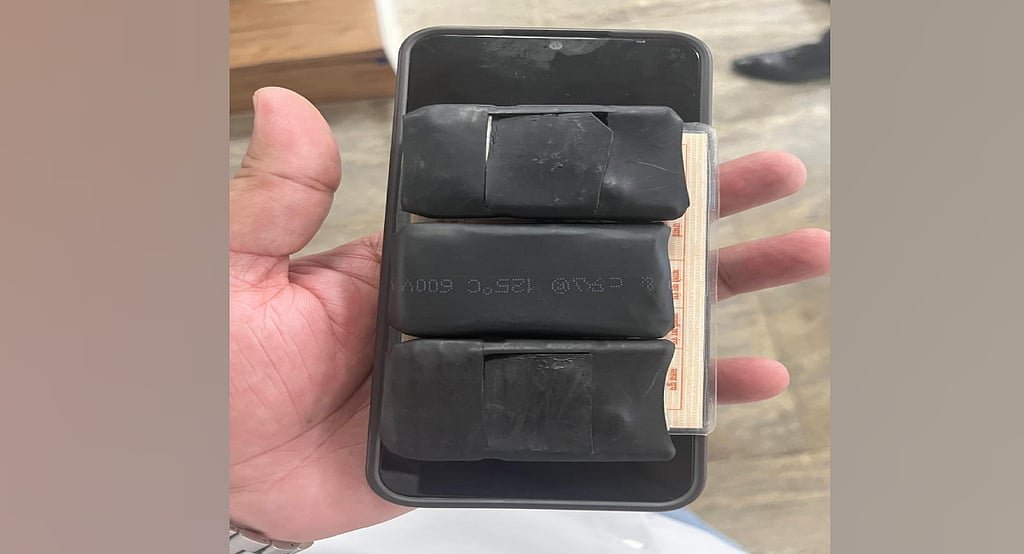

NEW DELHI — Two passengers bound for the national capital were detained on Saturday at Goa International Airport in Dabolim after security personnel intercepted electronic equipment allegedly used to facilitate malpractice during a non-teaching recruitment test conducted by the Indian Institute of Technology Goa. The Central Industrial Security Force apprehended both men during routine pre-departure screening ahead of their scheduled Air India Express flight IX 1340 to Delhi, which was slated to depart at 2:25 pm. Officials recovered an array of communication gear, including miniature Bluetooth earpieces, active SIM cards, and specialised electronic transmission units, before transferring the suspects to local law enforcement for formal interrogation.
Suspicious Baggage Scan Uncovers Concealed Devices
The interception occurred when security staff operating the X-ray screening checkpoint noticed anomalies within a handbag placed onto the conveyor belt. A subsequent manual inspection led CISF screeners to discover three electronic units, two SIM cards, and three Bluetooth earpieces commonly associated with examination malpractice. Upon preliminary questioning by CISF authorities, the traveller admitted that the equipment had been deployed to compromise the recruitment examination held earlier that day on the institute campus.
During the exchange, the individual reportedly confessed to impersonating an authentic applicant using a forged identity document, which he claimed to have discarded inside the airport security hold area. The detained passenger further stated that he held civilian employment at an establishment run by the defence administration. Investigators are currently verifying these initial claims, scrutinising CCTV footage from the terminal, and searching the holding lounges to reconstruct the timeline surrounding the suspect’s movements and recover the discarded paperwork.
Accomplice Removed from Aircraft Before Takeoff
Interrogators quickly broadened their operation after the initial detainee disclosed that a companion had already completed the boarding process and was seated inside the passenger cabin. Working in direct coordination with airline personnel, security teams halted the departure, boarded the aircraft, and offloaded the second traveller without delay. An immediate search of his carry-on baggage yielded an additional electronic transceiver, two Bluetooth earpieces, a SIM card, and an official admit card issued for the post of Administrative Assistant for the test session organised that morning.
Authorities indicated that the physical evidence collected from the aircraft cabin will serve as primary material in evaluating whether the two passengers acted in deliberate coordination. The second individual was placed under questioning while investigators catalogued the recovered equipment, admit card credentials, and transmission units. Forensic examiners plan to analyse the technical specifications of the seized electronics to determine the exact wireless protocols utilised during the exam session and trace any external support networks.
Investigation Transferred to Ponda Police
Following the initial detentions and recovery of the materials, the CISF handed over both men, their personal effects, and the seized electronic equipment to the Dabolim Airport Police Station. Because the alleged offences and examination venues fall within regional jurisdiction, the matter was subsequently formally transferred to the Ponda Police Station for comprehensive investigation and filing of statutory charges.
Police investigators are now focusing on establishing the precise operational role played by each individual, identifying the candidate whose identity was allegedly usurped, and determining how the hidden hardware passed undetected through examination hall checkpoints. Officials noted that the case highlights ongoing concerns regarding the use of sophisticated micro-transceivers and fake credentials to manipulate competitive recruitment pipelines. Authorities emphasised that all allegations remain subject to judicial verification, with further legal steps dependent on evidentiary findings developed during the ongoing police inquiry.
Follow for daily updates on cybercrime, corporate fraud, DFIR, hacking, investigations, and digital forensics
