

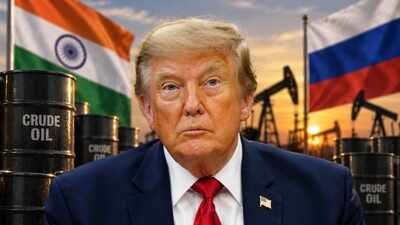
US President Donald Trump’s decision to pause Russian oil sanctions legislation has eased pressure on India’s crude imports.
Why Does the Decision Matter for India?
India remains heavily dependent on imported crude oil, meeting more than 88% of its requirements through overseas purchases. Russia is currently its largest supplier.
According to commodity market analytics firm Kpler, India imported approximately 1.9 million barrels per day of Russian crude in September, accounting for more than 35% of its total oil imports. Purchases reached 2.8 million barrels per day in July. Russian oil became increasingly important after Moscow’s February 2022 invasion of Ukraine. Western restrictions prompted Russia to offer discounted crude, attracting Indian refiners and reducing their dependence on traditional West Asian suppliers.
Trump’s decision to pause sanctions legislation, alongside an October 9 diesel agreement with Russian President Vladimir Putin, has complicated Washington’s earlier threats to penalise countries purchasing Russian energy.
FCRF Launches CP-FRM to Build India’s Next Generation of Fraud Risk Professionals
How Has US Policy Changed?
The Graham Act became law on September 18, creating concerns about possible penalties linked to Russian oil purchases. However, Washington’s subsequent agreement with Moscow has raised questions about the consistency of its sanctions policy.
- Ajay Srivastava, founder of the Global Trade Research Initiative, said the developments exposed uncertainty in American trade policy, particularly when threatened penalties become difficult to enforce. He argued that the United States’ willingness to reach an energy arrangement with Russia made similar penalties against other buyers harder to justify.
- Arpita Mukherjee, a professor at the Indian Council for Research on International Economic Relations, identified the European Union as another significant source of pressure. She said European restrictions targeting companies in countries including India, Turkey and China could complicate their commercial relationships with European businesses.
Could India-US Trade Talks Benefit?
The easing of the threatened 100% US tariffs could improve India’s position in bilateral trade negotiations. Both countries have broadly agreed on the American investigation into industrial overcapacity under Section 301 of the Trade Act of 1974. India has already restricted imports of goods produced using forced labour following an earlier US investigation.
India and other G20 members have also committed to addressing structural overcapacity in sectors including automobiles, electric vehicles, batteries, chemicals, semiconductors and solar panels. With some trade differences potentially narrowing, Russian crude purchases remain a significant issue between New Delhi and Washington.
India’s Ministry of External Affairs has maintained that energy security requires diversified sourcing based on changing market conditions.
How Are Rising Oil Prices Affecting Economies?
Fuel prices are creating additional economic pressure in both countries. According to the Council on Foreign Relations, US diesel prices averaged $6.18 per gallon on October 12, compared with $3.48 at the beginning of the year. American consumer prices rose 0.6% in September, taking annual inflation to 3.7%.
India is also experiencing higher inflation. National Statistics Office data showed retail inflation rising from 4.83% in August to 5.54% in September. Food inflation increased from 6% to 7.74%, with onions, ginger, garlic and lemons contributing to the rise. The FAO food price index also increased by 5.8%, indicating broader international price pressures.
The developments underline the competing priorities shaping energy policy and international trade. India’s dependence on imported crude makes affordable and reliable supplies essential, while changing American sanctions decisions complicate negotiations. Whether the reduced tariff threat produces a lasting improvement in India-US trade relations will depend on subsequent policy decisions.
Follow for daily updates on cybercrime, corporate fraud, DFIR, hacking, investigations, and digital forensics
