

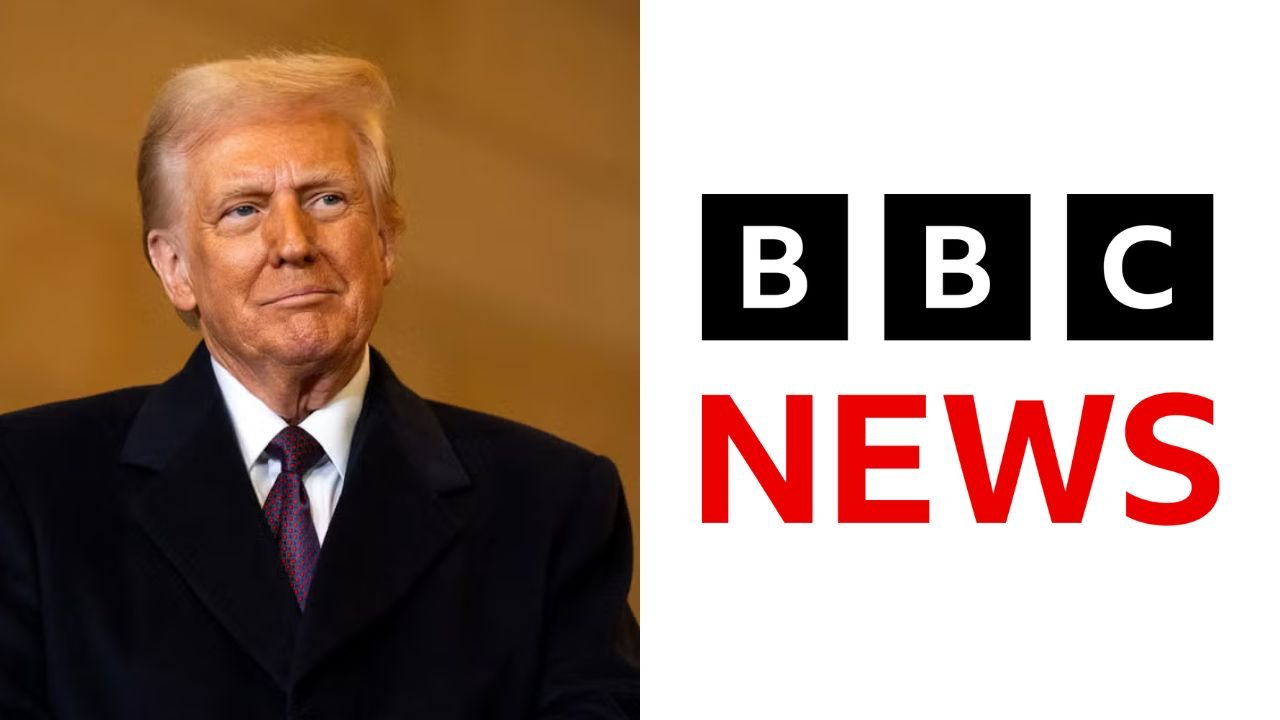

US President Donald Trump has escalated his confrontation with the BBC, announcing plans to file a multibillion-dollar lawsuit over the editing of his 6 January 2021 speech in a Panorama documentary. Speaking to reporters aboard Air Force One on Friday evening, Trump said he would sue the broadcaster for “anywhere between $1 billion and $5 billion”, adding that legal action would be initiated “sometime next week”.
The controversy, which has already triggered the resignations of BBC Director General Tim Davie and Head of News Deborah Turness, has emerged as one of the most serious editorial crises the corporation has faced in recent years.
How the controversy began: a disputed edit of the 6 January speech
The core of the dispute lies in a Panorama programme aired in October 2024. In the documentary, two separate lines from Trump’s 6 January address were edited together in a way that critics say created the impression that the President had directly urged his supporters to take violent action.
In his original speech, Trump told supporters:
“We’re going to walk down to the Capitol, and we’re going to cheer on our brave senators and congressmen and women.”
Nearly 50 minutes later, he said:
“And we fight. We fight like hell.”
But in the Panorama programme, the clip was presented as a single, continuous segment:
“We’re going to walk down to the Capitol… And I’ll be there with you. And we fight. We fight like hell.”
The edit was widely criticised for appearing to imply that Trump had delivered a direct call to violence—a narrative he has consistently rejected. The revelation prompted internal reviews within the BBC and ultimately led to senior editorial heads stepping down.
BBC admits mistake, issues apology — but stands firm against damages
In a “Corrections and Clarifications” note published on Thursday, the BBC acknowledged that the edit “unintentionally created the impression” that it was presenting one continuous part of the speech, rather than excerpts drawn from different moments.
The corporation added that the edited sequence “gave the mistaken impression that President Trump had made a direct call for violent action”, and confirmed it would not be broadcast again. However, it refused to pay any form of financial compensation.
A BBC spokesperson said the broadcaster had written to Trump’s legal team, outlining its position and reaffirming its apology.
“BBC Chair Samir Shah has separately sent a personal letter to the White House, making clear that he and the corporation are sorry for the edit used in the programme,” the spokesperson said.
Despite the apology, the BBC maintained that the case does not meet the threshold for defamation under US law.
Trump’s response: ‘They changed the words coming out of my mouth’
Trump accused the BBC of altering his remarks in a way that amounted to fabrication.
“They cheated. They changed the words coming out of my mouth,” he told reporters, saying he felt “an obligation” to sue to prevent similar incidents in the future.
He said he had not yet raised the matter with UK Prime Minister Sir Keir Starmer but noted that Starmer had requested a conversation. Trump added that he would likely call him over the weekend.
A search of public court records showed no lawsuit had been filed in Florida federal or state courts as of Friday evening.
BBC outlines five key legal arguments against Trump’s claim
In its letter to Trump’s legal team, the BBC set out five principal arguments explaining why it does not believe the broadcaster is liable:
- No US broadcast: Panorama was not distributed on any BBC US channel. When on iPlayer, it was restricted to UK audiences.
- No demonstrable harm: Trump was re-elected shortly after airing of the documentary, undermining claims of reputational or political damage.
- No malice or intent to mislead: The edit, the BBC said, was a standard condensation of a long speech.
- Context matters: The 12-second edit formed a tiny portion of an hour-long programme, which also featured multiple voices supportive of Trump.
- High legal protection: Political commentary and matters of public concern enjoy broad protections under US defamation law.
The corporation emphasised that while the mistake was regrettable, it does not give rise to a viable legal claim.
Another edited clip surfaces, fuelling further scrutiny
The BBC’s challenges intensified after the Daily Telegraph uncovered a similarly edited Trump clip broadcast on Newsnight in 2022. The revelation has triggered renewed political and editorial scrutiny of the broadcaster’s internal standards and archival reviews.
What lies ahead? A potential high-stakes media–politics showdown
Legal experts say that should Trump proceed with a lawsuit, the case could evolve into one of the most closely watched media-law battles of the decade. However, they also note the high bar required to prove defamation in the United States, especially involving a public figure and political speech.
Trump insists the case is about accountability and setting a precedent.
“If you don’t do it, you don’t stop it from happening again with other people,” he said.
With the President indicating that legal action is imminent, attention now turns to whether a formal case will be filed next week — and how the BBC prepares for what could become a protracted and high-profile courtroom fight.
