

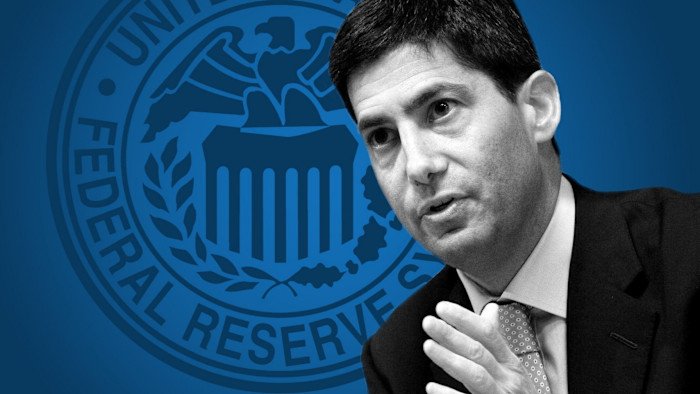

US President Donald Trump has announced former Federal Reserve governor Kevin Warsh as his choice for the next Chair of the Federal Reserve, replacing Jerome Powell in a move that is expected to reshape the trajectory of US monetary policy. The decision ends months of speculation and comes at a time of deepening tensions between the White House and the current Fed leadership.
Trump made the announcement on his social media platform, Truth Social, praising Warsh as a strong reformer capable of restoring credibility to the central bank. Describing the 55-year-old as a potential “outstanding Fed chairman,” Trump highlighted Warsh’s experience both within the Federal Reserve system and in international economic policy circles.
Warsh served as a member of the Federal Reserve’s Board of Governors from 2006 to 2011, a period that included the global financial crisis. He was closely involved in policy responses during the 2008 turmoil and later emerged as a vocal critic of prolonged ultra-loose monetary policy. Trump also cited Warsh’s role in drafting a reform blueprint for the Bank of England, portions of which were later adopted by the UK Parliament.
Certified Cyber Crime Investigator Course Launched by Centre for Police Technology
Long-running rift with Powell
The appointment formalises a long-running clash between Trump and incumbent Fed Chair Jerome Powell, whom Trump himself had nominated in 2018. Since then, relations between the two have steadily deteriorated, largely over interest-rate policy.
Trump has repeatedly accused Powell of keeping rates too high and slowing economic momentum, arguing that aggressive rate cuts are necessary to sustain growth and strengthen US competitiveness. Powell, in contrast, has defended the Fed’s data-driven approach, emphasising inflation control and institutional independence.
The confrontation intensified recently after the US Department of Justice issued a summons to Powell in connection with an inquiry into expenditure on the renovation of the Federal Reserve’s Washington headquarters. Powell publicly responded by warning that the move risked undermining the central bank’s autonomy and could be interpreted as political pressure aimed at influencing monetary policy decisions.
Warsh’s critique of the Fed
Warsh is himself a known critic of the Federal Reserve’s current operating philosophy. In a public interview last year, he called for what he described as a “regime change” within the Fed, arguing that its credibility had been damaged by policy inconsistencies and communication failures.
He has questioned the scale and duration of stimulus measures adopted after successive crises and has suggested that excessive reliance on balance-sheet expansion weakens market discipline. However, analysts note that implementing sweeping reforms may prove difficult, as Federal Open Market Committee decisions are made collectively rather than unilaterally by the chair.
Economic headwinds ahead
Warsh is set to take charge at a time when the US economy faces a complex mix of challenges. While the Trump administration has claimed that inflationary pressures are easing, price levels remain above the Federal Reserve’s long-term target of 2%. At the same time, signs of cooling in the labour market have raised concerns about slowing growth.
The most immediate test for Warsh is expected to be safeguarding the perception of Fed independence. The administration has been considering proposals that would increase oversight of the central bank and expand presidential influence over interest-rate decisions—ideas that have drawn concern from economists and lawmakers alike.
Complicating matters further is the fact that Jerome Powell’s current term still has two years remaining. Although Fed chairs have historically stepped down after being replaced, Powell has not indicated whether he will resign or remain on the Board of Governors, a move that could heighten institutional tensions.
Some Republican lawmakers have also signalled that the confirmation process may not be smooth. Senator Thom Tillis and others have indicated they may seek to delay approval until the Justice Department inquiry related to the Fed’s renovation expenses is concluded.
Global implications
Market participants and central banks worldwide are closely watching the transition, given the Federal Reserve’s influence on global capital flows, currencies and financial stability. A shift in policy tone under Warsh could have far-reaching consequences for emerging markets, borrowing costs and investor sentiment.
With Trump betting on a more assertive and reform-oriented Fed leadership, the coming months are likely to test the balance between political authority and central-bank independence—an issue that sits at the heart of the US financial system.
