

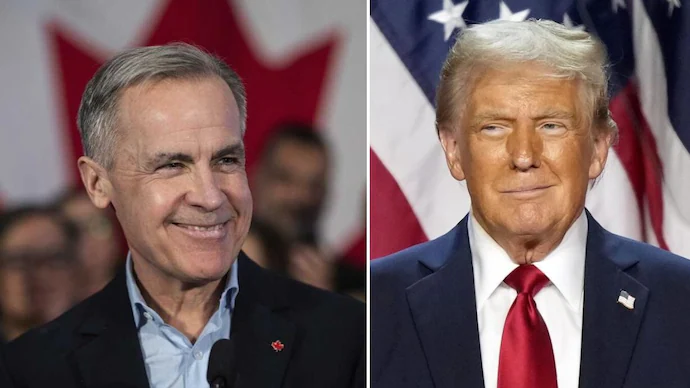
Trade tensions between the United States and Canada have sharply escalated after Donald Trump threatened to impose a 50% tariff on all Canadian-made aircraft sold in the American market, accusing Ottawa of unfairly blocking the certification of US-manufactured business jets. The warning signals a fresh flashpoint in the already strained economic relationship between the two North American neighbours.
Trump alleged that the Canadian government has “illegally” stalled the certification of multiple aircraft produced by Gulfstream Aerospace, despite the jets meeting what he described as the highest global standards of safety and technology. He claimed the move was aimed at protecting Canadian aircraft makers and keeping American planes out of the Canadian market.
In a strongly worded post on social media, Trump said Canada had refused to certify the Gulfstream 500, 600, 700 and 800 series—jets he described as among the most advanced business aircraft ever built. “Canada is using certification as a trade weapon,” he said, adding that the situation amounted to discrimination against US manufacturers.
Certified Cyber Crime Investigator Course Launched by Centre for Police Technology
Trump warned that unless the certification issue is resolved “immediately,” Washington would retaliate by cancelling approvals for Canadian aircraft and imposing steep tariffs. “If this is not fixed without delay, I will place a 50% tariff on every Canadian aircraft sold in the United States,” he said, escalating rhetoric that has already unsettled aviation and trade circles.
The former president also announced that, pending resolution of the dispute, the US would revoke certification for Canadian-made aircraft, including models from Bombardier, such as the Global Express series. Industry analysts say such a move, if implemented, could severely disrupt cross-border aircraft sales and affect supply chains across North America.
The latest threat comes against the backdrop of a prolonged trade standoff that has intensified since Trump returned to office in 2025. Tariffs have once again become a central tool of US trade policy, with Washington using them to pressure both allies and rivals on issues ranging from manufacturing to strategic alignment.
Trump also accused Canada of deliberately blocking Gulfstream jets to prevent them from competing in the Canadian market. “They are keeping our aircraft out while trying to sell theirs freely in the US,” he said, framing the dispute as a matter of economic fairness and national interest.
The confrontation extends beyond aviation. Earlier this week, Trump warned that Canada could face even higher tariffs—up to 100%— if it pursued deeper trade ties with China. He has repeatedly argued that closer Canada–China economic cooperation would undermine US strategic interests and threaten regional security.
Geopolitical tensions have further complicated the relationship. Trump recently criticised Canada for opposing his proposed “Golden Dome” missile defence project linked to Greenland, claiming the system would also enhance Canadian security. He warned that prioritising business ties with China over US-backed security arrangements could leave Canada vulnerable.
Canadian leaders have pushed back against the rhetoric. Speaking at the World Economic Forum in Davos, Prime Minister Mark Carney defended Canada’s sovereignty and economic independence, criticising pressure tactics by larger powers. Without naming Trump directly, he said smaller nations should not be coerced through trade threats or political intimidation.
Aviation industry experts caution that a full-blown tariff war could have serious consequences. Canada is one of the US aviation sector’s largest partners, and aircraft manufacturing relies heavily on integrated cross-border supply chains. Any disruption, they say, would raise costs, delay deliveries and hurt both manufacturers and buyers.
Trade analysts also warn that the dispute risks spilling over into other sectors, further straining bilateral relations. With no immediate signs of compromise, the aircraft certification row appears set to become the latest symbol of a broader deterioration in US–Canada trade ties, reviving fears of a renewed tariff-driven trade war between two of the world’s closest economic partners.
About the author – Ayesha Aayat is a law student and contributor covering cybercrime, online frauds, and digital safety concerns. Her writing aims to raise awareness about evolving cyber threats and legal responses.
